Visar inlägg med etikett Pocketknife. Visa alla inlägg

lördag 4 maj 2024

Review SRM 258L


-  the family grows

Is bigger the same as better? That is the question this review will partly deal with. This considering that this knife from SRM called 558L is actually quite similar to the predecessor 255 that I previously reviewed. It is an excellent knife otherwise. Of course, there are differences between the knives, but compared side by side it is probably the similarities that dominate.

SRM 258L


SRM has proven to go from strength to strength even if the pace they keep in terms of releasing new knives doesn't match the most aggressive on the market (I'm looking at you Civivi) the models they have presented are of high quality. Right now they seem to be rolling out Micarta handles as an option on older models.

Nor can the knives be available in quite as many different variants as with some competitors. This one, 558L, for example, can only be had as here with a black handle and satin blade or with a black blade and purple handle. This time I chose the discreet combination.

SRM switches up a size but offers the same fine action as before


Short version: SRM 558L, the knife that complements the group of siblings in an excellent way


Blade


The overall lines of the blade are completely shared with little brother, which of course saves some time at the design stage and concretely means a drop point with a long narrow swedge. In this case, the back is a little more worked than before, as SRM went to the trouble of rounding it nicely.

The blade is flat ground and the finish is a nice but difficult-to-photograph fairly glossy satin.

The blade is a drop point measuring 90mm in length


Then we come to the first thing that differentiates the knives and that is the size. Where little brother has a blade of just over eight centimeters, here we get 90 mm to play with. The height is 25.9 mm. The thickness is also a little more increased, although three millimeters of stock thickness is not excessive, but rather very well chosen in my opinion.

The factory edge was more than decent with good sharpness and reasonably approved thickness behind the edge. We are talking about 0.4-0.5 mm. Not optimal but is well in line with the fact that the knife is slightly larger and thus probably intended to be a bit more robust.

The same thinking seems to lie behind the choice of steel, as 10Cr15MoV was abandoned in favor of the well-known D2. Not completely stainless, but generally good knife steel and nothing to complain about, although personally I always prefer a more rust-resistant steel on folding knives in particular.

The steel used is D2


The 258L is a joy to use. The fact that it is easy to pull and put away is something that I appreciate as a common task these days is opening packages at work. I work in a professional kitchen and there is a lot of plastic and cardboard to process.

The blade is very all-round focused, neutral one could say. The tip does what it's supposed to and is pointed without being flimsy, there's a slight belly and a bit of a straight edge to work with. It makes most chores go like a dance. But of course, if you're going to have a real cutting machine, you take your 258L and thin out the edge the first time you resharpen it. The D2 steel can handle it.


Handle


The handle of this knife is markedly different from its little brother if we are to continue the comparison. Where the previous knife offered a nested mono chassis, here is something at least as unique. Here, the solution that looks like a box has been enlarged to resemble a more traditional steel frame on the outside. It's hard to miss as it rises above the sides of the handle. A detail chosen to be a design element as it is consistently made like a picture frame around the sides of the handle.

It is also nicely done as they chose to round the steel edges in an excellent way. No sharp edges or corners are found here. Then the box is drilled out for lower weight.

The appearance itself is clean and elegant as the knife has only two screws on the outside that hold it together. The adjustable pivot screw is in size T8 and a small T6 aft. There, I still think that almost all manufacturers skimp. Give us a size up, please!

The G10 sides are heavily chamfered and attached to the outside of the box-like frame


Then there was one more important detail. Here they have chosen to cover the back with a steel plate, something I really appreciate. It is the guard over the lock that has been extended to cover the rest of the handle. "Open backs" in all their glory, those that are apparently supposed to facilitate cleaning, but there is a great advantage in not choosing that solution. Namely, the contact surface against the hand increases, which gives less pressure when cutting slightly heavier things. It becomes particularly clear on larger folding knives.

In the back, there is also a small attachment for a lanyard. It's hard to get a paracord around the bolt that is there, but a thinner nylon string for those who wish.

The back is unusually not open. At the rear end, there is a hidden attachment bolt for a lanyard


The material in the sides is soft ground G10 which has been given a couple of substantial chamfered edges that extend along most of the handle. It gives a rounded and pleasant feeling in the hand.

The handle is 11.4 cm long, which is enough for a solid grip with all fingers. The thickness is at most 13 mm and the height is around 2.5 cm. The shape is quite straight and neutral and at the front, there is a fairly shallow finger recess that acts as finger protection.

258L is really comfortable to work with must be said


The simple straight shape makes it easy to find the right grip on this handle. There is simply nothing that gets in the way and hassles it. Nor details that require a certain hand size to work.

If the comparison with the little brother is to continue, the 258L is better on the handle front, which isn't that strange. Making the handle larger in all dimensions simply helps when you have to work a little longer. Something that became clear when some cardboard had to be processed after delivery of a sofa from IKEA. There was a lot of cardboard!


Opening and Lock


The knife opens with thumb studs and they work damn well. The buttons are found exactly where you want them and they are completely intuitive to use. There is nothing negative to say about them. Especially not as the handle is beveled for ease of access. In addition, they are found near the handle in the unfolded position, which means that they are not in the way when cutting with the knife.

The blade folds out via eminent thumb studs and for safety you have an "Ambi Lock"


Then, of course, the knife can be opened using the lock just like other knives of this type. Just pull the  bolt back and let the blade slide out or be flicked out depending on the angle you hold the knife at and how much hurry you are in. No wrist movement is needed as the knife has ball bearings and the blade falls completely freely as soon as the lock is out of the way. This applies both on the way out and in otherwise, so keep your fingers away. Incidentally, the action is even softer than on little brother.

The lock is a really good example of a well-executed "crossbar lock". In SRM's version it is called Ambi-lock and in the later versions includes something they call Mono-Chassis. It is a solution that involves placing the lock in what can be described as a box as I mentioned earlier. This makes for greater strength and less flex in the construction. This is especially true if you make knives without an internal frame where you choose to use the sides of the handle as a supporting structure.

Regardless of how it's done, it works really well in this version as well. The lock is exemplary to handle and, not least, it holds the blade in a very definite way. Movements in the blade are conspicuous by their absence.


To Carry


The 258L is likable as a pocket knife. There are no protruding parts or anything else that gets in the way when the knife is to be pulled or tucked away. The look is elegant and so is the performance in the pocket. Of course, the smooth G10 sides also contribute to that. Nothing that rubs against either pant fabric or hands on the way down to look for a key.

Certainly, the 258L weighs about 30 grams more than its predecessor, but the final weight still ends up at a low 101 grams, so there is nothing to complain about.

Ambi Clip is what SRM calls this nifty solution to a clip that can be removed without tools


Then we come to the second technical solution which is SRM's contribution to knife development and perhaps the one I consider the best. The one they call Ambi-Clip. It is a clip that can be easily both removed and changed sides without tools. Just pinch the legs together, push back, and pull out. A very flexible solution that really works!

Although it wouldn't have been anything if the clip hadn't been good in itself. But it is. The ramp is good and lets fabric through and the tension is well balanced. Due to the construction, the entire space under the clip can be used as there are no screw heads that can get in the way. The clip is of course shiftable from the right to the left side.

If something negative is to be said, it is that the clip possibly has a tendency to move slightly sideways because it must be able to flex in order to be removed. But it is only noticeable if you provoke the clip on purpose and not in practical use.

Since the clip is attached to the rear end of the handle, it automatically becomes a "deep carry" clip. Thus, nothing of the knife is visible when it is in the pocket.


To Conclude


The answer to the question that was asked at the beginning is probably that bigger is not always better, but still a little different. It also partly gives the answer to which of these knives you should choose if you are standing there hesitating. Because to be completely honest, you don't need both if you're not a knife fanatic like me.

Model 255 side by side with today's review object, the 258L


It's not about huge size differences, but if you choose 558L, it's clearly a size up, as this knife offers a blade of a full nine centimeters even though the weight is low.

The 258L is a really good EDC knife


Of course, this also makes the handle longer, and since it is also somewhat fuller and equipped with a closed back, the result is that this knife is more fun to work with for longer periods of time. In the same line is the choice of steel and the thicker blade. A knife a little more adapted for heavier work. Maybe even something that can be used as a smaller outdoor knife and not just as an EDC tool.

258L is SRM's answer for those looking for a slightly larger everyday knife


All in all, I think that SRM has succeeded well in building a big brother to the successful 255. The 258L is larger but still light, agile and very well-balanced. The appearance is sober and elegant but perhaps not for those looking for the extravagant. The materials are well chosen and the function is good.

Quite simply a very good folding knife and it currently costs around €50 in Europe. For that money, you get a lot of knife!

SRM Knives


Specification:


Length Overall: 203 mm
Length Folded: 112 mm
Weight: 101 g (weighed by me, stated 101 g)
Blade Length: 90 mm
Blade Thickness: 3,1 mm
Blade Steel: D2
Handle Material: G10
Lock: Ambi lock (a version of a Crossbar lock)

Produced by: SRM, made in China


/ J - compares

onsdag 7 juni 2023

Review Civivi Sokoke


-  an example of a particularly successful collaboration

Sometimes you can sense that specific collaborations will be good even before they are implemented. This was one of those. If you take the know-how that Civivi possesses at this point and combine it with a name like Ray Laconico, the outcome can only be successful. Whether the result is appreciated is another question. It's a matter of personal preference. But it can hardly be a bad knife.

The only question is how successful and if any details have been missed? Time for a review of Civivi Sokoke.

Civivi Sokoke


Ray Laconico is a name I came across for the first time eight years ago. Then it was an interpretation of his custom knife Jasmin that was up for scrutiny. Many knives have been reviewed since then and now it's time for another one. The two Laconico models have one thing in common and that is a light and airy design, simple if you like, even if it hides small subtleties.

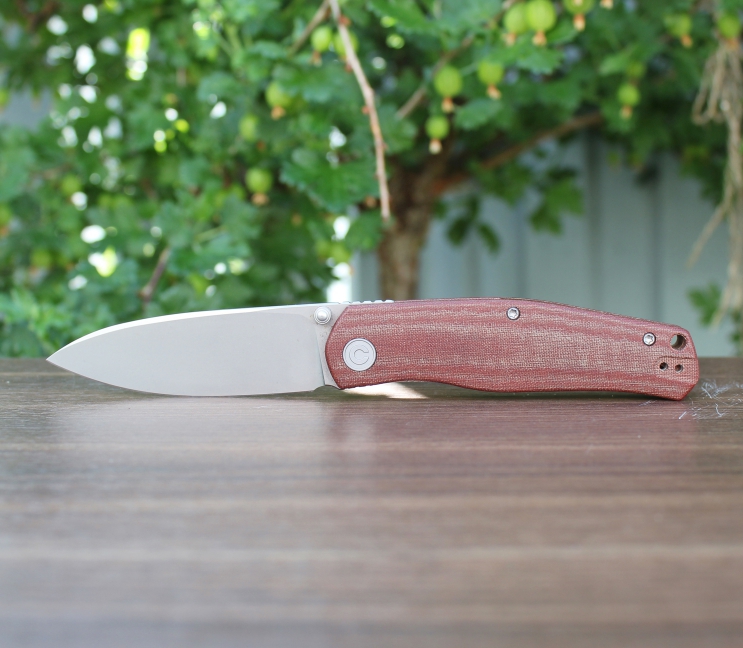
Sokoke is currently available in four versions. This specimen comes with a blasted blade and a brown Micarta handle. It is also available with the same blade finish but with a black handle, a combination of black blade and brown handle, and the luxury version with pattern welded blade and black handle.

Civivi and Laconico in beautiful harmony


Twitter version: Civivi Sokoke, near EDC perfection. This is an example of when good design meets excellent execution!

Blade


The blade follows the design philosophy I mentioned above. It, too, is apparently simple but executed with great finesse. A drop point blade with a slight swedge. 

The length is 85 mm or actually a tenth of a millimeter more as the knife is made in inches and is matched by a height of 21 mm. The thickness is almost more interesting as it contributes to how the knife works. Here, the stock thickness has been kept down to a sympathetic three millimeters.

The grind is almost completely flat except for a small flat surface closest to the thumb studs and the area that forms the front flipper. At the base of the blade, there are also some grooves with the purpose of giving a thumb a better grip.

A gray blasted drop-point blade


The choice of steel seems almost a given these days. I say so because Civivi uses Swedish Sandvik 14C28N in many of their knives. Now I'm not unhappy with it, quite the opposite. It is one of my favorite steels among budget materials. It keeps the sharpness reasonably well, but above all, it can get really sharp and it is easy to sharpen and maintain. In addition, it is very resistant to rust, although that property could probably be even better in this case.

I certainly haven't had any rust issues with the knife despite dropping it in a lake and then letting it dry a few times just to investigate. However, what I have in mind is the blasted finish which is not my preference. For one thing, I think that the gray surface can look a bit cheap, even if in this case it is evenly and nicely done. But what it does more than that is that it opens up "pores" in the metal where corrosion takes hold more easily. But in practical terms, I haven't had any problems as I said. 

Discreet branding as we are used to from Civivi. Completely clean presentation side and Laconico's marking on the other


The factory edge was good. Not the best but good, sharp enough to shave hair with some pressure and handle thin paper without problems. Then, as I said, this steel does not keep its sharpness for extremely long, but in return, it responds excellently to being honed or stropped. Then it's nice to have a good original edge to work with so you don't have to resharpen the knife right away. The thickness behind the edge is about 0.4 mm, by the way. 

If a knife blade is not more eye-catching than this purely in terms of appearance, then it should be practical. And this blade is! A tip that does what tips are supposed to do, penetrates various unpleasant plastics, and kills tape in an excellent way. Packaging and boxes have all the reasons in the world to be afraid. Speaking of which, Sokoke cuts excellently in cardboard and other commonly used materials.

Since cycling has started again, heaps of cloths are used for cleaning in the Wikström home. When these are to be cut from used clothes, it is appreciated that the knife does NOT have any damn features such as large "forward choils" or similar depressions. On the contrary, with Sokoke, you can cut fairly close to the handle where you have the most power and control, which I appreciate.

Wood in different varieties is something I quite often cut, as well as leather. The latter when I make sheaths, preferably for throwing knives. There, Sokoke's well-placed tip was actually an asset when I used it for cutting a pendant. Likewise, I tried to trim some edges. After a while, it is noticeable that the knife loses its sharpness. But as said, Sokoke is easy to maintain the edge on. 


Handle


While the blade is nice on this knife, it's the handle that shines. That's because it's both nice to look at, comfortable to hold, and well-made. A textbook example of what I described in the introduction. Good design meets manufacturing quality.

The size is sufficient to accommodate the whole hand, more precisely just over eleven centimeters. Because the shape is so simple, it also works for different shapes and sizes of hands. The thickness is 13 mm and the height of the handle varies between 24 mm and 27 mm.

The micarta in the handle is of very good quality


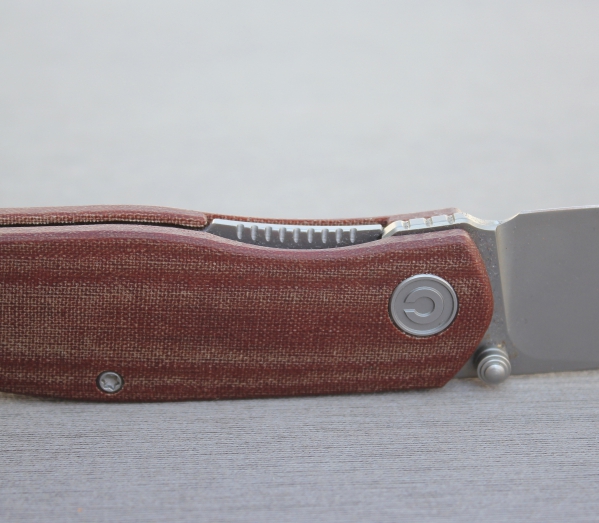
The load-bearing structure consists of a very lightened steel frame. Outside you find sides of linen-Micarta. The quality of the Micarta deserves an extra mention as it is excellent. Even the backspacer is made of the same material and design, which gives a uniform appearance. The sides are attached with only two T8 screws. Then, of course, there is a pivot screw that has got Civivi's usual logo with a stylized "C" on the presentation side. It is the same size as the body screws and is also "D-shaped, " making it easy to adjust. It's just one of several small elements that show the bank of knowledge that Civivi has accumulated and uses to build competent knives.

In the back is a back spacer made of the same material as the handle sides


The micarta is shaped so that it swells slightly in the middle and that the back is slightly curved to match the inside of the hand. In addition, they are slightly domed so no flat sides here.

An excellent handle is a sign of a good knife and it is found here


With this simple shape of the handle with its little subtleties, it is no wonder that it is comfortable to both hold and work with. All grips are actually equally good, whether you're using force in a hammer or saber grip or stabbing something (although I don't recommend it with a folding knife) with a reverse grip.

And since the thumb studs are kept out of the way and the blade doesn't have any giant "choils" or indentations, you can also use a pinch and grip to engage in detailed work when needed. This is an excellent handle for this size of knife. If you are going to work for a longer period of time, they should be slightly larger in my opinion.


Opening and Lock


Sokoke belongs to those knives that are modern to the extent that they can be opened in a couple of different ways. There's been a bit of a trend in that lately, I've noticed. In this case, there are both thumb studs and a front flipper.

Since a little blade sticks out when the knife is closed and the resistance from the detent ball is not extreme, it is also possible to carefully pry the blade out with two hands as well.

Sokoke can be opened both via a front flipper or with double-sided thumb studs


What is special about this and several other Civivi knives is that they master having multiple opening mechanisms that work equally well. It's very common that one method dominates so to speak, but not in this case. It is just as intuitive to open the knife with the thumb studs as with the flipper. Having said that, in nine cases out of ten, it will be the studs for me as I am simply more used to it.

It goes really quick in any case. The detent ball is tuned to perfection, it holds the blade securely in place while allowing a snappy opening action, and on top of that the blade runs on ceramic ball bearings. But most of the speed comes from good geometry. The size of the flipper is well balanced and the same can be said for the thumb studs. The latter is found exactly where they are expected and stick out just a little outside the handle, which gives a good grip. 

The thumb studs are barrel-shaped without sharp edges and are also extremely close to the handle when the knife is in the opened position, which means that they are never in the way. They are simply executed in an exemplary manner.

This is a really good liner lock


Civivi themselves call this a "Nested liner lock" which I do not agree with. Sokoke has a traditional two-part frame which is certainly nested into the sides in an excellent way, but that is not usually what is meant when referring to locks with that name. That term is usually reserved for systems where you have a material in the handle like G10 or Micarta without a frame and then attach a lock bar to the inside.*

The access to the lock bar is not perfect but works


In any case, the function is excellent. No movement in any direction can be detected when the blade is open and the lock snaps into place with one hundred percent efficiency. In other words, a reliable lock that is also easy to release even if the space is not the best. You have to poke the soft parts of your thumb into the lock bar to make it work. 


To Carry


The volume in the pocket is not much to talk about. Certainly, Sokoke is not the shortest of knives, nor is it the thinnest or lightest. But it doesn't go in the other direction either, and the softly rounded surface on the sides makes it really nice in the pocket. And no matter how you look at it, 100 grams isn't very heavy either.

The very basic shape without edges and corners makes the knife easy to carry


Especially not if that weight is distributed in a streamlined object. There is nothing that sticks out and is in the way. It also makes the knife very easy to pull and put away.

The clip is simple but really good


The clip contributes to much of that. Basically a simple steel clip but a very well-designed one. The tip does not point outwards, the ramp is just the right size and the tension is good. In addition, Civivi has understood how to attach a clip in the best way. The recess in the side of the handle means that the clip does not slide sideways and the double screws keep it in place. The space under the clip can be utilized to the maximum as the clip is recessed at the same time as the flat screw heads are also. Watch and learn, I say to many other knife manufacturers. Especially as it is also movable to the left side.


To Conclude


Civivi Sokoke belongs to those knives that are easy to review. There are two categories of knives that are, the really lousy ones and the really good ones. This one is one of the latter as you may have noticed by now. Most of it is simply very good. Civivi and Laconico became just as successful a combination as one could hope for.

The only thing I would have preferred differently is the blade finish. Blasted surfaces are not among my favorites. However, it has a small advantage, it makes the knife easier to photograph due to fewer reflections. Joking aside, I would have preferred a satin or tumbled finish. 

Sokoke is a real standout as an EDC/pocket knife for everyday use


But that's my personal preference as I haven't experienced any rust issues with the existing finish on the blade.

Otherwise, this knife is the result of a series of steps performed in the correct way. Everything from details such as the execution of the clip that I praised, via flipper, thumb studs, and lock to important bits such as ergonomics and blade shape. In short, Sokoke is good design executed in an excellent way. 

Civivi Sokoke doesn't make a fool of itself outdoors either


Overall, the knife both looks and feels elaborated and exclusive, and even more sympathetic is that the feeling is reflected in how the knife feels to work with. It is comfortable and cuts well. You can't ask for much more from an EDC knife. Civivi is a reputable company and this is one of their best knives in my opinion.


Civivi Knives


Specification:


Length Overall: 195 mm
Length Folded: 112 mm
Weight: 100 g
Blade Length: 85 mm
Blade Thickness: 3 mm
Blade Steel: 14C28N
Handle: Micarta
Lock: Liner lock

Produced by: Civivi, made in China

* One of the earlier examples of such a solution was Spyderco Military.


/ J - more than happy

tisdag 22 november 2022

Review MKM Isonzo


-  this is how it should be done!


Is it possible to dig for gold in the Alps? It's a question that feels relevant after becoming more familiar with this knife from the Italian MKM. Named the Isonzo after a river that runs through the European mountain range, it is a shining example of how to build on past successes. But on the other hand, it also comes from a man who right now, like King Midas, seems to turn everything he touches into gold.

MKM Isonzo, desing Jesper Voxnaes
MKM Isonzo


There is no doubt where Jesper Voxnaes, the man behind this knife, got his inspiration. He has taken it from himself! For those who know their folding knives, it doesn't need to be explained but addressed to everyone else, it can be said that a few years ago he designed a knife for another company with an appearance that is very close to this one. A company that, however, is not known for its eminent quality and its exclusive materials, to put it mildly. Nevertheless, that model was a sales success. Or perhaps rather thanks to the low price that resulted from that combination.

But the model's full potential was not directly explored with those knives, even though they have now come out in a slightly upgraded edition. I suspect this is why Voxnaes chose to reuse so many elements throughout a new knife.

The best in terms of ergonomics and practicality was retained, but the quality was improved at the same time as the materials were gradually turned up to the max. The result was, as I said, Isonzo, a knife that is built in a city with proud traditions in the field and by a company that is a consortium of the best in its field. MKM or Maniago Knife Makers is an association of several companies from the northern Italian city.*

The number of versions of Isonzo give us a hint about the basic ideas have become successful again. First, a less exclusive variant was released with FRN handles and simpler steel. But right from the start, the knife was available with three distinctly different blade shapes, such as drop point, hawkbill, or as here, a sheep's foot. 

Then came the knife with Micarta in the handle and these days a carbon fiber edition awaits around the corner. It can also be obtained with both a flipper and thumbhole opening. All in all, this means that there are many variants to choose from. 

The lines feel familiar as they are the result of a collaboration between MKM and Voxnaes


Twitter version: MKM Isonzo, reuse of ideas at its best. A small pocket knife with a big personality and high capacity!


Blade


As I said, you can choose from three different blade shapes on this knife. This is probably the one that looks the least aggressive and MKM calls it "cleaver point", whatever that might be. A somewhat vague description. I call it a modified sheep's foot. The modified parts stem from the fact that the edge is curved and not straight as on the original variants, and that the back has also been curved.

In addition to the shape, the blade is characterized by the considerably enlarged thumb hole it has been provided with. Then the rather thick back has got a couple of substantial notches towards the tip to place a thumb or finger on. The back is also beveled in a way that makes it feel rounded.

Otherwise, the blade is flat-ground and in this version stone-washed. There is a lot of text on the page, but the size of it is kept small. Here you will find logos from both manufacturers and designers, steel type, and who made the knife.

This version features a modified sheep's foot blade


The dimensions are quite modest as the length is less than two inches, which is 49 mm and the thickness of the blade is 3 mm. Not excessively thick in absolute terms, but quite sturdy given the size of the blade.

The material is one of the areas where this knife surpasses both the cousin from the other company as well as MKM's first edition. Here you will find among the best that can be found in Böhler/Uddeholm's famous M390. One of the steels is often referred to as "super steel". In concrete terms, this means that properly treated, you get steel that takes extreme sharpness and keeps it like carbon steel at the same time as it is stainless, not too difficult to maintain, and reasonably impact resistant.

Here MKM reportedly keeps the hardness to 58-60HRC and spontaneously I would guess that this specimen is found in the middle of that range considering how it holds its sharpness. I wouldn't mind seeing it a bit harder but doesn't feel soft. 

The steel is a fine M390 from Böhler/Uddeholm


As I said, the blade is ground flat and from a height of 26 mm. Behind the edge, this knife measures around 0.5 mm. It is quite robust for a knife of this size.

Those characteristics are of course reflected in how this knife behaves when it is used. As much as I like this little thing, it is not a godsend for someone who cuts a lot and often. It is a blade with a profile and an edge solid enough to belong to a knife two or three times its size.

Sure, the edge is sharp, it cuts reasonably well in most everyday materials, but it doesn't do it with ease. It becomes noticeable when breaking down cardboard, for example. In fact, it cuts better in wood in my opinion. There it is not bad at all, to my surprise. 

When it's time to resharpen this knife, I will reduce the edge angle and remove the"shoulder" between the edge and the flat of the blade. The current edge is somewhat too steep and does not make use of the steel's qualities, I think. 


Handle


The Isonzo belongs to those knives that trick you with the size. The handle is simply more spacious than first impressions suggest. This is achieved, of course, with what is popularly known as a "forward finger choil", a recess for the index finger that increases the available surface for the hand. In this case, around 95 mm depending a little on how you measure. Without that detail, the length stays around seventy millimeters. How well this feature is incorporated varies greatly between different knives. Here it is masterfully executed.

The thickness of the handle is 12.5 mm and the height varies between 20 mm at the finger recess to 28 mm towards the rear end. It's enough to fill the hand surprisingly well considering the overall size of the knife.

The handle has sides in Micarta and details in anodized titanium


The material used for the handle sides on this version is Micarta. It is also linen-Micarta of the highest quality. It gives somewhat better traction than, for example, most FRN, while it is a material that ages with dignity, read get patina rather than wear. The sides are screwed with two small T6 screws into a steel frame. The latter is not weight-reduced in any way.

The frame is neatly recessed into the sides and is therefore not visible. The thickness is 1.5 mm, which makes the knife sturdy while at the same time forming a solid basis for a liner lock.

As you can see, the handle is quite chunky


The screws are also pulled through another very noticeable part of this knife's design. Here, Voxnaes has solved the problem of a lanyard hole by not drilling a hole straight through an existing handle but by incorporating that detail into the design itself. 

A smart move that provides a lanyard hole large enough to pull a tow line through while not disturbing the looks by messing with the overall lines. The latter has been facilitated by the fact that the shape mirrors the shape of the blade hole while at the same time following an imaginary outer line on the handle itself. But it sure is visible!

The material in both this back spacer and the decorative pivot collar is titanium. In this case, the light and strong material has been anodized to match the knife's color theme. 

Isonzo belongs to the category of knives that tricks you with the size of the handle and all four fingers can fit if you use the choil in the blade


The design of the back spacer contributes to the comfort of this knife. Making it wide enough and well-rounded at the back end, help rather than destroys the ergonomics. 

In a more conventional hammer grip, this is a "three-finger knife"


Also, the Micarta feels soft to the touch, despite having flat sides but the edges and corners are beveled and well-rounded.


Opening and Lock


Like much else on this model, you as a buyer can choose between different options when it comes to how the knife should be opened. This version lacks the flipper tab, so a blade hole remains. On the other hand, it can be used in several ways. With a thumb or an index finger on the back, quickly or slowly, and of course, the knife can be opened with two hands for those who feel less stressed in life.

The hole is apparently oblong and wider at one end. All edges are rounded, which means that you have to press slightly against the blade when you open the knife, but the movement feels natural and does not require much getting used to. The thumb also does not have to search to find the hole and the arc feels natural.  

The blade has been given a substantial hole to facilitate handling


The motion itself is extremely smooth, thanks to the fine ceramic ball bearings found in this knife. There are different opinions about putting small balls sensitive to dirt in a folder depending on what the knife is to be used for. In this case, it's not a concern as I don't see this as a knife for really hard use in demanding environments. More like an EDC knife for lighter tasks. That means less risk of getting gunk in the pivot area. 

Here you will find a well-executed liner lock. The ceramic detent ball is also clearly visible 


The lock is not much to talk about. What there is to say is positive. A simple steel liner lock holds the blade in place. There is no play in the blade, nor does the lock bar slide if you press hard against the back of the blade. The lock bar falls into place with a reassuring "click" sound and it does so every time the knife is opened. Furthermore, it is easy to disengage. Mostly depending on the fairly thick blade stock giving plenty of space between the sides of the handle.


To Carry


The Isonzo is a small and a lightweight knife. The use of Micarta and not least titanium in the details keeps the weight down even though the frame is massive. It weighs in at just under 70 grams. Sure, you only get five-centimeter blade, but as a total weight considered, it is still good.

With low weight and smooth sides as well as a good clip, the Isonzo fits well in the pocket even though it occupies some space


And not to forget, this is a little chubby knife. As I said, the thickness is close to 1.3 cm, which is substantial in relation to the length. With this bladeconfiguration the knife i also quite tall in the folded position with its 3.8 cm. Not modest measurements, especially with the overall length taken into account, but not excessive in terms of absolute numbers.

In return, there is nothing that stands out and is sharp and everything that should be rounded is. That, combined with a material that does not wear on pockets, makes the Isonzo as a whole pleasant in the pocket.

The Wire clip on Isonzo is really good


The wire clip is of the best kind. This means, among other things, that it is stiff enough not to wander sideways. Some of it can probably be attributed to the size as it has been adapted to the knife. Smaller means stiffer. Something that is not always a given with pocket knives. Sometimes the manufacturers take what they have on the shelf and throw on an existing knife model or at least it can be perceived that way. Here, even that detail feels well thought out.

The clip can be shifted from the right to the left side if desired and it is attached with a T8-size screw that holds it in place in a recess in the side of the handle. In addition to being stiff enough not to move, proper tension is needed to keep the knife in place. That too is found here. 

In addition, the space is reasonably large. Regular trousers and thinner jackets don't cause any trouble. If you want to wear the knife in really thick trousers, there may be problems, especially as the ramp is not huge. It's just a small clip. Otherwise, I appreciate that the ramp is not too high as it keeps the tip of the clip at the right level. The tip also has the right angle, which concretely means anything but outwards. 


To Conclude


Given the fierce battles historically fought on the Isonzo River, one can almost hope that there is no gold in it if it risks sparking new conflicts. This knife, on the other hand, is worth its weight in gold! In my opinion, of course.

This is despite the fact that I'm not really a fan of "forward choils" nor of sheep's foot/wharncliffe blades, especially if the word "cleaver" is mentioned in the context. Nor do I usually appreciate huge holes for lanyards.

Despite this, I am extremely fond of this knife, which is incidentally my first from MKM and it must be the result of good design considering the tough conditions to sell this knife to me in particular.

Everything or almost everything works on this knife. The recess for the index finger** for example. It doesn't feel like a bad retrofit but something the handle is designed around. Especially in this version, I suspect as you don't get a flipper between your fingers.

Nor does the blade shape offer the disadvantages I usually see with them, namely that it is the most forward part of the blade that is used and that there is no tip. Here, the curved edge makes that problem, if not completely avoided, reduced, and the point that exists works well. Especially as the thumb ends up at an angle that makes it easy to push.

As you can see, the Isonzo is not a large knife, which makes it good for everyday use


And there we come to the next advantage of it is the knife and its ergonomics. It is really really good for such a small knife. It is simply up there with the best for the size. A relatively plump handle with all the curves in the right places makes the knife comfortable both to hold and to work with. Voxnaes obviously knows what he's doing.

Here, that competence has been well managed by MKM or Mikita who makes the knives. Materials such as high-quality Micarta, titanium, and M390 paired with very good build quality make the knife a real jewel both in the collection and in use.

However, they have not really dared to trust the material one hundred percent. In that case, they should have chosen to grind it thinner behind the edge and have a significantly less steep edge angle. The knife may be chunky, but it doesn't have to feel that way when you cut with it. In that area, Isonzo doesn't get quite the same lyrical reviews from me.

As I said, the knife is available in many different variants and really I should have chosen a different blade shape, but I wanted to challenge myself a bit. Then the choice of opening method was easy as I prefer thumbholes to flipper fins in general. The color scheme was chosen because I thought it was sober and elegant. But one advantage of the knife is that if you think the opposite, there is an Isonzo for you too! This applies to colors, blade types, opening method, and not least price.

MKM Isonzo the result is a very successful collaboration between Italy and Denmark


Pricing yes, it's always interesting, and in this version the knife costs €179 on MKM's website. With somewhat simpler materials, it can be had for around €106. For that sum, you get an absolute top-class design that was carried out in a distinguished way by MKM.

Isonzo is a knife that with a lot of charm and solid quality worked its way into my knife heart and I can only recommend it for that reason.


Specification:


Length Overall: 145 mm
Length Folded: mm
Weight: 70 g
Blade Length: 49 mm
Blade Thickness: 3 mm
Blade Steel: M390
Handle: Micarta
Lock: Liner lock

Produced by: MKM, made in Italy


/ J - charmed but glances at the sharpening stones

* Something I wrote about in the presentation of this knife.
** The same way it does on knives like the Spyderco Lil' Native and Cold Steel Tuff Lite for example.

#knivesandbikes #aliaspostmortem #knivigtvarre