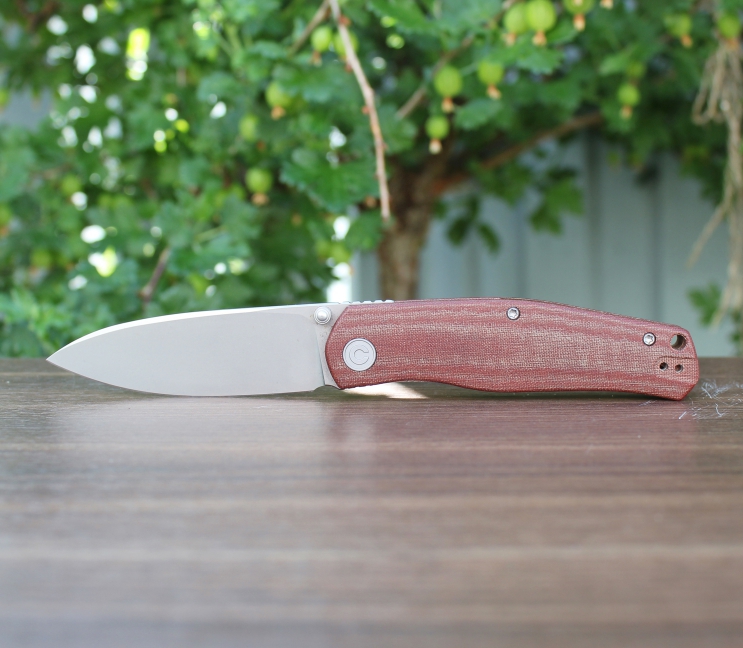
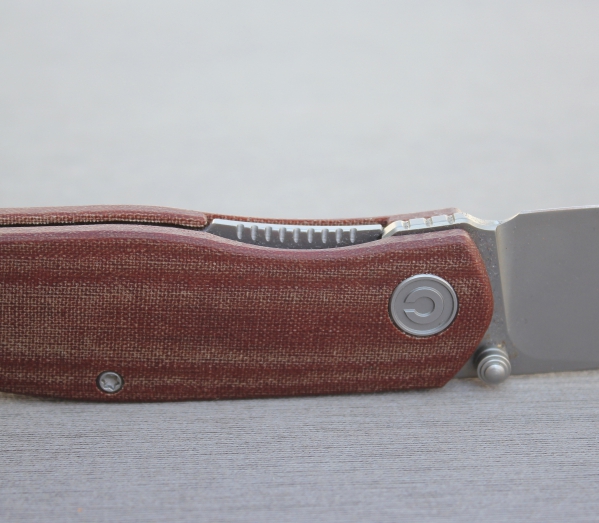
Visar inlägg med etikett Civivi Knife. Visa alla inlägg

torsdag 6 november 2025

Ny kniv - Buster FG

Det finns inget diskret sätt att uttrycka det, Buster FG är en förbaskat stor fällkniv! Den ko mer från  Civivi och är designad av Snecx Tan. Något som kan anas dels på likheten med en annan modell från Civivi kallad Vision FG och dels på den på ryggen uppstickande låsarmen som är typiskt för "Super Lock". En låsvariant utvecklad av Snecx själv.

Civivi Buster FG


En markant skillnad mellan modellerna är dock storleken. Där Vision är en normalstor EDC-kniv så är det här en bjässe. Eller vad sägs om en kniv som mäter fjorton centimeter i fickan och med en totallängd som närmar sig tjugofem centimeter utfälld? Mer exakt 245 mm varav bladet utgör 107 mm. 

Det är med andra ord en gigantvariant av en Sheepsfoot som uppenbarar sig när kniven öppnas. Stålet som används är tyskt Nitro-V. 

Kniven är relativt lätt för att vara så stor men det går inte att trolla bort den ingående mängden stål  i bladet varpå vikten ändå hamnar på 176 g. Buster FG är dock mycket välbalanserad så grammen känns något mindre än vad de borde. 

I öppet läge avslöjas ett av de största Sheepsfoot-blad jag sett


Handtagsmaterialet är i det här utförandet grön linne-Micarta. Vad finns mer att tillägga? Jo, att kniven har exceptionellt mjuk gång. Något som vi förvisso är bortskämda med från Civivi. Men här får god byggkvalitet hjälp av keramiska kullager och inte minst fysik. Ett tung blad och ett lätthanterat lås gör att det här är en veritabel fingergiljotin. Det gäller att hålla bort fingertopparna när man stänger kniven. 

Det kan också sägas att kniven kan öppnas och stängas med låsfunktionen förutom tumknopparna som annars är tänkta för det. 

Överlag är det här en rätt djärv design som understryks av de tilltagna måtten. Nu skall den bara användas också så återkommer jag med en rapport om hur det utföll. Om jag nu kan behålla fingertopparna vill säga. 


/ J - slår på stort

#knivesandbikes #knivigtvarre

lördag 4 oktober 2025

Review Civivi Sentinel Strike II


-  When bigger actually is better

Civivi is a brand that has developed gradually and constantly seems to strive upwards. From initially being mostly a budget alternative spun off from WE-knife to standing more on its own two feet. This knife, called Sentinel Strike IIis brilliant proof of that.

This is an example of a really good knife, regardless of the price level. Maybe not the most exclusive in terms of materials, but good in terms of design, handling and not least fit and finish.

Civivi Sentinel Strike II


First, perhaps we should clarify what "II" stands for. In principle, this is the same knife as the first one, although the blade shape has been given a major overhaul. The first model had a boldly modified Wharncliffe blade with a large hole in it. In fact, I don't find that model particularly attractive.

But then this variant came with a drop point blade, and my interest was piqued. A larger Civivi knife was actually what I was looking for, as most of the others in the catalogue are of a slightly smaller model.

Now, it's not just any blade as it has a compound grind. Then this version shares several features with the original, such as the rather special handle. All in all, a really interesting knife, large, light and quite dramatic.

A large and sturdy knife that is nevertheless light and well-balanced


Short version: Civivi Sentinel Strike II, A folding knife that is not only well-sized, but it is also light and well-balanced and cuts excellently. A real all-rounder!


Blade


It is a substantial blade we have in front of us, the length is 94 mm, and the height is 31 mm. However, it is not excessively thick with its 3 mm. It is even quite neat for being so large. Those proportions make it thin, and that property is reinforced by the fact that most of the edge is hollow ground. This makes it really thin behind the edge, 0.3 mm to be exact.

Then, as I said, the blade has a compound grind, which means that the tip is flat ground, which is what the rounded transition shows. However, that part is also quite thin. So, of course, the tip is reinforced, but not much. It is quite delicate, but that also makes it an excellent tool.

The large blade has a hint of a tanto tip and a compound grind where the main part is hollow ground.


The shape of the blade is enhanced by the substantial false edge that runs along most of the blade. It can also be said that the way the knife is sharpened gives it a slight tanto tendency. With its curved front part, it can probably be said to be a Japanese one. But it can be added that at the first real resharpening, it will disappear, and what remains will be a more traditional drop point with a fairly substantial belly thanks to the height of the blade. Functionally, it is already one of those.

The finish is a pretty nice stone wash. The blade steel is Nitro-V, a well-balanced mid-range steel that is found in the class around or just above 14C28N and similar materials. It holds its edge well, but not to the same extent as finer steels. It is fairly rust-resistant and tough enough not to chip in the first place.   

The steel is Nitro-V


Sentinel Strike II is really good for most things. A wide but thin blade makes it particularly suitable for cutting materials where you need good control, such as cardboard and the like. I will, however, grind off the small tanto-like secondary tip as it certainly does not do much damage but irritates me a little as it can be a little "stop" when cutting textiles, for example.

Otherwise, this is a blade that works unexpectedly well for cutting wood. However, you have to be a little careful not to bend too much sideways when you loosen the edge, as it is thin. That it is good for cutting rope was more expected.

I wouldn't use a folding knife for hunting at all, and especially not one with various decorative holes in the handle that make cleaning difficult, but the blade could undoubtedly be used for that as soon as the aforementioned secondary tip is ground away. The shape means that long sweeping cuts are excellent in general.

The tip is also very capable. It is certainly reinforced, but to such a small extent that it is still very thin. This makes penetrating cuts in various materials easy to make. Last time I needed an improvised funnel that I made from a PET bottle, and for that kind of task, this is a good knife. Overall, the tip is also easy to control as it is located in the intended centre line of the knife.


Handle


Sentinel Strike II has a handle that is not one of the most common. What makes it stand out is the combination of aluminium and a back spacer in FRN. The odd thing about it is that it is of the integral type, which means that it covers parts of the sides and the entire back. This also gives the knife the feeling of being an integral (a handle made of a single piece) even though it is not.

The advantage of backs that are not open is that they provide a larger contact surface with the hand, which reduces the risk of hot spots.

The shape of the handle is familiar, and the size is quite large.


The aluminium has been brushed to a grey surface that resembles titanium, which is probably no coincidence. The surface is hard enough that scratches will not occur too easily. The edges are heavily bevelled, which makes the handle a little softer in the hand. From the side, it has three holes drilled from which the function is purely aesthetic. From the side, the Civivi "C" logo that is found on the pivot screw is also visible.

The back spacer can also be seen from the side thanks to its design. It is made of plastic, although it is an advanced one in the form of FRN. It has a square pattern, and a series of holes is found in the back. Both patterns are for the sake of appearance more than anything else, as they do not add much extra traction. 

In the back, you will find a rather unique back spacer made of FRN


This handle is sturdy and easily fits most hand sizes, and is also sufficient if you wear gloves. The length is a full 125 mm, and the open shape without a beak or other boundaries at the back means that you can grip the entire handle. The length behind the finger guard formed by the front part of the handle and the flipper is 104 mm. The thickness is 12 mm, enough to fill the hand but thin enough not to be too much of a burden in the pocket.

The shape is quite generic, as it has been made many times before and will be made many times in the future. But that's because it works. A substantial indentation for the index finger followed by a fairly straight shape with rounded edges and corners. A stick, but a stick with good ergonomics.

A simple but comfortable and, above all, spacious handle


It is noticeable as soon as the knife is gripped. Hammer grip is an excellent grip on this knife, and sabre grip is even more comfortable. The thumb ends up exactly where it should and is helped with the traction by the grooves on the base of the blade spine. They could possibly be a little longer in my opinion. But they work well. In both grips, it becomes clear that this clip is excellent in that it does not cause hot spots that can cause chafing.

Then you can, of course, put an index finger on the back of the blade for better control. Then this knife has a large recess for the index finger on the blade, so if you want to get even closer to what you are cutting, you move your hand forward a step.

With the size of the handle, it is no problem to find a good grip. The same applies if you are wearing thin work gloves. In addition, the Sentinel Strike II can be used in a reverse grip when needed. Both if you hold the knife like an ice pick with a thumb over the back end of the knife, or if you have the edge towards you with the blade upwards.

Overall, a very flexible and practical handle.


Opening and Lock


How do you want to open your knife? Whatever your preference, you will find it here, except for the blade hole. But otherwise, using the double-sided thumb studs or the flipper works just as well for the purpose. You can also open the knife slowly with two hands if desired. Then you can always use the lock just like you can with the cross-bar lock. Just press the button, and the lock is released and the blade swings freely. 

Civivi has made the lock so that both thumb studs and the flipper tab work equally well


The reason everything works so well is that Civivi has perfected the tension in the small spring that holds the lock bolt in place. With this type of lock, it follows that they are the ones that hold the blade in place in the retracted position. There is no "detent-ball".

Thumb studs are particularly pleasant to use. The soft barrel shape provides a good grip against the thumb without being uncomfortable. They also sit far enough out to provide good access and good leverage. They are also found on the ricasso, which means that they are not in the way when cutting with the knife.

The flipper tab also works excellently. As usual, Civivi has the good habit of providing them with grooves so that your finger does not slip. In addition, the geometry is such that you can both press the flipper straight down or backwards. This makes handling very intuitive. In addition, the speed of the blade is really good.

This is how you make a good button lock


The locking mechanism is, as can be seen from the pictures, a button lock, also sometimes called a plunge lock. The principle is simple: an asymmetrical bolt with a thicker and a thinner part is moved sideways. When the thicker part is in place, it presses against the back of the blade just like a cross-bar lock. When the button is pressed, the thinner part falls into position and the blade moves freely. Very freely in this case, thanks to ball bearings.

The lock is extremely well made, which partly gives the very nice opening properties I mentioned above, but above all, it holds the blade in an iron grip. It is not possible to perceive any play in the blade even if the blade is provoked or subjected to pressure from the wrong direction.

This type is generally very easy to handle, and this also applies here. So, overall top marks for the lock!


To Carry


For being so large, the Sentinel Strike is really comfortable to carry. It is certainly a long knife, over twelve centimetres when folded, but otherwise it is discreet. The thickness is not excessive, but that is still not what makes it easy to carry in your pocket. There are other reasons for that.

The clip is made of steel and quite long, but nevertheless very discreet in the hand.


One is the design of the handle itself. It is very streamlined, as you can see. Nothing sticks out or catches, even though this is a flipper knife. But what makes the most difference is the soft surface of the materials, which makes the knife slip easily both in and out of a pocket.

The knife is completely hidden in the pocket


Then it is combined with a deep ride clip, which means that very little of the knife is visible when it is in the pocket. What makes it stand out a little, in terms of appearance, is that it is attached to the back of the handle and not on the sid,e which is more common. This means that it is possible to change sides without the handle side having to look like it has been attacked by termites.

The shape is then excellent in the way that the shape makes the clip almost imperceptible when you are working with the knife. 


To Conclude


With the Sentinel Strike II, Civivi has managed to create another really good knife. It's big, light, well-balanced and doesn't look too bad. Version one already had all that, possibly with a look that was more polarising than this. Even if you ignore that, drop point blades have other properties, such as being easier to use for sweeping cuts and, not least, against flat surfaces. Two properties I appreciate, even though it is, of course, situational. That's what makes me prefer this edition.

Of course, bigger is not always better, but sometimes it is, hence my subtitle. In this case, it means that you get a solid grip on the knife and that you can use it for heavier tasks if necessary. A solid blade also attracts you to more advanced jobs than just opening boxes. This means that the Sentinel Strike II can be moved outdoors, to the lake, the forest or the mountains and not just used in an office environment.

One of the knife's main features is that it cuts really well.


The handling of the Sentinel Strike II is also very pleasant. The speed of the blade is impressive if you consider two aspects that usually make that part difficult: that the blade is really big and that there is no hard-trimmed detent ball. However, the blade is very light thanks to the relatively thin blade material and, not least, the combination of a swedge and a hollow grind, which removes material. The resistance has been achieved with a perfect level of spring tension in the lock. A detail that is not entirely easy to achieve. Something that is proven by the fact that all manufacturers would have done it if it were.

The appearance is both figuratively and literally a bit grey. But a variant of a back spacer that gives the impression that the knife is an "integral" adds a bit of flair. But that is reduced to part of the use of FRN as a material. I would have preferred to see it made of a slightly more exclusive material that suited the knife a little better, like G10 or, even better, Micarta. But that would probably have driven up the price a little.

Another detail that I can both lose and have is the small ball at the end of the handle. It is actually a glass breaker. But at least it is discreet and not sharp against the hand, as is usually the case. I think the detail is so pointless that I actually didn't even bother to test it.

Civivi Sentinel Strike II is an excellent all-around folding knife of the larger variety


But I don't have much more negative criticism of the Civivi Sentinel Strike II. It's simply an excellent knife.* So if you're looking for a big and sturdy knife that's still light and well-balanced, this is the knife for you. It cuts damn well, is easy to carry and even easier to handle.


Specifications:


Length Overall: 219 mm
Length Folded: 125 mm
Weight:105 g (weighed by me, stated 04,7 g)
Blade Length: 94 mm
Blade Thickness: 3 mm
Blade Steel: Nitro-V
Handle: Aluminium/FRN
Lock: Button lock

Produced by: Civivi, made in China


/ J - goes big

At the time of writing, you will have to pay between 100 and 150 EUR for this knife, so it pays to compare prices.

söndag 7 september 2025

Recension Civivi Yonder


-  Ännu en i raden av mycket bra knivar från det här märket!

Dagens recension handlar om den här skapelsen döpt till Yonder. En kniv som formgivaren kallar mellanstor även om jag tycker att den är liten. I vilket fall kommer den från Civivi och är en i mitt tycke synnerligen sympatisk kniv som täcker de flesta dagsbehov som tarvar en vass egg. Jag ämnar här tala om varför jag uppskattar den. 
 
Civivi Yonder


Den här kniven är designad av Zac Whitmore under 2023 och enligt hemsidan föddes idén under en tid han tillbringade i Montana.  Erfarenheterna därifrån mejslades ut under en samtal med en god vän och resultatet ser vi här. Faktum är att själva arbetet från idé till färdig produkt finns att ta del av på hemsidan.

Uttrycket "Yondering" är förresten inspirerat av eller kommer från författaren Louis L'Amour. Det står för att att påbörja en resa mot det okända driven av en inre kompass. 

Att många gillar kniven bevisas inte minst av att den vann "Blade Best Buy" 2024. Av mig får den ytterligare ett pris, mest inspirerade knivnamn 2024.

För att vara praktisk är Yonder även estetiskt tilltalande i mina ögon. Balansen i proportionerna bidrar till det


Kortversion: Civivi Yonder, en idé som föddes i Montana och blev till en riktigt bra fickkniv som fått god spridning i världen


Blad


Yonder har faktiskt en rätt udda bladtyp. Det här är nämligen ett nästan renodlat "Spey Point"-blad. För er som inte vet är det en typ av spets som ofta återfinns på klassiska amerikanska fällknivar som en Stockman exempelvis. Själva typen är som namnet antyder till för att kastrera djur med. Det är därför spetsen finns men inte är så uttalad och framförallt återfinns lågt ned i relation till knivens tänkta mittlinje. Man vill inte råka sticka fel när man arbetar med den typen av uppgift helt enkelt. 

För ovanlighets skull hittas ett Spey-blad i Yonder. Det är inte det vanligaste på en EDC-kniv


På den här kniven är det mest valt för att den även är tämligen praktisk. Du har en spets som sagt även om den inte är så distinkt. Men det gör den också starkare. Sedan gör den lätt svängda eggen att Yonder har en buk vilket underlättar allt arbete som inkluderar flata underlag vare sig det är en stock i skogen, en planka, arbetsbänk eller skärbräda. Det är något jag annars saknar hos helt raka eggar som på en Wharncliffe.  

Stålvalet föll på 14C28N härdat till uppgivna 57-59 HRC. Något mjukt kan konstateras. Jag har knivar där tillverkarna skrämt upp hårdheten på det stålet någon grad till och min erfarenhet är att stålet klarar det utan att bli skört. Fördelen är nämligen att skärpan håller längre. Yonder kräver att man underhåller den tämligen ofta. Men i gengäld svarar stålet mycket snabbt på att striglas och brynas så det är inget problem men väl lite merarbete. 

Bladet är 73 mm långt och 25 mm högt som mest. Tjockleken är endast 2,2 mm vilket är en liten finess. Yonder har inte en full flatslipning men väl en hög sabelslipning men när godset är så tunnt blir resultatet bra. Men fullt ut har man inte vågat lita på stålet eller kanske användaren då bladet är 0,5-0,4mm tjockt bakom eggen. Där kunde man plockat någon tiondel till för att uppnå optimalt resultat. 

Bladstål är 14C28N som i det här utförandet är svärtat. Den enda märkningen återfinns på baksidan med Whitmores logotyp samt ståltyp skrivet på ricasson


Med det sagt så skär Yonder ändå riktigt jäkla bra. Särskilt som fabrikseggen var mycket skarp som så ofta på Civivi samt att eggen som sagt är lätt att underhålla. 

Men det är ett rätt kort blad och jag håller som sagt inte med formgivaren om att det är en mediumstor kniv. Det märks ännu mer i det som avhandlas under nästa rubrik. 

Resultatet blir att det här är en förträfflig EDC-kniv för mig. Lätt att använda, skär bra och smidig i största allmänhet. Det gör Yonder till en mycket bra reservkniv på jobbet där jag använder dylika varje dag. Främst till allehanda förpackningsöppningar vare sig det är plast eller kartong med eller utan tejp. 

Någon liten pinne  går också att tälja till och själva grundformen skyr inte lite tyngre uppdrag heller. Men skall jag använda lite mer kraft som i skära i tjockare rep eller en bit gummi eller hårdplast som var aktuellt vid något tillfälle under testperioden då är faktiskt Yonder lite för liten för mig. 

Allt går brukar man säga men i det här faller blir det inte särskilt bekvämt helt enkelt. Något som däremot också fungerar ytterst väl är spetsen. Inte "pilla-ut-spetor-tunn" men borra-hål-i-saker-stark. Därtill hittas den faktiskt i knivens centrallinje vilket gör den lättkontrollerad när man behöver trycka till. 


Handtag


Det skall sägas direkt att handtaget på Yonder är riktigt bra. Bra fast något för litet för mig. I siffror innebär det att längden uppgår till precis under 95 mm, tjockleken är 11,6 mm och höjden är 23,5 mm. 

Nu finns det visserligen möjlighet att vika pekfingret över fingerskyddet men det hamnar då farligt nära eggen så det gör jag helst inte. Men fingerskyddet i åtanke kortas den tillgängliga greppytan bakom detsamma ned till 86 mm. 

Mot brun bakgrund kan man se att Micartasidorna är gröna


Det gör att Yonder är en "tre och en halvfingerskniv" för mig. Den snyggt rundade bakänden underlättar det greppet särskilt vid sabelgrepp som är det mest bekväma. Även hammargrepp fungerar väl även om bakänden på clipet känns något vid båda greppen om du sluter handen hårt. Annars är det inget problem.

Appropå snyggt rundat så är alla kanter och hörn det, precis som det skall vara. Det är områden där Civivi ofta excellerar och det gäller även här. Detsamma kan sägas om Micartan som är snyggt fasad. Faktiskt såpass att sidorna känns 3D-formade vilket de inte är. 

Handtaget är öppet i ryggen och byggt kring en mycket lättad stålram


Handtaget är traditionellt uppbyggt kring en kraftigt lättad stålram som här är svart för att passa knivens färgtema. Utanpå den hittas Micarta-sidor som ser gröna ut mot brunt underlag men annars kan passera för bruna. De är mycket mjuka och bekväma och får en skön patina över tid. 

Sidorna är skruvade från två sidor genom en distans mot bakänden till och ytterligare en skruv som även är en av de två som håller clipet på plats. Så två punkter totalt utöver pivotskruven. Intressant att båda skruvarna har storlek T8. Små T6or hittas bara i clipet. 

Pivotskruven har som vanligt Civivis "C" på skruvhuvudet och den sidan är även D-formad vilket gör att den inte börjar spinna om du vill demontera din kniv. Om du gör det bör du vara medveten om att den här typen av lås innehåller ett par fjädrar som sitter i spänn. Så gör det inte ute på en gräsmatta!

Balansen är mycket god men för mig är det här inte fullstorlekskniv, tre och ett halvt finger får plats med lite god vilja


Men de grepp som  tas  är mycket bekväma!


Balansen i Yonder är mycket god och när det kombineras med en redan lätt  kniv känns den extremt kvick i handen. Det märks även att formen är väl genomtänkt då alla grepp fungerar utmärkt, bortsett från storleken då. Men det är personligt och min kära fru håller inte med mig på den punkten.  


Öppning och lås


Yonder är en fröjd att öppna och stänga. En litet lätt blad på kullager och ett par mycket väl fungerande öppningsmetoder är anledningen. Som alla knivar med välgjorda cross bar-lås kan knivbladet snärtas fram samt stängas genom att låskolven dras bakåt. Det frigör bladet och sedan används en mycket liten rörelse för att få  ut bladet. Används för mycket kraft studsar bladet in igen. 

Tumpknopparna är av klassiskt snitt och både sitter där de skall och fungerar utmärkt


Trots det underhållande sättet att öppna en kniv på så är Yonder främst tänkt att öppna med tumknoppar. Formen på dem är inget extraordinärt men funktionen är i gengäld utmärkt. Du hittar dem där du skall utan att du behöver "leta" med tummen. Knopparna sitter förvisso rätt nära handtaget som inte har någon fördjupning för att underlätta åtkomst. Men de sticker upp lagom mycket så de kan  nås ändå. 

Något Civivi lyckats  med är att få till motståndet i fjädrarna till låset så att de inte bara sköter den funktionen  på ett bra sätt utan att de även är tillräckligt starka för att agera "detent". Det behövs inte bara för att hålla bladet på plats när det är infällt utan även för att du skall få en bra snärt i öppningen. Något som förvisso är viktigare på en flipperöppnad kniv. Men även här fungerar den detaljen förträffligt. 

Bladet hålls på plats med ett närmast perfekt utfört cross bar-lås 


Precis lika förträfflig är låsfunktionen. Bladet hålls i ett mycket fast grepp och något spel eller glapp talar vi inte om. Inte ens den lilla tendens som ofta kan kännas  upp- och ned med den här typen av lås.

Som nämndes ovan är det ett cross bar lock. Ett lås som bygger på att en fjäderbelastad bult ligger ovanför bladtangen i öppet läge. Bladet är klämt mellan den och en stoppbult som tar upp kraften från bladet. 

Det är även lätt att släppa låset både med ett eller två fingrar. Det går även oavsett om du gör det på vänster eller höger sida. Skall något minus alls nämnas  så är det att låsbulten har en tendens att röra sig en smula i sidled. Det är inget som påverkar funktionen men det finns knivar där det är bättre gjort. 


Att bära


Yonder är en riktig fickkniv. Det betyder att den faktiskt är riktigt bra att bära vid sidan om att användas. Släta sidor, ingen flipperfena och avsaknad av stora fingerskydd bidrar till det intrycket. 

Ja, det och vikten förstås. Yonder väger endast 72 gram vilket är lätt oavsett vad det jämförs med. 

Det enkla stålclipet är litet och svart


Micartan ger heller inget motstånd när  ett byxtyg skall mellan handtagssidan och clipet. Det senare är ett av Civivis standardvarianter. Ett stålclip som är litet och svart. Det sitter monterat i en försänkning i handtagssidan med två stycken T6skruvar i tandemkonfiguration. Det gör att clipet sitter stabilt. 

Förutom clipet är kniven närmast osynlig i fickan


Clipet är av deep carry-typ och som synes syns inte mycket av kniven då den befinner sig i en ficka. Inget alls  faktiskt. En svag utbuktning som skulle kunna vara ett veck i tyget är allt som avslöjar Yonder. 


Sammanfattningsvis


Stallet av utmärkta fickknivar från Civivi växer. Särskilt som de tillhör de där företagen som bara spottar ur sig nyheter. Både riktiga och varianter av existerande modeller. Men när Yonder kom för något år sedan blev åtminstone jag intresserad. Det är inte någon extraordinär kniv när det kommer till vare sig utseende eller material. Men den har ändå något särskilt i mina ögon. 

Jag tror att det är den så förbaskat genomtänkt. Det är inte en designgrupp som suttit och spånat fram den här kring ett konferensbord. Det är i alla fall min känsla. En som dessutom förstärks när kniven används både i vardagen, på jobbet eller ute i skogen. 

Det är främst som en excellent EDC-kniv jag ser Yonder


Med det vill jag ge en eloge till Zac Whitmore för designen och till Civivi för genomförandet. Det sistnämnda är nämligen som vanligt oerhört bra. De har skämt bort oss med det och det är ytterst sällan något måndagsexemplar slipper igenom deras kvalitetskontroll. 

Exempel på det är den mjuka gången från start, vass fabriksegg, och mjukt slipade kanter och hörn. Några få element adderar till att kniven känns välbyggd och det är att tid lagts på att lätta ramen och att det finns en täckplatta för den kanal som för närvarande inte används till att fästa clipet i. 

Överlag är Yonder därmed ett gott exmpel på två saker. Nummer ett är ett gott hantverk där många detaljer är väl utförda. Nummer två är hur man på ett bra vis översätter en designers vision till en produktionskniv.  

Det har lett till något mycket bra. Faktum är att kombinationen av det nätta formatet, att Younder är lätt att öppna och stänga samt att kniven skär bra gjort att den blivit en av min frus favoritknivar att snappa åt sig här hemma. Det är ett gott betyg då det finns en hel del att välja på. 

Civivi Yonder är utmärkt på utflykter, här på Linnés Råshult


Själv ser jag Yonder främst som en EDC-kniv i det mindre formatet och kanske inte som en friluftskniv. Den räcker till det mesta men inte till allt och handtaget är inte särskilt stort. Men till alla små uppgifter som dyker upp i vardagen är Civivi Yonder en utmärkt kniv. En av flera Civivi-favoriter. 

Därför har jag heller inga problem med att rekommendera den här kniven för den som söker en solid vardagspartner till överkomligt pris. Den finns att tillgå från 70€ och uppåt beroende på utförande. 


Specifikation:


Längd utfälld: 168 mm
Längd hopfälld: 95 mm
Vikt: 72 g
Bladlängd: 73 mm
Godstjocklek: 2,2 mm
Bladstål: 14C28N, HRC 57-59
Handtag: Micarta
Lås: Cross bar Lock

Producerad av: Civivi, tillverkad i Kina


/ J - just yondering

onsdag 7 juni 2023

Review Civivi Sokoke


-  an example of a particularly successful collaboration

Sometimes you can sense that specific collaborations will be good even before they are implemented. This was one of those. If you take the know-how that Civivi possesses at this point and combine it with a name like Ray Laconico, the outcome can only be successful. Whether the result is appreciated is another question. It's a matter of personal preference. But it can hardly be a bad knife.

The only question is how successful and if any details have been missed? Time for a review of Civivi Sokoke.

Civivi Sokoke


Ray Laconico is a name I came across for the first time eight years ago. Then it was an interpretation of his custom knife Jasmin that was up for scrutiny. Many knives have been reviewed since then and now it's time for another one. The two Laconico models have one thing in common and that is a light and airy design, simple if you like, even if it hides small subtleties.

Sokoke is currently available in four versions. This specimen comes with a blasted blade and a brown Micarta handle. It is also available with the same blade finish but with a black handle, a combination of black blade and brown handle, and the luxury version with pattern welded blade and black handle.

Civivi and Laconico in beautiful harmony


Twitter version: Civivi Sokoke, near EDC perfection. This is an example of when good design meets excellent execution!

Blade


The blade follows the design philosophy I mentioned above. It, too, is apparently simple but executed with great finesse. A drop point blade with a slight swedge. 

The length is 85 mm or actually a tenth of a millimeter more as the knife is made in inches and is matched by a height of 21 mm. The thickness is almost more interesting as it contributes to how the knife works. Here, the stock thickness has been kept down to a sympathetic three millimeters.

The grind is almost completely flat except for a small flat surface closest to the thumb studs and the area that forms the front flipper. At the base of the blade, there are also some grooves with the purpose of giving a thumb a better grip.

A gray blasted drop-point blade


The choice of steel seems almost a given these days. I say so because Civivi uses Swedish Sandvik 14C28N in many of their knives. Now I'm not unhappy with it, quite the opposite. It is one of my favorite steels among budget materials. It keeps the sharpness reasonably well, but above all, it can get really sharp and it is easy to sharpen and maintain. In addition, it is very resistant to rust, although that property could probably be even better in this case.

I certainly haven't had any rust issues with the knife despite dropping it in a lake and then letting it dry a few times just to investigate. However, what I have in mind is the blasted finish which is not my preference. For one thing, I think that the gray surface can look a bit cheap, even if in this case it is evenly and nicely done. But what it does more than that is that it opens up "pores" in the metal where corrosion takes hold more easily. But in practical terms, I haven't had any problems as I said. 

Discreet branding as we are used to from Civivi. Completely clean presentation side and Laconico's marking on the other


The factory edge was good. Not the best but good, sharp enough to shave hair with some pressure and handle thin paper without problems. Then, as I said, this steel does not keep its sharpness for extremely long, but in return, it responds excellently to being honed or stropped. Then it's nice to have a good original edge to work with so you don't have to resharpen the knife right away. The thickness behind the edge is about 0.4 mm, by the way. 

If a knife blade is not more eye-catching than this purely in terms of appearance, then it should be practical. And this blade is! A tip that does what tips are supposed to do, penetrates various unpleasant plastics, and kills tape in an excellent way. Packaging and boxes have all the reasons in the world to be afraid. Speaking of which, Sokoke cuts excellently in cardboard and other commonly used materials.

Since cycling has started again, heaps of cloths are used for cleaning in the Wikström home. When these are to be cut from used clothes, it is appreciated that the knife does NOT have any damn features such as large "forward choils" or similar depressions. On the contrary, with Sokoke, you can cut fairly close to the handle where you have the most power and control, which I appreciate.

Wood in different varieties is something I quite often cut, as well as leather. The latter when I make sheaths, preferably for throwing knives. There, Sokoke's well-placed tip was actually an asset when I used it for cutting a pendant. Likewise, I tried to trim some edges. After a while, it is noticeable that the knife loses its sharpness. But as said, Sokoke is easy to maintain the edge on. 


Handle


While the blade is nice on this knife, it's the handle that shines. That's because it's both nice to look at, comfortable to hold, and well-made. A textbook example of what I described in the introduction. Good design meets manufacturing quality.

The size is sufficient to accommodate the whole hand, more precisely just over eleven centimeters. Because the shape is so simple, it also works for different shapes and sizes of hands. The thickness is 13 mm and the height of the handle varies between 24 mm and 27 mm.

The micarta in the handle is of very good quality


The load-bearing structure consists of a very lightened steel frame. Outside you find sides of linen-Micarta. The quality of the Micarta deserves an extra mention as it is excellent. Even the backspacer is made of the same material and design, which gives a uniform appearance. The sides are attached with only two T8 screws. Then, of course, there is a pivot screw that has got Civivi's usual logo with a stylized "C" on the presentation side. It is the same size as the body screws and is also "D-shaped, " making it easy to adjust. It's just one of several small elements that show the bank of knowledge that Civivi has accumulated and uses to build competent knives.

In the back is a back spacer made of the same material as the handle sides


The micarta is shaped so that it swells slightly in the middle and that the back is slightly curved to match the inside of the hand. In addition, they are slightly domed so no flat sides here.

An excellent handle is a sign of a good knife and it is found here


With this simple shape of the handle with its little subtleties, it is no wonder that it is comfortable to both hold and work with. All grips are actually equally good, whether you're using force in a hammer or saber grip or stabbing something (although I don't recommend it with a folding knife) with a reverse grip.

And since the thumb studs are kept out of the way and the blade doesn't have any giant "choils" or indentations, you can also use a pinch and grip to engage in detailed work when needed. This is an excellent handle for this size of knife. If you are going to work for a longer period of time, they should be slightly larger in my opinion.


Opening and Lock


Sokoke belongs to those knives that are modern to the extent that they can be opened in a couple of different ways. There's been a bit of a trend in that lately, I've noticed. In this case, there are both thumb studs and a front flipper.

Since a little blade sticks out when the knife is closed and the resistance from the detent ball is not extreme, it is also possible to carefully pry the blade out with two hands as well.

Sokoke can be opened both via a front flipper or with double-sided thumb studs


What is special about this and several other Civivi knives is that they master having multiple opening mechanisms that work equally well. It's very common that one method dominates so to speak, but not in this case. It is just as intuitive to open the knife with the thumb studs as with the flipper. Having said that, in nine cases out of ten, it will be the studs for me as I am simply more used to it.

It goes really quick in any case. The detent ball is tuned to perfection, it holds the blade securely in place while allowing a snappy opening action, and on top of that the blade runs on ceramic ball bearings. But most of the speed comes from good geometry. The size of the flipper is well balanced and the same can be said for the thumb studs. The latter is found exactly where they are expected and stick out just a little outside the handle, which gives a good grip. 

The thumb studs are barrel-shaped without sharp edges and are also extremely close to the handle when the knife is in the opened position, which means that they are never in the way. They are simply executed in an exemplary manner.

This is a really good liner lock


Civivi themselves call this a "Nested liner lock" which I do not agree with. Sokoke has a traditional two-part frame which is certainly nested into the sides in an excellent way, but that is not usually what is meant when referring to locks with that name. That term is usually reserved for systems where you have a material in the handle like G10 or Micarta without a frame and then attach a lock bar to the inside.*

The access to the lock bar is not perfect but works


In any case, the function is excellent. No movement in any direction can be detected when the blade is open and the lock snaps into place with one hundred percent efficiency. In other words, a reliable lock that is also easy to release even if the space is not the best. You have to poke the soft parts of your thumb into the lock bar to make it work. 


To Carry


The volume in the pocket is not much to talk about. Certainly, Sokoke is not the shortest of knives, nor is it the thinnest or lightest. But it doesn't go in the other direction either, and the softly rounded surface on the sides makes it really nice in the pocket. And no matter how you look at it, 100 grams isn't very heavy either.

The very basic shape without edges and corners makes the knife easy to carry


Especially not if that weight is distributed in a streamlined object. There is nothing that sticks out and is in the way. It also makes the knife very easy to pull and put away.

The clip is simple but really good


The clip contributes to much of that. Basically a simple steel clip but a very well-designed one. The tip does not point outwards, the ramp is just the right size and the tension is good. In addition, Civivi has understood how to attach a clip in the best way. The recess in the side of the handle means that the clip does not slide sideways and the double screws keep it in place. The space under the clip can be utilized to the maximum as the clip is recessed at the same time as the flat screw heads are also. Watch and learn, I say to many other knife manufacturers. Especially as it is also movable to the left side.


To Conclude


Civivi Sokoke belongs to those knives that are easy to review. There are two categories of knives that are, the really lousy ones and the really good ones. This one is one of the latter as you may have noticed by now. Most of it is simply very good. Civivi and Laconico became just as successful a combination as one could hope for.

The only thing I would have preferred differently is the blade finish. Blasted surfaces are not among my favorites. However, it has a small advantage, it makes the knife easier to photograph due to fewer reflections. Joking aside, I would have preferred a satin or tumbled finish. 

Sokoke is a real standout as an EDC/pocket knife for everyday use


But that's my personal preference as I haven't experienced any rust issues with the existing finish on the blade.

Otherwise, this knife is the result of a series of steps performed in the correct way. Everything from details such as the execution of the clip that I praised, via flipper, thumb studs, and lock to important bits such as ergonomics and blade shape. In short, Sokoke is good design executed in an excellent way. 

Civivi Sokoke doesn't make a fool of itself outdoors either


Overall, the knife both looks and feels elaborated and exclusive, and even more sympathetic is that the feeling is reflected in how the knife feels to work with. It is comfortable and cuts well. You can't ask for much more from an EDC knife. Civivi is a reputable company and this is one of their best knives in my opinion.


Civivi Knives


Specification:


Length Overall: 195 mm
Length Folded: 112 mm
Weight: 100 g
Blade Length: 85 mm
Blade Thickness: 3 mm
Blade Steel: 14C28N
Handle: Micarta
Lock: Liner lock

Produced by: Civivi, made in China

* One of the earlier examples of such a solution was Spyderco Military.


/ J - more than happy