onsdag 8 december 2021

Den som lever får se...

 ...heter det. I det här fallet handlar det inte om liv eller död, såvida inte jag är alltför nära en rekyl från tavlan i och för sig. Det närmsta jag kommit var ett jack i magen och något i benet. 

Ämnet är nämligen knivkastning och en tanke på att summera min kastsäsong 2021. Det här var året då jag började träna. 

Knivkastning är något som jag alltid varit intresserad av men som nu ligger mig mycket varmt om hjärtat. En stor del av det kan tillskrivas Internet. Den information, de idéer jag fått och de människor jag "träffat" online har jag gett mig oerhört mycket kunskap och insikt som jag inte hade tidigare. I arla gryning, det vill säga sen barndom/tidiga tonår kastades det mycket kniv i skogarna norr om Helgasjön. I början var det många kastknivar från Tyskland via Hobbex-katalogen. Alla över en viss ålder känner till den. En typisk generationsfråga. Ni som vet vad jag talar om ler troligen lite för er själva just nu. Ni andra är nog mest förbryllade. Ordet för dagen på den tiden var "Wurfmesser" och de hette saker som "Silverpilen" eller snarare "Silberpfeil Original" och "Pro" och var tillverkade i Solingen. Sönder gick de och med dagens krav var de inte mycket att ha. Ofta med råttsvanstånge, läderringar som handtag och skruvad ändbult. Resultatet av den konstruktionen var att de ofelbart gick av i trakterna av övergången mellan blad och handtag. Men även knivarna i helstål som skaffades gick av till slut. Sedermera blev det av olika anledningar uttjänta styckarknivar av märket Bahco som fick agera kastprojektiler jämte begagnade stämjärn. Favoriten blev sedan en kopia av en Gerber Mark I. En kniv som jag faktiskt har kvar. 

Knivar från Gil Hibben, United Cutlery, Max Knives, Cold Steel och Spyderco
Längst till vänster ses den tidigaste av mina kastknivar som finns kvar. Först försvann spetsen och eggarna och sedan ett fingerskydd följt av det andra. Sist färgen på handtaget som dessutom är lagat med stålplast för att bladet skall sitta kvar. Vidare knivar från: United Cutlery, Gil Hibben, Max Knives, Cold Steel och Spyderco

Nu har jag andra knivar till mitt förfogande. Knivar som mitt ungdomsjag hade blivit grön avund inför och de flesta av dem är i princip omöjliga att förstöra. Eller nja, jag gör bra försök ibland. Som ni ser på bilderna har alla knivar många ärr och rundande spetsar. Ett resultat av "Robin Hoodträffar", då man sätter en kniv i eller delvis i en annan. 

Wulflund Vengeance, knivar i 8 mm tjockt fjäderstål. Synnerligen svåra att knäcka

Men utöver teoretisk kunskap behöver man praktisk sådan. Så vid sidan av att jag läst och förkovrat mig i det mesta som går att hitta på nätet så har det övats flitigt samt införskaffats en mängd kastknivar. Dels behövs det för de olika discipliner jag försöker ägna mig åt och dels ger det erfarenhet av hur olika projektiler uppträder. Jag gör med andra ord tvärtemot vad de flesta rekommenderar. Jag har inte specialiserat mig på en sak för att sedan vidga horisonterna. Jag kastar allt som är löst, inklusive sten i glashus och med vilken teknik som helst.  

Teknikmässigt hittas min grund i "Military half-spin" då det var det enda jag kände till en gång i tiden. Den innebär att kastaren fattar kniven i bladet och och placererar en tumme på sidan av detsamma. En teknik som kan användas till att kasta vad som helst inklusive knivar med egg, en tältpinne, skruvmejsel eller gaffel. Men bäst göres det med kastknivar som är en smula baktunga. Olika Arrow-inspirerade knivar är utmärkta som t ex Wulflund Vengeance och Acejet Stinger och Osetr-varianter som Biting Metal Bug Osetr TZ och AceJet Apache är mycket bra till ändamålet de också. Fast de egentligen är avsedda främst för en annan teknik.
AceJet Apache, Excelibur och Stinger
Mina knivar från AceJet så här långt: Apache, Excalibur och Stinger heter modellerna

Det handlar förstås om "No spin", det vill säga tekniker med grepp i handtaget där kniven sedan kastas utan att den roterar alls eller mer korrekt ca ett kvarts  varv från det att den släpps tills dess att den förhoppningsvis återfinns i tavlan. Samma gäller här, allt kan kastas med de teknikerna (det finns lite olika skolor, däribland Skanff exempelvis) men det är lättare att få till det hela med knivar som är mer eller mindre baktunga. Särskilt om man är nybörjare. 

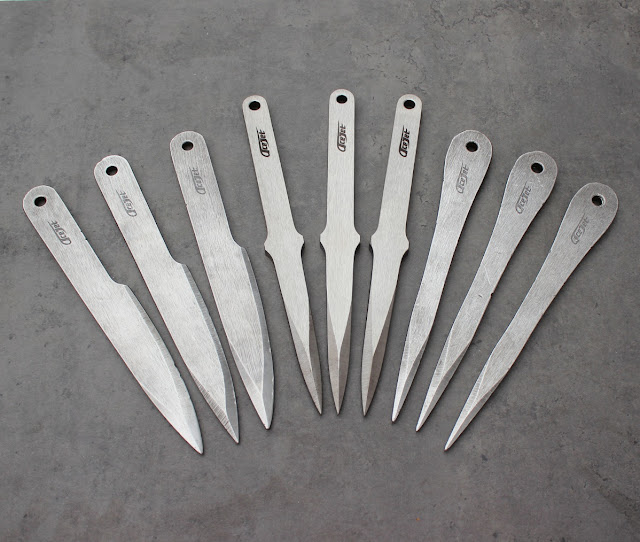
De nedersta knivarna, T1XL från polska Graf Knives var mina första något finare kastknivar. Överst T2 Bowie av samma märke

Men saker och ting ändras och en förändring som inleddes i maj med min träningssatsning var att jag gav mig tusan på att lära mig rotationskastning. Något jag aldrig bemästrat förut. För det ändamålet införskaffades också ett par set knivar. Allt inleddes förvisso med Spydercos Large Spyderthrowers som fanns i knivsamlingen sedan tidigare jämte en gammal UC. Men de knivarna har några rejäla brister. Därefter blev det Graf Knives modellerna T1XL samt senare T2 Bowie, jämte Condor Dismissal och sist de underbara Woodpecker från Pierre Cazoulat

Knivar som är excellenta för No spin även om Bug Osetr TZ till höger även är utmärkta för rotationskastning. De kommer från franska Biting Metal. Till vänster AceJet Stinger


Nu går det bättre kan konstateras. Det är också den här tekniken och i disciplinen "walk back" jag tränar mest vid sidan av No-spin. Givet måtten på min trädgård har det blivit mycket precision på korta avstånd som tre och fyra meter de senaste månaderna. Jag måste nämligen ut i skogen för de längre distanserna som behövs för såväl "walk back" som långkastning. Det får därför anstå till våren. Just nu kan jag inte kasta alls då vintern håller staden i ett järngrepp. 

De här franska knivarna från Pierre Cazoulat kallade Woodpecker är extremt bra för rotationskastning och är särskilt framtagna för disciplinen "Walk Back". 


Av det skälet är jag något osäker på hur många kast det här året kommer att sluta på då det trots allt återstår någon vecka. Men av vad det verkar kan det i princip summeras nu. Det är inte så svårt i mitt fall då jag tidigare tränat/motionerat på cykel och därifrån är van vid träningsdagböcker. En vana jag tagit med mig till kastningen. 

Därför har jag siffror på det mesta även om de inte är helt kompletta. Riktigt allt är inte räknat vilket innebär att det i praktiken kastats lite mer än vad som skrivs här. Jag började först efter det att jag köpt min första uppsättning AceJet-knivar. Innan dess kastade jag med de knivar jag hade från Hibben, UC, Max Knives och Spyderco.

Med det sagt är den första intressanta siffran det totala antalet som hamnar strax över 175 000 kast

Av dem står modellen Graf T1XL för hela 59 000. Anledningen är att de var det första riktiga setet jag skaffade. De senaste knivarna, AceJet Excalibur, har jag för övrigt inte ens hunnit inviga! I september var det tydligen bra väder för då avverkades mer än 28 000 kast under 69 timmar vilket är rekord så här långt. Den totala tiden jag spenderat med kastknivar i handen den här säsongen är ca 375 timmar

Det är siffror som jag är fullkomligt övertygad kommer ryka all världens väg nästa år. När jag bestämmer mig för något brukar jag bli tämligen bra på det. Och nu har jag gett mig tusan på att jag skall bli bättre på framförallt på No-spin men även rotationskastning med inriktning på fasta tävlingsdistanser som tre och fem meter samt Walk back i båda disciplinerna. Därtill ämnar jag fördjupa mig i backhandkastning, underhandskast och andra roliga varianter. Det finns hur mycket som helst som lockar. 

Sedan kommer det förhoppningsvis ett SM nästa år om nu inte pandemier och annat skit ställer till det. Där ämnar jag dyka upp, var så säker!


J - eder digitala kastare

Review - Civivi Lumi

 - almost Scandinavian simplicity

Designer and knifemaker Justin Lundquist is known through a number of collaborations with well-known knife brands such as Kizer, Kansept, and not least WE-Knives. WE have recently released a number of smaller knives signed him such as AngstBlack Void, and Eidolon.

But it can not be ignored that WE-Knives are not among the cheapest of brands. It has therefore been a while before any of his designs were more accessible to those with not quite as spacious wallets. This is where WE's sister brand Civivi comes into the picture. This is the first model released by Lundquist under their direction. The knife has been named Lumi and it is the one I will present here.

Civivi C20024-3 Lumi


There is no doubt about who designed this knife for those who are familiar with his design language. A knife that it directly reminds me of is, for example, an older collaboration between Lundquist and Kizer that resulted in a knife called Feist.

His style fits very well with the smaller type of pocket knives that Civivi often makes. One thing that characterizes Lumi is that it is straightforward. By that, I mean that it is not a knife that can handle "everything". Something that can be nice as a change at a time when marketing departments sometimes go a little too far when it comes to how to formulate sales texts regarding folding knives.

This is a dedicated EDC knife that can also be seen as a "gentlemen's knife", whatever that is. But a knife clearly leaning more towards the package opening side of the spectra than the bushcrafting side, so to speak. 

Sharp and pointed is how this blade can best be described


Twitter version: Civivi Lumi, a real pocket scalpel. Razor-sharp edge and needle tip for the smaller chores in everyday life that need a knife.


Blade


The blade on Lumi is a drop point but a very pointed one. A fact that is hard to miss. The length is 65 mm and the height is a modest 17 mm at most. The thickness matches the otherwise modest dimensions with its 2 mm. A small and slender knife blade in other words. In addition, it is equipped with a nice stone-washed finish and is almost as discreetly marked as all knives from Civivi. I wrote "almost" because here, unusually for them, you find a logo, although not Civivis but Lundquist's "J". Which brand it is about can, as usual, be indicated by the stylized c on the head of the pivot screw.

Lumi boasts a thin needle-sharp drop point blade


The steel Civivi has chosen is in my opinion well adapted to the price range and area of use. This is a piece of Swedish Sandvik 14C28N. It is dedicated knife steel that was developed together with Kershaw once upon a time. The features are recognizable from the simpler 12C27 it is based on but are better in all respects. Above all, it can be said to be very stainless at the same time as it takes a good edge and is easy to sharpen.

Speaking of sharpening, the factory edge was as usual with Civivis knives excellent straight out of the box. In this case, the edge is helped by the fact that the blade is very thin from the beginning and that it is nevertheless provided with a hollow grind. A really good choice for this type of knife as it gives a knife that cuts really well. Not in very rough materials, but that's not what this little knife is meant for anyway.

On the lock side, you find Justin Lundquist's logo


Extra competent is of course the tip, which is needle-sharp. However, it is not something you use to pry with. But in return, it is excellent for things that require precision. Not least to remove metal shavings from fingertips and palms.* For the same reason, it is good for all penetration that does not require brute force. Something that is a good property when that tough plastic around cheeses is to be removed, for example. And, yes, that is a very common task in my household. 

The small blade also cuts excellently in cardboard, tape, string, and similar things that a knife like this can be used for. The fact that the blade is thin and also hollow grind gives, as I said, good cutting properties. It feels especially when you shred boxes and the like. Theoretically, you could use this as a small peeling knife in the kitchen but it is not something I recommend. Otherwise, the blade is too small for kitchen chores.


Handle


This handle is characterized by Lundquist's deceptively simple design language. The soft lines and the slim shape hide more work than you might first be tempted to believe. This slightly streamlined handle is not flat or straight anywhere. To begin with, both ends are rounded as can be seen. All edges are also beveled or slightly broken.

Then the handle sides themselves curves both longitudinally as well as having a curved cross-section. To further enhance the rounded feel, the frame rises slightly over the sides around the entire handle.

A deceptively simple handle that fits well in the hand


The material used in the sides is G10, which in addition to being well rounded, has a quite smooth finish. Very comfortable to hold but nothing that provides enough grip in a fish factory. The sides have a single depression and this is the groove milled for the clip. It is centered to enhance the visual impression of symmetry. There is also the only screw that holds the knife together in addition to the pivot screw. The screw head is exemplarily countersunk and does not protrude.

The knife is open in the back and the steel frame is heavily lightened on the inside


The screw goes through a nice hourglass-shaped stand-off. The knife is otherwise completely open in the back. The steel frame that makes up the knife body is well machined. All edges have been rounded and sanded exemplary without exception. Civivi does not miss such details. In addition, the frame is really drilled out or perhaps rather milled out for lighter weight. I am grateful for that because the knife nevertheless has the balance shifted towards the handle. Something that in itself does not play such a big role in a small knife. 

The handle is not large but still holds almost all four fingers thanks to its soft shape


Lumi has an almost Scandinavian simplicity in the handle shape. Think of a slimmer version of a Mora No 1 and you will understand what I mean. For that reason, there are no limitations at all on how the knife can be held. It's up to the user. The clip could be a problem, causing hot spots, but because the knife is so small, it usually slips away in the hand. On the contrary, the clip almost helps to fill the hand better. The only thing that sets limits on how this handle can be used is the size. With a length of about 8 cm, I can just place all my four fingers there, but then a bit of them protrudes outside the handle. The handle is quite exactly one centimeter thick and 21 mm high. It is rather small in terms of volume in other words.

As mentioned, the actual material in the sides does not help with traction as it is semi-polished. But in return, neither this, finger guards, "jimpings" or anything else is needed for this format. If you want to do penetrating cuts with the tip, you simply place the back end of the handle against the palm of your hand and push. 


Opening and Lock


The opening mechanism on this knife is not completely intuitive. Firstly, the placement of the flipper is not the most common and then the size is very modest, even for being a "front flipper". If you look at the knife from the side, the flipper tab is actually difficult to see. It only protrudes one and a half millimeters from the handle and most of it is grooves.

Lumi probably offers one of the market's most discreet flipper tabs


The function is good but it requires certain habituation to be able to be used. To begin with, it's if not impossible so at least very difficult to use with the index finger. Here, instead, it is required that you place the knife on the side and hit the flipper tab with your thumb. A bit like using a lighter. In return, the blade really moves when you do it correctly. Despite the blade's modest weight, it comes out with impressive speed. Some of it is explained by ceramic ball bearings. Something that Civivi often uses. In such a small knife aimed at the EDC segment, I do not mind that finesse. By the way, the well-tuned "detent" ball is in the same material.

A well-made lock but the small line that appears on the lock bar is less fun


A small depression in one of the handle sides reveals some grooves that belong to the lock bar of a liner lock. It's fairly easy to access even if they kept the recess to a minimum so as not to ruin the beautiful lines on the handle. But it is large enough to function as the lock bar is only 1.5 mm thick and thus does not offer much spring tension. However, the function is excellent. The blade feels solid without play in any direction, it can handle a bit of pressure from the wrong direction without the lock bar starting to move and it engages with about thirty percent. In other words, there is room for the lock to wear in without problems. 

Then it remains to be seen if this particular specimen can be worn at all because a defect was discovered when I edited the pictures. Namely, it is barely visible to the naked eye, the thin line that has arisen in the lock bar when the detent ball was pressed into place. It appears to have cracked the steel. It is not something that is noticeably so far, but it is also not something you want to see in a lock. It can't be trusted! I intend to contact Civivi in the matter.


To Carry


Civivi Lumi is a knife that is simply perfect to carry. The shape, size, and weight are factors that contribute to it. A length of 9 cm and a weight of 59 grams. Everything in a streamlined cigar-like package is just great in that respect.

As usual, the Civivis standard clip is very good in terms of function


Especially not as the material under the clip does not make the knife catch on the way up or down in a pocket. The sleek format also allows you to remove the clip completely and carry the knife loosely in a pocket. In comparison, it is no bigger than an old Barlow or a small Swiss Army knife. 

None of the knife itself is visible when in a pocket


The clip is one of Civivi's standard ones which in this version works well as usual. The only thing that could be improved is the visual impression. A straight milled titanium clip that accommodated the handle would have been nicer. But you will find it on the WE knives instead.

Here you get an excellent feature at a lower price. The ramp is good, the tension well-tuned, the space underneath is adequate, and not least, they used screws with flat heads countersunk in the clip itself. This means that the entire space under the clip can be used. In addition, it is a "deep ride" clip that basically hides the entire knife when carried. The look is well in line with the rest of the knife's appearance as well.


To Conclude


Civivi Lumi is an honest knife. By that, I mean that it does not pretend to be something it is not. This is a small knife intended for the small tasks of everyday life. Someone claimed on Youtube that the tip is too delicate for them to dare to use it for anything. There is something in the criticism but I do not completely agree. Rather, some caution is enough. Don't use it as a pry bar or twist the blade when cutting into stuff. With that, I want to relate to what I said initially. This is not a knife for all chores.

Instead, it is a small slicing machine made of proper materials and with the usual Civivi precision. Also in Lundquist's typical stripped-down style. 

Lumi is a good EDC knife in the smaller format


That concept includes an intricate handle with a deceptively simple appearance and a matching blade. The overall shape makes me suspect that Justin took inspiration from Scandinavian Puukkos. Something that I only see as positive.

The flipper action on this knife is a bit special. An impression that was reinforced when I lent the knife and noticed that several people who are not very used to knives actually do not know how to open it. Once you get used to it, the opening mechanism works great. It is both quick and reliable.

So is the lock, reliable, even though this specific knife was probably made on a Monday since a crack was found in the lock bar. Otherwise, the fit and finish are excellent as so often with knives from Civivi. Both frame and handle material are finely shaped and polished and the blade is well sharpened and centered.

Civivi Lumi 


Thus, it can be stated that for those who like Justin Lundquist's design paired with Civivis quality, Lumi is an excellent alternative as a small pocket knife. It is sharp, easy to carry, and above all damn good-looking. If you do not appreciate the aesthetics, you are either blind or have bad taste. Jokes aside, the look is clean and elegant and if that is something that appeals to you, this is a hit. For the rest of you, Civivi has a very comprehensive catalog to botanize in.


Specification:


Length Open: 155 mm
Length Closed: 91 mm
Weight: 59 g
Blade Length: 65 mm
Blade Thickness: 2 mm
Blade Steel: Sandvik14C28N, 58-60HRC
Handle Material: G10
Lock: Liner lock

Produced by: Civivi, made in China


/ J

Metal shavings are something you end up within your hands if you are a knife thrower. It is in the nature of things.