Visar inlägg med etikett Canvas Micarta. Visa alla inlägg

torsdag 18 juni 2026

New Knife - Joker Bush Camp Knife

With the good first impressions from the Ranger I previously presented in the back of my mind, I felt that it was necessary to test at least one more knife from Joker's modern segment. And to continue on the path chosen, I aimed at another outdoor knife. One that could act as a complement or sometimes a replacement for the Ranger, I thought.

The choice fell on the Bush Camp Knife. Now it must be said that this is a knife that is, how should I put it, tangible! It is big and sturdy. A knife that does not apologise for itself. A knife that is intended to be used as a "camp knife", as it is called in English. Or instead of a small axe, one might think up here in the north. However, the idea is not new; even at these latitudes, the Sami have their stuorraniibi (a direct translation from Saami to English is "large knife"), for example.

The knife comes with a sturdy leather sheath and some extra paracord.


But this particular piece comes from Spain; it is both designed and manufactured in Albacete. It may be important to point out that today, when origin marking rules can vary.*

Bush Camp Knife measures 340 mm in total length, of which the drop point blade accounts for 200 mm. The knife is of full tang construction, and the thickness of the material is 6 mm. In other words, you are not likely to break it in the first place. Especially not as the blade is 45 mm high. The blade has a high flat grind or a high sabre grind if you prefer. The steel is Böhler N695. A slightly tougher relative of the N690 often used in folding knives.

Joker Bush Camp Knife 


The weight is 485 g, which gives it enough mass to be a good cleaver. At the same time, the knife is well balanced with the balance point just in front of the handle, so the knife feels nimble and lively despite its size.

To round off the package, Bush Camp comes with a sturdy leather sheath. The Spaniards know how to make one, it can be noted at this point. The sheath is made of strong, quality leather and is sewn with double seams. The knife is made to be worn both high on the belt or a little lower in an extra loop. Since the belt loop is attached with press studs, it is easy to switch between them or if you want to remove the knife from the belt without taking it off.

Just like the previous Joker knife, this one feels extremely solid. I'm thinking of build quality. The finish on the blade is well done, the factory edge is good, the transitions between the materials in the handle are excellent, and, not least, the sheath exudes quality. An extra bonus that can't be seen in the picture is that the knife is so well-balanced.

For these reasons and many more, I'm looking forward to testing this Spanish knife as well. A report will follow!


/ J - goes for a double


* The Bark River Knives scandal echoes in the back of my mind as I write this.

#knivesandbikes #knivigtvarre

måndag 15 juni 2026

Ny kniv - Joker Bush Camp Knife

Med de goda första intrycken från den av mig tidigare presenterade Ranger i bakhuvudet kände jag att det var av nöden tvunget att testa minst en kniv till från Jokers moderna segment. Och för att fortsätta på den inslagna vägen valdes ytterligare en friluftskniv. En som skulle kunna agera som komplement eller ibland ersättare till Ranger var det tänkt. 

Valet föll på Bush Camp Knife. Nu skall det sägas att det här är en kniv som är, hur skall jag formulera mig, påtaglig! Den är stor och rejäl. En kniv som inte ber om ursäkt för sig. En kniv som är tänkt att kunna användas som "camp knife" som det heter på engelska. Eller istället för en liten yxa skulle man kanske tänka här uppe i norr. Tanken är emellertid inte ny ens på de här breddgraderna, samerna har sin stuorraniibi till exempel.

Kniven levereras med ett kraftigt läderfodral och lite extra fallskärmslina


Men just den här pjäsen kommer från Spanien, den är både designad och tillverkad i Albacete. Det kan vara viktigt att påpeka idag när ursprungsmärkningsregler kan se lite olika ut.* 

Bush Camp Knife mäter 340 mm i totallängd varav drop point-bladet står för 200 mm. Kniven är av fulltångekonstruktion och tjockleken på godset är 6 mm. Med andra ord lär du inte bryta av den i första taget. Särskilt inte som bladet är 45 mm högt. Bladet har en hög flatslipning eller en hög sabelslipning om man föredrar det. Stålet är Böhler N695. En något tuffare (segare) släkting till det i fällknivar ofta använda N690. 

Joker Bush Camp Knife 


Vikten är 485 g vilket ger tillräckligt med massa för att utgöra en bra huggare. Samtidigt är kniven välbalanserad med balanspunkten precis framför handtaget så kniven känns kvick och livlig trots formatet.

För att runda av paketet så kommer Bush Camp med ett stadigt läderfodral. Spanjorerna vet hur man gör ett sådant kan konstateras vid det här laget. Fodralet är gjort av kraftigt kvalitetsläder och är sytt med  dubbla sömmar. Kniven är gjord för att kunna bäras både högt på bältet eller lite lägre i en extra ögla. Då bältesöglan är fäst med trycknitar är det lätt att byta mellan dem eller om man vill avlägsna kniven från bältet utan att ta av sig detsamma. 

Precis som med den förra kniven från Joker så känns den här synnerligen gedigen. Jag tänker då på byggkvalitet. Finishen på bladet är väl utförd, fabrikseggen är god, övergångarna mellan materialen i handtaget är excellenta och inte  minst utstrålar fodralet kvalitet. En extra bonus som inte går att se på bild är att kniven är så välbalanserad. 

Av de skälet och många till ser jag fram emot att testa även den här Spanska kniven. En rapport kommer därefter!


/ J - kör en dubbel


* I bakhuvudet ekar skandalen med Bark River Knives när jag skriver det här. 

#knivesandbikes #knivigtvarre

torsdag 6 november 2025

Ny kniv - Buster FG

Det finns inget diskret sätt att uttrycka det, Buster FG är en förbaskat stor fällkniv! Den ko mer från  Civivi och är designad av Snecx Tan. Något som kan anas dels på likheten med en annan modell från Civivi kallad Vision FG och dels på den på ryggen uppstickande låsarmen som är typiskt för "Super Lock". En låsvariant utvecklad av Snecx själv.

Civivi Buster FG


En markant skillnad mellan modellerna är dock storleken. Där Vision är en normalstor EDC-kniv så är det här en bjässe. Eller vad sägs om en kniv som mäter fjorton centimeter i fickan och med en totallängd som närmar sig tjugofem centimeter utfälld? Mer exakt 245 mm varav bladet utgör 107 mm. 

Det är med andra ord en gigantvariant av en Sheepsfoot som uppenbarar sig när kniven öppnas. Stålet som används är tyskt Nitro-V. 

Kniven är relativt lätt för att vara så stor men det går inte att trolla bort den ingående mängden stål  i bladet varpå vikten ändå hamnar på 176 g. Buster FG är dock mycket välbalanserad så grammen känns något mindre än vad de borde. 

I öppet läge avslöjas ett av de största Sheepsfoot-blad jag sett


Handtagsmaterialet är i det här utförandet grön linne-Micarta. Vad finns mer att tillägga? Jo, att kniven har exceptionellt mjuk gång. Något som vi förvisso är bortskämda med från Civivi. Men här får god byggkvalitet hjälp av keramiska kullager och inte minst fysik. Ett tung blad och ett lätthanterat lås gör att det här är en veritabel fingergiljotin. Det gäller att hålla bort fingertopparna när man stänger kniven. 

Det kan också sägas att kniven kan öppnas och stängas med låsfunktionen förutom tumknopparna som annars är tänkta för det. 

Överlag är det här en rätt djärv design som understryks av de tilltagna måtten. Nu skall den bara användas också så återkommer jag med en rapport om hur det utföll. Om jag nu kan behålla fingertopparna vill säga. 


/ J - slår på stort

#knivesandbikes #knivigtvarre

måndag 4 november 2024

Review Viper Orso 2


-  a sequel for those who prefer frame locks over liner locks

It's time for a closer look at a model called Orso 2 from Viper Knives. What makes both this review and the knife somewhat special is that there are already a couple of knives on the market that it strongly resemble and are also made in Maniago, Italy.

It's hard not to relate to them as I own all three and the same designer is behind the knives.

Viper Orso 2


Of course, I am talking about one of the Danish giants in the field, Jens Ansø. The other knives are the Fox Ziggy, a series-produced version of a custom knife of the same name. But then we come to knife number two, the MKM Goccia. It is seemingly even more similar to this knife with its milled pattern Micarta handle, flipper tab, and overall flowing lines.

But there are of course differences. If we talk about materials, there are no less than eight different versions of Orso 2 at the moment. So this look is more down to my taste than everything else, I happen to like Micarta. Then the blade steel is not the same in the two knives. The biggest differences, however, are found in the design of the blade and lock construction. To confuse, however, Orso (1) can be thrown into the mix as it, like Goccia, is a liner lock.

That hardly made anyone the wiser, so let's study Orso 2 more closely.

Orso 2 is a knife designed by virtuoso Jens Ansø


Short version: Viper Orso 2, is a solid addition to its predecessor for those who prefer frame locks over liner locks.

Blade


The blade shape is one of the two things that set this knife apart from the other knives listed. In this case, we have a "straight" blade. That is, the back is neither sloped nor cut off in any way. In addition to changing the appearance, it means that the tip is found higher up than otherwise and that the belly becomes longer and in this case more sweeping.

The rest of the appearance is characterized by a well-executed semi-polished stone wash. As usual, the Viper logo and model name are found on the blade. Some people think that the text is too large, but I would like to add that it is designed so that in many angles it is barely visible at all. On the opposite side is the Ansø logo and steel type.

Orso 2, has a completely straight blade spine, which is unusual


A steel that is actually completely new to me. The designation is LO-QPM20-4 and it is a powder steel of some kind. From what I understand, it should belong to the same family as the M390 and 20CV. A quality steel in other words. It is reportedly hardened to 59-61HRC which sounds good on paper.

The Orso 2 is not an entirely small knife with a blade that measures 87 mm in length. The height is exactly one inch, 24.5 mm, and the material thickness is a whopping 4 mm. A solid blade in other words. Now, the blade is basically completely flat ground, a small flat surface is found closest to the ricasso. But despite that, around 0.6 mm of steel remains behind the edge. That is very robust. I don't know why they chose to go down that road. A powder steel should theoretically have no problem being made thinner. Especially not as this is not a chopper of any kind but a folding knife.

The blade is made of a rather uncommon steel with the designation LO-QPM20-4


Naturally, such choices affect how well the knife cuts. It's not that it isn't sharp, the edge is good and it was straight out of the box. But it is more sturdy and durable than filled with finesse, so to speak.

Now it is matched for every part of the handle and the lock, so it is not completely bad. But it moves Orso 2 away from office use and closer to outdoor use, to use somewhat sweeping terms. That's actually where I appreciate it the most. Of course, it cuts tape, cardboard, and paper when needed. But it is when you approach thicker ropes, heavier plastics such as wide cable ties, and above all wood that it performs best.

At first glance, the Orso 2 might not appear to be a "bushcraft" knife, and it isn't. But it is not bad for more demanding outdoor tasks. In addition, both the blade and the handle are strong enough, and, not least, the robust edge does its job in those contexts.


Handle


Orso 2 has a rather lavish handle. What makes me say that is not the two materials although the canvas Micarta on the presentation side is of good quality. Instead, the comment stems from the fact that a lot of processing time is spent on the handle.

Alongside the handle side, there is a pattern in the form of four lines that underline the look of the knife. They also reappear on the titanium side and thus bind the two sides together. It also has a finer basic pattern that is a bit reminiscent of Micarta. However, it is so subtle that it is almost brushed away.

The presentation side is in this case Canvas-Micarta


Otherwise, the knife is softly rounded, with no flat handle sides. Some effort also went into the back spacer. It covers approximately half of the back and is somewhat "floating". It also features a hole for a lanyard. 

The two sides are connected by an advanced-shaped backspacer


The length of the handle measures 12 cm, of which the grip surface is 10 cm and the height varies between 20-25 mm. The handle has no frame, but the two sides are screwed from two sides via the back spacer in three points in addition to the pivot screw. The size of the bolts is T6, while tougher T8 heads have been used in both the pivot and fastening screw for the clip.

Orso 2 has a well-thought-out handle


In hand, the Orso 2 is really comfortable. The curvature of the back of the handle follows the hand well and there are no sharp edges or corners to disturb that impression. Even the clip works well as the back end is a bit into the handle and the tip is parallel to the side of the handle. This means that it integrates well with the handle and rather contributes to making the grip fuller than creating hot spots. 

The thickness is 12.5 mm, which makes the handle full.


Opening and Lock


Orso 2 is not exactly trendy when it comes to opening methods. This knife opens with a flipper, period. You may be able to get the blade out with two hands but it is cumbersome as not much of the blade is available to grip.

The flipper works well but may not be the fastest on the market. This is partly because the blade is relatively heavy and partly because Orso follows at least one, and in my eyes healthy, trend. It is to generally make flipper tabs smaller. This way you don't get as big leverage but, on the other hand, better-carrying comfort and as a bonus, better looks. 

The flipper tab is small but works


The flipper tab is not only discreet, but it also lacks grooves. But the shape is distinct enough to give decent friction anyway.

Then it can be added that it is actually possible to get some kick to the blade, but you have to "pre-tension" the finger to do so. The knife itself is not fast unless the user is, so to speak. It can also be said that this tab can only be used in one way and that is by pulling straight back. All other techniques are doomed to failure.

Another detail that makes the blade more nimble is of course the ceramic ball bearings. Even so, the blade does not fall into place under its own weight when the knife is closed. The tension from the lock bar is too high to allow that. 

The frame lock comes with an overtravel stop and a lock bar steel insert 


The lock bar is not quite easily accessible. There is a small recess on the opposite side but no more


The lock is a fairly sturdy frame lock. However, it was noted during the test period that it can be very dependent on the pivot screw being tight. It loosened slightly at one point and the lock became unreliable. It didn't lock securely at every opening and there was also some lock slip because it locked with very little contact area. After adjusting the pivot screw, the function was excellent.

The lock bar now falls into place and stays there. The blade sits firmly without play in any direction. However, the lock is not completely easily accessible. Certainly, the opposite side is slightly recessed but the lock bar itself is slippery. There is potential for improvement in this area.


To Carry


For being around twelve centimeters long when folded and a full 1.2 cm thick, the Orso 2 is nice in a pocket. Much of it is due to the fact that the thickness is hidden by the sides not being flat but contoured.

Then the knife does not weigh very much for being a full-size knife where both the lock side, back spacer, and clip are made of metal. The total weight is 125 g, which should be set to a blade length of nearly nine centimeters.

Orso 2 comes with a milled titanium clip


The fact that there is no distinct pattern under the clip makes it easier to pull the knife or put it back. Especially since Viper chose the more stylish solution with the cut-out in the lock bar on the inside instead of on the outside. This avoids the edge that otherwise occurs.


The function of the clip is excellent for being of this type


Orso 2 has a milled titanium clip. The function is not bad at all with a decent ramp and adequate tension. This allows you to thread the clip over most fabric edges and the knife stays in place. It is also a clip that aesthetically follows the rest of the design language, and it is also comfortable when gripping the knife.

However, the latter brings with it a disadvantage and that is that much of the knife is visible when in a pocket. The clip is attached with only one screw, a solution that works perfectly because it is recessed in the titanium. But this means that it's positioned a bit up on the handle, which provides comfort since the back end of the clip ends up inside the hand.

If you want to be positive, you can also say that there are plenty of knife to grab when it is to be grabbed. 


To Conclude


At first, I was actually a little puzzled when this knife was released. Not only because it is a sequel to an already existing model, Orso, but also because it is quite similar to two more knives in my collection as I mentioned before. But then I grasped the concept, both figuratively and literally.

Part of the difference lies in the handle. This is a knife for those who prefer frame locks over liner locks, that is obvious. But that is still not the biggest difference between the models.

Namely, it is found in the blade shape. The others have features of the undulating lines that Ansø used in its early models. It is most obvious on the blade spine. However, this does not apply to Orso 2. Here, the back is completely straight.

Orso 2 is a knife for those who like straight blade shapes and frame locks in titanium


It actually gives slightly different user characteristics as it affects how the edge or rather the belly behaves but above all where you find the tip. In this case, very high up. Among other things, this makes sweeping cuts easier, while at the same time, you have to angle your wrist properly if you want to use the tip in certain cases. 

Then in this knife is found an exciting and for me new German steel which is said to belong to roughly the same family as the M390/CV20. As for that, I can only read steel compositions and am not knowledgeable enough to find out if it is correct. As for practical use, I can say that the steel is really good. It stays sharp for a long time, can be stropped when it has lost the outermost sting and it has not got any rust spots despite varying weather conditions during the test period with some rain.

The latter feels important as the Orso 2 is definitely a knife that I want to use outdoors. To me, this is almost more of a folding outdoor knife than an EDC knife. Especially as it belongs to the larger-sized medium knives if you can put it that way. But a solid lock and a slightly fuller handle entice, in addition to the blade, to use the knife seriously.

An early morning with a cup of coffee by a lake and a good companion in Viper Orso 2


Then the fit and finish, as usual with knives from Viper, is outstanding. The edges that are present are rounded as they should be. The lock works without complaint and the blade is centered. The Micarta also ages with dignity, which is excellent.

Orso 2 also offers some small details that indicate that some extra time was spent during the manufacturing process. This applies to things like the rounded blade spine, the titanium collar around the pivot screw, and the complex back spacer.

All in all, this results in a well-built knife that corresponds to the stylish design from Jens Ansø. Orso 2 is therefore a superb companion for your upcoming adventures.*


Specifications:


Length Overall: 208 mm
Length Folded: 121 mm
Weight: 125 g
Blade Length: 87 mm
Blade Thickness: 4 mm
Blade Steel: LO-QPM20-4, HRC 59-61
Handle: Canvas-Micarta
Lock: Frame Lock

Produced by Viper Knives, made in Italy


/ J 

* The price level is somewhat difficult to comment on as it is usually just over two hundred Euros, but when purchasing this knife and when the text was published it was sold out for around 160€.

tisdag 15 oktober 2024

Review MKM Makro 2


- a first contact with a fixed blade knife from MKM

Although the Makro 2 is a knife that measures by a good margin under twenty centimeters when it stretches out to impress, it is larger than its predecessor, which was consistently named Mikro. Both models come from MKM.

These knives aim at an interesting segment, fixed-blade EDC knives. Knives small enough to carry around without feeling clumsy or making those around you think you're a terrorist while being sturdy enough to tackle most daily tasks.

A semi-hidden jewel from Italian MKM


Our Danish friend Jesper Voxnaes. is the man behind the design. He hardly needs any introduction at this point as he is in the middle of a long and successful career. Sometimes together with one of the other Danish giants Jens Ansø and sometimes by himself as in this case.

Teaming up with the Italian Maniago Knife Makers is a very good idea as they account for much of the craftsmanship accumulated in Maniago. Especially as it is a conglomerate of several large manufacturers. In addition to their own brands, they produce knives under the name Mikita whose brand is MKM. On folding knives, that information is usually found inside the handle. Here it can be read on the underside of the same.

MKM Makro 2


Short version: MKM Makro 2, a knife whose name does not describe measurements and proportions but how it performs, is big and with an overview.


Blade


MKM describes the blade as a sheepsfoot on the website. I can almost agree with that if you add "modified". Here it is not the spine of the blade that swings downwards as on a genuine sheep foot, but actually the edge that swings upwards in a constant arc until it meets the inversely cut tip. The blade type has sometimes also been called "reverse tanto" in Anglo-Saxon terms.

It is simpler with the sister model Makro 1, which is simply a drop point. There are thus two blade types to choose from.

The suffix "2" to the name means that the knife has a sheepsfoot blade


As I said, the knife is not large and the blade measures only 7.3 cm in length. It is 27 mm high at the base and then quickly tapers to about 14 mm where the angular tip is. Then I think that a misprint has appeared on the website which claims that the blade is as thin as 2.5 mm. I have two calipers, one digital and one manual, both of which claim it's a full 4 mm thick. A sturdy piece of metal in other words.

It is also noticeable on the edge, because even though the flat-ground primary bevel is approx. 20 mm high, the blade is around 0.6 mm behind the edge. Very sturdy, but perhaps not the one that cuts the best.

The material used is Böhler M390. A frequently used steel in folding knives but somewhat less common in fixed-bladed knives, the fact is that this is my first encounter with that combination. In this case, I don't think it causes any problems whatsoever. You may want a tougher steel in a large chopper, but here we are talking about a small knife for everyday use. It doesn't need the same toughness. 

The M390 is quite resistant to rust and keeps the sharpness if not forever for a very long time. In addition, it is not completely hopeless to sharpen. A very fine steel in other words and there is a reason why it is found in many exclusive folding knives.

The blade is stone-washed and the knife is marked with MKM's logo on one side and Voxnae's on the other. 

"The other side" offers Voxnae's logo


In use, the Makro 2 is just as likable as it looks. The handle that I will return to is excellent. That together with a competent blade that can handle most tasks makes me happy. If we start with the tip, it is both sharp and strong at the same time. This means that it works perfectly for both smaller and larger penetrating cuts. It is possible to both pry a metal splinter out of your finger and puncture a thick plastic can with accuracy.

Regarding other materials, it can be said that the small blade literally eats cardboard and the like for breakfast. The full flat grind makes it easier and the design means that you work close to the hand where you have the most power. Then the cuts naturally become more of a "push cut" nature due to the length of the blade. But there the fine steel means that the knife bites well also without sweeping movements.

Even when it comes to, for example, cutting nylon rope, Makro works excellently as the robust format allows you to use a little weight behind the cuts. Overall, this is a handy little bugger.


Handle


The Makro knives are full tang knives and the steel runs visibly with full thickness through the entire handle. On the outside, you find handles slabs that can be had in a few different variations and you can actually leave them out as well. In this case, it is canvas-Micarta and if you don't like it, the knife can be had with G10, carbon fiber or wooden handle as well.

This version has handle sides in Micarta. They can be removed for those who want an even thinner and lighter knife


I chose micarta because I have a weak spot for the material. It is durable at the same time as it gradually acquires a patina and thus ages with dignity. Here it is exemplarily done with good quality material, which is beveled with smooth edges. The sides are also nicely rounded. In other words, some machining time has gone into this knife.

The sides are screwed in place with two T8-type bolts. Around the front is a decorative collar ring of anodized titanium.

Makro is a full tang knife with well-polished edges. No sharp corners here


For being this small, this handle is really comfortable. The question is whether I should go so far as to say that the ergonomics are great. Then the question is how I should relate to other small knives with even better handles on that parameter.* But as long as you don't engage in carving or what is often called "bushcraft" these days, everything is fine.

For all tasks that do not require as much power, this is an excellent knife, as I said before. When an IKEA sofa arrived during the test period, a lot of cardboard was cut on that occasion, among other things. The packaging material would not have gone into the recycling room otherwise.

A large little knife, so to speak


The grip is built around the enlarged recess for the index finger. Once there, everything else falls into place. Or everything, by the way, mostly the rest of the fingers. The knife is best in a saber grip with the thumb on the intended grooves on the back of the blade. But hammer grips and reverse grips also work well.


Sheath


The sheath that comes with the knife is a bit special. However, it is not the material or the design that deviates from the usual. It's a fairly simple but well-stitched leather sheath. At the bottom, a connecting rivet is found. The color is black. Not much more to say about it.

The leather case is simple but sturdy


The sheath does, however, have a twist in the form of a strong magnet


Or it does. Firstly, it fits the knife well and it holds the knife in place in a decent way. That, in turn, is because of the more novel part of the sheath.

This solution is not completely anonymous when carried in a pocket


It can be carried in a couple of different ways, as the belt loop which consists of a simple leather flap contains a strong magnet.

Therefore, the Makro 2 can certainly be carried on a belt like most more traditional sheaths but also on the inside of a pocket. It is a very ingenious construction in all its simplicity. I personally carry the knife in a slightly different way. Either it lies loose in a compartment in my bag, in the jacket pocket as the knife is very small, or I have it inside a pocket as intended. In the latter case, however, the handle sticks up quite a bit.

Then it happens that I put it inside the belt in the small of the back in a scout carry as the knife is fairly flat, that works too. 


Conclusion


Since I have several knives from MKM, the expectations for the first fixed blade were pretty high. Fortunately, they were not only met but surpassed. This is an excellent little knife in a category that's fairly new.** Or maybe just popular again. People in all ages have used smaller knives to complement larger ones. 

This knife belongs to a growing group of knives, fixed blades for EDC use


It took me a while to find this little gem but I'm glad I did. MKM has skillfully managed a clever design. The materials are not only well chosen and of the highest quality, but they have also been very finely crafted. It shows in the blade finish and how nicely the handle is made.

MKM Makro 2 is an excellent little knife that I highly recommend


Then it must be admitted that I think it is a rather attractive knife. But above all, it is practical enough to match the expectations the appearance raises. This is simply a premium tool. It is reflected in the price as it is not completely cheap. The price is currently around 180-200€.

But with the Makro 2, MKM has created a great fixed-blade knife for EDC use. Small enough to fit in a pocket but big enough to handle most things. It is a knife that is therefore frequently found on my person.


Maniago Knife Makers


Specifications:

Total Length: 166 mm
Blade Length: 73 mm
Blade Thickness: 2,5 mm
Steel: Bohler M390
Weight: 66 g
Handle Material: Micarta
Sheath: Leather with a magnetic belt loop 

Produced by Maniago Knife Makers, made in Italy


/ J - size isn't everything


* An example of that is the Karesuando Knife Uraka. A knife with roughly the same blade length and an even more comfortable handle.

** However, it's a category that I appreciate and I have several knives of this type such as Necker 70, Scara 60, and PK70FX from Brisa, ESEE Candiru, ML Custom Blade Caper Knife, and more.

torsdag 27 april 2023

New Knife - MKM Flame Light

Small and pointy, you know dagger shape is it really THE most practical blade shape on a folding knife? Well, it's not, but is it pretty? Yes, it is! And for that very reason, I have this version of the MKM Flame Light. A knife designed by Michael Zieba.

If you don't like small knives with dagger blades, Flame Light is also available with a flat ground drop-point blade.

Maniago Knife Makers Flame, a Zieba design
MKM Flame Light


Otherwise, there is very little that has changed with the addition of "Light" to the name. Of course, the knife has become a few grams lighter because the titanium side is gone. The difference between the all-titanium version and this one is particularly noticeable. Then the weight has been reduced from 70 g to 55 g. In the versions that already have a presentation side in Micarta, the difference is even smaller as the starting point was only 59 g.

Mainly it is the lock that has changed. Instead of a frame lock, there is a liner lock that holds the blade in place. Something I don't mind at all. Any disadvantages that would exist are erased by the symmetrical appearance achieved with two sides in the same material. In this case, you can choose between three shades of canvas-Micarta.

Otherwise, the materials are recognizable as the pivot collar is made of titanium and the blade is made of M390 steel. The clip is somewhat simpler, made of spring steel instead of titanium as found in its slightly more expensive relative.

The length is just under 18 cm, 176 mm of which the blade measures 72 mm. A small knife in other words. But very pretty if I do say so myself! In addition, very well made it seems. A report will come sometime in the near future.


/ J - going for looks this time

#knivesandbikes #knivigtvarre

onsdag 15 mars 2023

Recension Viper Turn Essential


-  en modern tolkning av en klassiker har ömsat skinn

Dags för en orm igen. Närmare bestämt en huggorm i form av Viper Turn Essential. Jag tycker det känns som det var igår jag presenterade en kniv från dem men det kan vara för att jag bär italienska knivar tämligen ofta. 

Däremot är det faktiskt ett år sedan jag recenserade en kniv från det Maniagobaserade företaget och den var en fastbladad jakt/friluftskniv. En fällkniv signerad Viper Knives har jag inte recenserat sedan slutet av 2021. Därför är det hög tid nu anser jag!

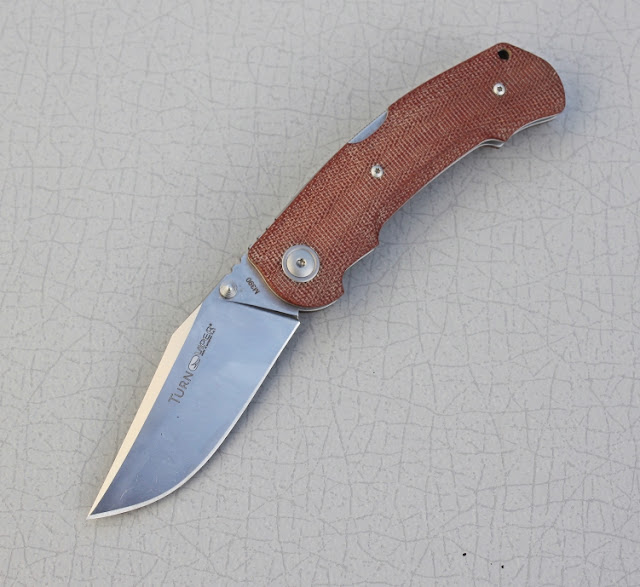
Turn Essential Brown Canvas Micarta
Viper Turn Essential


Det här är en tämligen ny modell för 2023. Eller det är inte riktigt sant. Snarare rör det sig om en variation av en kniv som funnits på marknaden ett par år. Om jag inte missminner mig presenterades original-Turn mot slutet av 2020. Men det är en kniv som har ett främre bolster, något som saknas på "Essential"-modellerna.  

Det här förfarandet är något som Viper praktiserat rätt länge. Först släpper de en modell, vanligen med bolster, därefter kanske någon lyxversion av den med exempelvis mönstervällt blad eller titanhandtag och därefter en något enklare variant av samma kniv. Redan relativt tidiga modeller som Timeless finns i versioner med eller utan bolster och detsamma kan sägas om exempelvis Gent, Key och Novis. Turn är således en av de senare att få den behandlingen. 

Nu innebär "basic" eller Essential i det här fallet inte någon direkt nivåsänkning i vare sig material eller byggkvalitet. Det är samma höga finish och omsorg om detaljerna och materialen är av högsta kvalitet i både blad och handtag. Sedan är förstås grundformen signerad Fabrizio "Silver" Silvestrelli densamma.

Turn är designad av Fabrizio Silvestrelli


Twitterversion: Viper Turn Essential, modernt och klassiskt i skön harmoni. En kompakt och välbyggd fällkniv i toppmaterial för skogspromenaden eller kanske som stadig fickkniv.


Blad


Drop point kallar Viper den här formen. Jag är inte riktigt böjd att hålla med. Om det är något som är en kvintessentiell clip point så är det den här kniven! Särskilt som den "klippta" delen av bladet förstärks utseendemässigt med en solid falskegg/swedge. Men visst, om man med "drop point" enbart avser att spetsen hittas under knivens våg- eller mittlinje så stämmer det. 

Bladet är inte gigantiskt men ändå stabilt med sina strax över åtta centimeter eller mer exakt 82 mm längd. Höjden uppgår som mest till 28 mm och det matchas av en tjocklek på 3,5 mm. 

Märkningen av bladet består av modellnamn samt logotyp på bladets presentationssida i klassisk Viper-stil. Det är inget jag tycker något särskilt om. De som vill se helt sterila blad får däremot titta bort. På samma sidas ricasso hittas även ståltyp. På motstående sida hittas Silvestrellis märkning. Finishen är en blank satin. 
Clip point
Åtminstone jag anser att det här är en clip point 


Ståltypen som hittas på bladet är den som Viper använder i alla sina finare knivar och det kommer från Böhler/Uddeholm och har den numera kända beteckningen M390. Ett stål som vid det här laget inte tarvar så mycket introduktion. Utan att gå alltför djupt in på teknikaliteter så är det, förutsatt det inte är för mjukt härdat, ett av de finare stålen som finns att tillgå för fällknivar. Rent praktiskt yttrar det sig som att det är rosttrögt, tar en mycket fin egg och framförallt, håller den förbaskat lång tid. Hårdhetsgraden uppges från Vipers sida till HRC 59-61. 

Turn Essential har en mycket hög, i praktiken helt flat slipning. Det enda som återstår som inte är slipfas är falskeggen och lite lite av ricasson kring tumknopparna. Den bit av ryggen som är kvar efter vad som närmast kan liknas vid en "harpun-spets" är kraftigt rundad på sedvanligt Viper-vis. Det ger en lyxig känsla och är mjuk att lägga tummen emot även om främre delen av låsarmen och bladryggen har fått sig en rad väl utförda räfflor.

Bladet har fått en blank satinfinish


Ett vasst blad med en schysst flatslipning brukar bita bra i det mesta och det gäller även i det här fallet. Särskilt gäller det vardagsmaterial som kartong, tejp, plastförpackningar av varierande tjocklek och hårdhet samt buntband och nylonremmar. Detsamma kan sägas om tamp och rep. 

Sedan märks det att stålet är bra då det är tämligen uthålligt. Till skillnad från några recensenter grottar jag inte ned mig alltför djupt i detaljer vad gäller stålkomposition. Jag noterar mer hur det uppträder dels initialt och dels över tid. Även om det senare kräver ännu längre användning än i det här fallet. Knivar som brukas behöver i vilket fall som helst slipas om efter ett tag. Med M390 behöver du i allmänhet inte göra det särskilt ofta. Särskilt inte om en kniv används som "EDC"/fickkniv. De nyttjas sällan några längre perioder i taget. Det är inte en styckarkniv eller liknande vi talar om. 


Handtag


Det är själva utseendet på handtaget som är den stora och för övrigt enda skillnaden mellan "Essential" och orginalversionen av Turn. Som nämndes i inledningen så hade den en konstruktion med ett främre bolster i titan vilket den här kniven som synes inte har. Istället sträcker sig ett stycke Brun canvas-Micarta över hela knivhandtagets sida. Gillar man inte den färgen på skollor finns även svart Micarta som närmast ser grå ut på bilder, två nyanser av G10 samt kolfiber att välja emellan även på Essential-modellen. 

Handtag i brun Canvas Micarta
Handtagssidor i Micarta


Micartan är av mycket hög kvalitet och därtill fint bearbetad. Det innebär i det här fallet att sidorna är lagom slipade, jämnt bearbetade samt att de är elegant välvda. Sedan är själva slipningen av ram och sidor väl utfört men trots det finns det några skarpa hörn med det är mer avhängigt designen än genomförandet. 

Sidorna är skruvade på plats med två små T6 skruvar med runda huvuden. Ett val jag kanske inte är helt förtjust i men i gengäld är skruvarna av hög kvalitet och Viper är fortfarande en av extremt få märken jag känner till som t o m skriver ut stålsort på sina skruvar på hemsidan. Utöver de skruvarna finns en justerbar pivotskruv som försetts med en lyxig krage av titan. 

Back spacen på den här kniven är gjord av polerat rostfritt stål som rundats ordentligt. I den och genom handtagssidorna återfinns ett litet hål som agerar fånglinehål. 

Även ramen är i stål och den har inte lättats något vilket tillsammans med låskonstruktionen gör kniven något tyngre än vad den behövt vara. Det förskjuter även vikten mot handtaget till. 

Ett mycket välbyggt handtag men kanterna kunde fått en kraftigare fasning för bättre ergonomi 


Komfort och ergonomi på den här kniven är en märklig trestegsraket. På bild och vid en snabbtest framstår kniven som utmärkt på det området. Storleken känns lagom, fyllig utan att vara överdriven, sidorna är som sagt formade, fingrarna hittar sina platser och ryggen är elegant krökt för att passa handen bättre. 

Men vid steg två upptäcks några detaljer att fundera kring. Första gången jag kände och klämde på den här kniven var jag faktiskt inte begeistrad alls. Tvärtom upplevde jag ett flertal hörn som potentiella problemområden/hot spots. Det gällde såväl främre som bakre "plattformarna" för pek- och lillfinger jämte bakkant av fingerskyddet samt clipet. Alla har distinkta avslutningar i form av kanter. För att försäkra mig om att det inte bara var jag lånade jag ut kniven till en god vän som tyckte ungefär detsamma. Dock lite annorlunda uttryckt. 

Handtaget fungerar väl så länge du inte skär för länge och för tungt


Därefter kommer steg tre, att faktiskt använda kniven. Och då är den helt ok igen! Visst alla kanter jag nyss räknade upp gör sig påminda. Men på något märkligt vis fungerar Turn Essential i alla fall. Vid vanligt hammargrepp hittar faktiskt alla fyra fingrar sin plats och kniven sitter säkert i näven. Det gäller bara att greppa "noggrant" om jag kan uttrycka det så. 

Detsamma gäller i ännu högre grad om kniven greppas i sabelgrepp. Då gäller det att avlägsna pekfingrer en smula, någon millimeter bakåt räcker, från fingerskyddet för att det inte skall kännas obehagligt. Därtill skall bakänden på kniven med tillhörande clip placeras på rätt ställe inuti handen varpå detsamma gäller där. Tummen hittar därefter naturligt till sina räfflor på bladryggen och kniven är bekväm att arbera med. 

Möjligen kan jag tänka mig att en del av de här detaljerna kräver mindre exakthet för den med mindre händer eller om du använder handskar. 

Men sedan bör påpekas att allt det jag skrev ovan gäller vid lättare användning. Skär man trä en stund så är övergångarna från handtagssidorna trots allt något för kantiga. Särskilt gäller det vid lillfingret men även vid tummen. Det är inte behagligt efter en stund. De delarna hade behövt en kraftigare rundning. 


Öppning och lås


Tumknoppar är det som gäller för att öppna Turn om man nu inte känner för att använda båda händerna förstås. Den klassiska stilen på kniven lockar till det sistnämnda. Det går dessutom mycket lätt då bladet trots att det är en back lock löper på kullager. Det är inte en helt vanlig kombination. Än, kanske jag får tillägga. Men det ger en mycket mjuk gång. 

Turn öppnas med tumknoppar som sitter tätt inpå handtaget


Pyramid shaped thumb studs
Den typiska pyramidformen ger en aning vassa tumknoppar


Knopparna är dubbelsidiga vilket tillsammans med låskonstruktionen gör kniven helt ambidextriös vad det beträffar de bitarna. Tumknopparna ja, de är jag inte helt vän med. De som är bekanta med lyxknivar känner igen formen från t ex CRK Sebenza. Det betyder i klartext att de är pyramidformade. Det ger förvisso mycket bra grepp mot tummen med de är baske mig inte bekväma att använda. Särskilt som de i det här fallet är placerade tämligen nära handtaget. 

Placeringen ger emellertid tillräckligt med hävstång vilket i kombination med lagren gör kniven lättöppnad. Särskilt gäller det eftersom motståndet som skall övervinnas på den här typen av kniv kommer från ryggfjädern och inte från en traditionell "detent-kula". 

Ett sätt att undkomma den skarpa spetsen är emellertid att vrida kniven i handen och istället för att placera tummen ovanpå tumknoppen trycka mot sidan på densamma. Jag kände mig fiffig när jag kom på det och det gör Turn mycket mer bekväm att öppna. 

Den här kniven ståtar med ett ruskigt bra back lock


Det kan sägas direkt att back lock konstruktionen på den här kniven är en av de bästa jag stött på. Den får endast se sig slagen av en annan italienare från ett annat märke men samma stad. Mer säger jag inte. Hur som haver, låset faller på plats med ett förtroendeingivande ljud och håller bladet stenhårt. Den lilla spel i vertikalled som ibland kan kännas i back locks är här närmast helt obefintligt. Detsamma gäller i sidled men där kan kniven förstås justeras om så önskas. Känslan är extremt stabil med andra ord. 

Att släppa låset är dessutom mycket lätt. Motståndet är väl avvägt och låsarmen rundad för ökad komfort samtidigt som den försetts med några små skåror för bättre fäste. 


Att bära


Turn Essential är en kompakt liten gynnare. Kombinationen av sluten rygg med en back lock och en ram i stål sätter sina spår. Vikten skrivs därför till 125 gram. Inte tungt per se men mer än vad man förväntar sig på något vis. Det sätter för övrigt sina spår i balansen. Balanspunkten återfinns precis vid det andra steget för fingrarna. Kniven är således något baktung. 

Titanclipet är fäst i bakänden på handtaget vilket ger ett s k "deep ride loop over"-clip


Måtten är annars inte avskräckande på något vis. Längden på 10,8 cm och tjockleken på 1,4 cm gör den förvisso en smula knubbig men inte överdrivet så. Men visst, du känner att du har en kniv i fickan. Det går inte att förneka. Men den kniven har inte vassa kanter eller hörn som stör handen om den måste ned i samma ficka. Något jag uppskattar. 

Spänsten i clipet är god och rampen räcker till


En av anledningarna till det är det eminenta clipet gjort av titan. Det är av "deep ride"-typ vilket gör att kniven sitter mycket djupt i fickan. Vad man tycker om det är olika. Jag tillhör dem som oftast men inte alltid förespråkar den typen av clip. Men det finns för- och nackdelar med de flesta lösningar. Den här varianten som fästs i bakänden av handtaget och sedan böjer sig framåt i en "loop" tenderar till att kännas mer i handen när man arbetar med en kniv. Så är fallet här med som jag varit inne på tidigare. Men det är inte så illa då det oftast hamnar utanför handen när man greppar kniven. I andra grepp får man kompromissa lite. Vill man verkligen använda kniven till tyngre uppgifter återstår alltid alternativet att avlägsna clipet. 

Ta bort clipet går som sagt men skifta position är inte möjligt till nackdel för den som är vänsterhänt. Spänsten i clipet är mycket god och håller kniven i ett fast grepp i fickan. Rampen är tillräcklig för att fungera tillsammans med de flesta tygkanter.  


Sammanfattningsvis


Faktum är att de första intrycken av Turn Essential, att det är en kompakt, kraftfull och välbyggd kniv står sig även efter det att smekmånadsintrycken passerat. Det är ett solitt bygge vilket yttrar sig i t ex god passning mellan låsarm/back spacer/ram, snyggt rundad bladrygg, välvda och lagom slipade sidor. Sedan kan tilläggas att gången är mycket mjuk och låset synnerligen väl utfört. Bladet är dessutom väl slipat och centrerat. De vet vad de gör i Maniago kan konstateras. 

Sedan är förstås materialen av högsta standard. Det är canvas-Micarta, M390-stål och detaljer som clip och pivotkrage i titan. Turn Essential är och känns lyxig helt enkelt. 

Med Turn har Viper Knives lyckats göra en riktigt bra back lock-kniv som fungerar även i en EDC-roll


Allt som glimmar är emellertid inte guld. Det finns saker som kunde vara bättre. Några detaljer har med personliga preferenser att göra och något är val i designen som kanske kan funderas kring. Med det första avses exempelvis tumknoppar och en back lock, andra föredrar kanske en flipper-öppnad kniv och liner- eller ramlås. Med det sagt kan konstateras att skall man använda sig av en klassisk back lock-konstruktion så är det så här det skall utföras. Det kan inte bli annat än högsta betyg på den fronten.

Andra detaljer är mer generella, exempelvis de som har med ergonomi att göra. Jag har sagt det förut och jag säger det igen. Det finns en fara i att forma ett  handtag så här mycket. Det kan nämligen begränsa komforten beroende på handstorlek och form. I det här fallet finns ett antal kanter att ta hänsyn till. De försvinner om man har handskar på men jag ser inte behandskade händer som det mest naturliga i EDC-sammanhang och faktiskt inte utomhus heller. 

På något vis känner jag på mig att den här kniven är gjord för någon med mindre händer än jag. Utan att veta exakt misstänker jag att den genomsnittliga italieneraren är något mindre än gemene man i Sverige Kanske är det ett villospår eller inte. Och sedan borde de yttre kanterna rundats mer om kniven skall användas för friluftsliv. Möjligen kan det se annorlunda ut beroende på vart i världen man befinner sig. Men i Sverige innebär det ofta att skära trä i olika former och det kan vara tungt. 

Viper Turn Essential en kvalitetskniv med stark personlighet


Viper Turn Essential återfinns mer i kategorin stadig och stabil än lättviktare när vi talar fällknivar. Men så placerar Viper själva kniven i facket "Outdoor & Hunting" på sin hemisda. Det är något jag håller med om. Turn är inte överdrivet stor och tung men möjligen i överkant för EDC-bruk även om det är en högst personlig avvägning även det. 

Men är det vad som sökes och du inte har enorma labbar till händer är det här ett lyxigt alternativ som jag varmt kan rekommendera. 


Viper by Tecnocut
 Viper Knives


Specifikation:


Längd utfälld: 188 mm
Längd hopfälld: 108 mm
Vikt: 125 g
Bladlängd: 82 mm
Godstjocklek: mm
Bladstål: Böhler M390
Handtag: Canvas-Micarta
Lås: back lock

Producerad av: Viper Knives, tillverkad i Maniago, Italien


/ J - får snart bygga ut terrariet