Visar inlägg med etikett Kitchen knife. Visa alla inlägg

torsdag 1 februari 2024

New Knife - QSP Mulan Series Kritsuke

One of my favorite brands has entered the kitchen knife segment. An event that is far too big to miss. For those of you who don't know, I work as a chef in a kitchen and am generally interested in cooking. In addition, my wife is a chef, and the bonus son is studying for the same profession. So there is a lot of food talk in our family. Thus, the connection to utensils in general and kitchen knives in particular is not too far off. In any case, the latter applies to me. 


QSP has opened with a fairly wide range right from the start. This can be seen, among other things, on the chef's knives, which can be obtained with several different blade shapes. You can choose between a "harpoon", Santoku, more traditional Gyuto, and this one which is a "Kritsuke". Then all the variants can be had in a luxury version with a patterned welded blade if desired. A particularly luxurious one as it is a laminated version with different edge steel. However, all knives are under a series they have chosen to call "Mulan", which suggests that there may be more in the future!

In addition to that, they have a "butcher's knife" in the range. It, in turn, is available in an ultra-luxurious edition.

QSP Mulan Series Kritsuke


As you may notice from both the name and appearance, the various models are taken from the Japanese knife flora. Kritsuke in that case is usually a boning knife. But here they have used the blade shape for a larger chef's knife. Concretely, this means a clipped tip where the upper side has a distinct angle straight down towards the edge.

The size in this case is eight inches, which is 203 mm. But to be clear, that's the blade we're talking about because that's what you go by in the kitchen knife world. This means in plain language that an 8" chef's knife in this case measures 343 mm in total. The thickness of the blade is 2.5 mm and the weight is around 179 g according to the information. The balance is excellent.

"The first cut is the deepest" som de säger


The blade steel is Sandvik 14C28N with a stated hardness of 59-61HRC. I hope it's in the higher end of that range as I don't appreciate if kitchen knives are too softly hardened. If they are you have to spend a lot of time sharpening. It remains to be seen. The handle is made out of wood, ebony in this case. 

I chose the non-patterned welded blade for its simpler and cleaner look. Sometimes it's something I prefer. It will be interesting to see how QSP's first foray into the kitchen stacks up against some competitors.* The knife will be tested in both home and professional kitchens.


/ J - chefing away

* I have knives to compare with from as widely different brands as IKEA via Victorinox a couple of different series, Brisa and Sabatier Lion and Sabatier Four Star Elephant to Global, Hiro, Masamoto, and Hattori.

måndag 9 januari 2023

Review Victorinox Grand Maître Bread Knife


- when only the best is good enough


Introduction


There are a couple of misunderstandings about bread knives/bread saws that I would like to discuss at the outset. One such is that all bread knives are the same and therefore it doesn't matter which one you buy. Another is that they are still not important because they are only supposed to do one thing anyway and they can't be resharpened because of the serrations.

Victorinox is almost as famous for their kitchen knives as their folding knives with the red handles


We can start from the back by saying that it is certainly possible to both sharpen and resharpen them, but that it is a rather cumbersome procedure as each wave valley must be treated as a separate edge. But if you have a good knife that you enjoy, it is worth the trouble. And it will take three, four, or maybe five years between times.

That it matters which knife you use becomes obvious if you compare a couple of them side by side. Certainly, the bread knife is significantly more niche than the kitchen's Swiss knife, the versatile chef's knife. They're only supposed to cut bread. Something that also goes well with a very sharp chef's knife, as long as you don't approach a sourdough loaf with a really solid crust because then you might run into trouble. But there are plenty of other knives with limited or rather specialized uses. There you will find, for example, fillet knives, salmon knives, carving knives, Nagiris, meat cleavers, and so on. They are the next step after you have a basic set of kitchen knives. 

Chances are you've used this bread knife if you've ever stayed in a better hotel. These knives are often found at the breakfast buffet, at least in Europe


In other words, the bread knife has a special task that it must do well, and that is to cut bread and other baked goods. But now all bread is not equal. There is a significant difference between sharing a freshly baked airy roll, cutting a firm rye bread, or sharing a cake or pastry. A good bread knife should also handle the latter. As an aside, it can be mentioned that if you don't have a sharp chef's knife,  a good bread knife can also handle, for example, ripe tomatoes or, if necessary, even Christmas ham. Although a dedicated steak knife is preferable to the latter, speaking of knives for special purposes.

Grand Maître compared to a Sabatier Four Star Elephant straight bread knife. The latter actually has the grind on the wrong side for the right-handed!


It is because of the specialization that bread knives are serrated, by the way. In fact, a really hard crust can destroy an ordinary edge if it's sharp and thin enough. At the same time, a knife for bread must be really sharp so as not to require so much force that you press together and compress an airy white bread, for example. That equation is next to impossible to solve without adding saw teeth to the blade. How these should be designed is an essay in itself, but there is evidence that a soft wave pattern with sufficient length and sharp peaks is what works best.*

Today we will take a closer look at a knife that meets all the requirements that can be put on a good bread knife. It comes from Victorinox and their top series called Grand Maître.


Weight and Measures


Bread knives can look a little different, although the blade has similarities in how the edge is designed. Then they can be provided with completely straight or slightly curved blades, have a handle that sits in line with the blade, or be slightly angled in relation to it, and so on. They have one thing in common, however, and that is that they are usually made a bit flexible, that goes for this knife as well. The blade flexes slightly if you press the flat side against a surface.
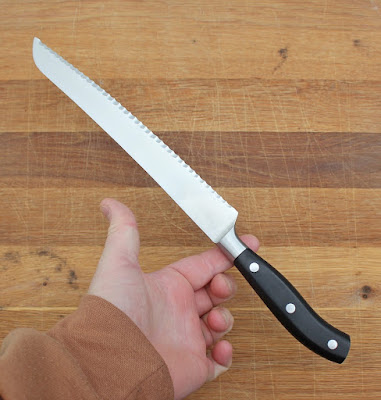
Kniven har utmärkt balans
As with all kitchen knives, balance is essential to how the knife feels to work with. This one is exceptionally well-balanced which helps it feel light and nimble


The Victorinox Grand Maître is an exclusive knife in that it is forged. This means that the blade, bolster, and tang are made in one piece. The material is X50CrMoV15 steel and the handle is made of POM (Polyoxymethylene), a material which is very suitable for kitchens as it is both easy to keep clean and very durable. For example, it can handle heat very well. This makes it possible to clean the knife in a dishwasher*.

The knife weighs in at just over two hundred grams, 216g, and is a total of 370 mm long, of which the blade is 23 cm. The height of the blade is 30 mm. Proportions that are fairly common on bread knives. The tip is slightly rounded and the outer part of the edge is not sharp.


Blade


First, some comments about the blade itself as there are some rules of thumb for bread knives. Firstly, they should be quite long. Otherwise, they are not enough if you have to cut a large loaf or perhaps a cake.

However, the blades should not be too high as it is more difficult to change the direction of the cut with a wide knife blade if needed. Then the edge is slightly curved on the Grand Maître, which I prefer over completely straight blades because it makes it easier to cut with the entire edge against a cutting board.

The serrations have been given a rather classically shaped wave pattern. The advantage of this wavelength is, in addition to cutting well, that the knife can be sharpened and resharpened when necessary


Then there was the small unsharpened piece of edge towards the tip. It is there so that the knife does not unnecessarily cut into your cutting boards. After all, it is a variant of the saw you are holding!


Handle


As I said, the handle is made of man-made material but is also available in stabilized maple for those who want a wooden handle. The grip is 13 cm long, 1.8-2.7 cm high and 1.9 cm thick. The sides are apparently attached with three rivets, which gives a traditional look. That was also the goal when the Grand Maître series was created. To create knives with an exclusive look and feel without being too expensive.

The knife has a very well-shaped handle attached with three rivets


The shape is curvy and fits a hand well, but really it's something secondary as you don't grip kitchen knives in the same way as a carving knife or the like. They are very rarely held in a "hammer grip" but more often in the pinch or with a finger on the back. Here are a couple of details that elevate this knife above the crowd. One such is how soft and fine the grip is on the bolster closest to the blade. This makes the knife very comfortable to work with. Then the balance is exceptionally good. It is found right at the transition between handle and blade and it makes the knife feel light and nimble. Something that is certainly even more important on chef's knives, which are usually used for a longer period of time than bread knives.

The Grand Maître series is forged from one piece and has a full tang


Then the handle is angled in relation to the blade. There are two schools of bread knives and the other has completely straight handles. However, the angle means that the risk of hitting the knuckles on the surface is reduced. The low blade means that there is not much space left for the fingers otherwise.


To Use


I've had this knife for quite a while at this point and it's had it work with most things that are reasonable. We are mainly talking about bread, but also some vegetables. However, it should be added that all bread is not the same as you know.

Fresh rolls baked with apples in the dough are very tasty


There is a difference between bread with crusts like baguettes and ciabattas and softer bread. Then we have hearty home-baked sourdough loaves with really hard crusts versus fresh rolls. In addition, for the sake of testing, I have also cut soft vegetables such as tomatoes with this knife.

What is wanted is a knife that does not send the crust from the bread like brown confetti all over the kitchen, but bites well even on the most stubborn of surfaces. That's what the Victorinox Grand Maître does with its sharp tips on the saw teeth. Incidentally, the knife arrived really sharp and I haven't had to resharpen it during the time I've owned it despite daily use. But I haven't abused it either. It also works well for e.g. removing the skin of a pineapple, but for that, I usually use a special "junk knife" that I have for such tasks because it quickly dulls a knife.

One challenge is to cut really soft white bread without making a mess


Then comes the delicate task of sharing really soft white bread. In that area, this knife has competition from my chef's knives as I keep them so sharp that they can handle that too. But so does this knife! It is important that the knife really cuts when "sawing". Otherwise, the bread is pressed together into a lump.


To Conclude


Victorinox Grand Maître bread knife is a premium knife, which is only partially visible on the price tag. It stipulates a price of around 140$ or just under that. Whether you are going to spend that much money on a bread knife depends to some extent on whether you have the opportunity to sharpen and possibly resharpen it yourself or can give it away for that. Because all knives wear, even serrated ones, and then they need a new edge. In return, it takes quite a long time to get there and in the meantime, you can enjoy the good qualities.

Victorinox Grand Maître Bread is a well-made and very well-balanced bread knife


This knife is classically elegant and pleasant to look at with its fully forged construction, which gives nice transitions between the blade, bolster and handle. But even more important is that this knife is very ergonomic and also has excellent balance. The latter means that it not only looks exclusive but also feels the same way when you hold it. The function is excellent whether you want to defeat rustic Levain bread or just share a delicious freshly baked roll.

Then there is a real possibility that you have already tried this or an older version of the knife, as many slightly more sophisticated hotels have them as utensils on the breakfast buffet.

In any case, the Victorinox Grand Maître is a knife I highly recommend as it is one of the best in the field I have tried. They know their stuff in these parts of the world and it shows in the tools designed to handle them, whether you are a professional or want something really good for the home.


Specifications: Victorinox Grand Maître bread knife 7.7433.23G


Length Overall: 370 mm
Blade Length: 230 mm
Blade Thickness: 2,4 mm
Weight: 216 g (weighted by me)
Steel: X50CrMoV15
Handle: Polyoxymetylen (POM)


/ J - looking for knives among the mountains

Among others from Cooks Illustrated.
**  BUT you should NEVER do that. More on why at another time.

torsdag 22 juli 2021

Review Brisa Chef 185

  - Brisa ventures into the kitchen knife jungle

It is not every day that you see a chef's knife from Sweden's eastern neighbor Finland. Especially not from Brisa, a company that has otherwise made itself known as a seller of mainly knife and handicraft materials. In addition, they have also developed a solid range of knives consisting mainly of knives for outdoor life, but have also supplemented that area with folding knives and small neck knives for more EDC-oriented use.

Första kockkniven från finska Brisa
Brisa Chef 185 with handle in black Micarta


But on the kitchen knife side, there had been a black hole. Something that was corrected when they released this knife, that is. As the headline says it's called  Chef 185.


First impression


A first glance at this knife gave the impression that it is clearly Japanese-inspired with its Santoku blade. Something that is also confirmed when you read the introduction on the website. I also thought it was and is nice with its classic look with a black handle attached with two rivets. Then the Micarta handle gives a solid feeling and the knife feels well made. Just good impressions in other words.

Then I was excited to see how Bris managed the kitchen knife area. My personal experience from knives from Mora and Fällkniven, among others, is that it is not a given that the knowledge from outdoor knives can be applied in a kitchen environment.


Type of knife


Chef 185 is a somewhat unusual knife in that it's basically a hybrid between a Santoku and a classic chef's knife. In terms of shape, it is a Santoku but the measurements are closer to a chef's knife of a more traditional European style. It is a bit larger than most Japanese models, although I myself have one from Hiro that has almost identical dimensions in terms of the blade and edge length. However, it is lighter with thinner blade stock, a slimmer handle, and a different balance. There is thus a certain difference between, for example, that Santoku and this knife. The question is what does it mean in terms of use?

Brisa Chef measures a total of 305 mm, of which the blade length is 185 mm, which the name sugests. By the way, this is how kitchen knives are normally measured. The blade stock is stated to be 2.5 mm and it is by the tang and at the base of the blade. Otherwise, it quickly tapers to 2 mm. The height of the blade is in this context a fairly normal 49 mm.

The blade is made of 12C27 steel from Sandvik


The steel chosen comes from Sweden and Sandvik and is what used to be the sole stainless "mora knife steel" 12C27. A steel that is very common in many knives made in various places in Europe, not least in France. As a kitchen knife steel, I have not used it before, I must admit. It has a couple of features that should make it appropriate in this context. Firstly, it takes a good edge and secondly, it is really stain resistant. Two areas that are of course important for a knife that is used more and is washed significantly more often than all other knife types.

Micarta is used as the handle material. A material that is not completely common in kitchen knives but well meets all the criteria for a good utility knife. It is hard, durable, and can withstand the wear and tear required of a good kitchen knife. The handle is attached with two stainless steel rivets. By the way, Chef 185 is available in two colors, in addition to black, there is also a version with a mustard yellow handle.


    To work with


    However, the most interesting thing about a kitchen knife is not how it looks but how it behaves when used. During the fairly extensive test period, this knife has become acquainted with most of the common tasks and things that can be cut in a kitchen. Mainly roots, vegetables, and fruit. But of course, also meat, fish, and poultry as well as bread and some occasional package opening, although I usually avoid it with my chef's knives. For those tasks, there are other sharp objects around.

    A typical example of a task when it is good to have the right blade length


    When the knife is put to work, the first impressions are initially amplified. The knife not only looks solid, it feels solid as well. It is above all the sturdy handle in Micarta that contributes to that feeling. 

    The blade is long enough to handle, for example, dividing carrots lengthwise, but is too short for those tasks that require a larger chef's knife, such as splitting cabbage, halving watermelon, etc. The height, on the other hand, is excellent. The blade, which is almost five centimeters tall, makes it easy to guide the blade with your knuckles when chopping onions. Simpler kitchen knives are often too low, especially when they have slightly shorter blades. 

    The factory edge was also very good and that sharpness helps both when going through a tomato that may not be completely fresh as well as finely chopping red onions. No problems there with Chef 185.

    The height of the blade facilitates chopping onions


    The edge also has a suitable curvature to facilitate "rocking cuts" where the tip is held against the cutting board throughout the procedure. The height also contributes to the fact that you can use a chopping technique instead if you so prefer even if it's clearly not a Chinese cleaver. 

    Like all chef's knives, Chef 185 is a little too wide to be optimal for slicing meat with. Wide blades do not react as quickly as a narrower steak knife blade to changes in direction. But Chef also gets approval in that area as well as cutting chicken.

    Overall, I like this knife, I must say.


    More impressions after further usage


    But not everything is milk and honey. After using the knife for a longer period of time, I discovered some details that can be improved. One such is that the spine of the blade could have been more rounded in my opinion. As it is now, the edge is broken, it is not a ninety-degree edge to be used with fire steel. But I belong to those who tend to move my hand forward with their index finger on the spine when I hold chef's knives in a pinch grip, which means that it hurts a little after a while. 

    Chef 185 also works for meat, but it could have been thinner behind the edge


    Another detail that I would have liked to see designed in a different way is the front edge of the handle, which is slightly too abrupt with too-marked corners. It is distinct and thus looks nice, but for the same reason that the spine of the blade could have been softer, the handle could also have been. After all, it is in a pinch grip that chef's knives are held the most and this particular handle is quite thick there.

    Then I am not completely satisfied with the choice of steel. Or some things are very good as it shows no tendency to develop either corrosion or stains of any kind even if you forget the knife with lemon juice for a while. However, it does not keep the sharpness in the way I am used to. Now I'm a little spoiled with my Japanese chef's knives with VG10 "scared" to 60HRC per se. But even if I compare with my Sabatier and Victorinox knives with softer and simpler steel, the knife loses sharpness relatively quickly. Of course, it is possible to both use a strop and rods to hone it back to sharpness, but it still provides some extra work. It would be interesting to see what hardness this blade holds.

    Another thing to object to is that this knife does not cut very well when it loses its extreme sharpness. First I thought about why and then I took out my Santoku from Hiro and a caliper and compared. It turns out that Brisa has chosen to keep the steel behind the edge to about 0.5mm, compared to 0.3mm for the Japanese knife, which is a significant difference and explains a lot of the difference in behavior as well.


    Conclusion


    With Chef 185, Brisa has made its official entry into the world of kitchen knives and as I wrote at the beginning, it is not just a matter of translating your knowledge from other knife manufacturing straight off. There is something that I think becomes clear with this knife.

    It is a solid and well-built knife that is aimed at those who are looking for a chef's knife in the middle price range. Because it is an important aspect to emphasize in this context, the knife costs 59 € if you buy it directly from Brisa's home page

    Brisa Chef 185 is an affordable knife for those who want to upgrade their kitchen equipment


    The advantages of this knife are that it offers a classic look that is still somewhat unusual with its oriental influences. The construction is very solid with almost indestructible Micarta in the handle and a 2.5 mm thick full tang and blade steel that can withstand some abuse.

    But it is noticeable in some details that this knife does not reach the pinnacle of chef's knives and that the influences from other Brisa production are there. One such area is the handle. It is, in fact, incredibly comfortable to hold in a "hammer grip". If this handle had been placed on any hunting, outdoor, or even work knife with its curvy appearance and three-dimensional sharpening it would have been great. The only problem is that you do not grab kitchen knives that way. This makes the handle, which is 18 mm thick, feel a bit clumsy. It could generally have been a bit slimmer.

    Another influence that feels as if it comes from outdoor knives is that they have chosen to make the blade so strong with half a millimeter of steel behind the edge. A measure that is excellent on a folding knife for EDC use. Had this been one, I would have praised it because it was thin behind the edge. Now, on the contrary, it is quite much. This makes the blade more durable but also demands that the knife is kept very sharp to cut well. And it is not so easy it turns out because the steel is quite soft and thus must be maintained frequently.

    Brisa Chef 185 do not get lost in the kitchen


    Despite those objections, I see this as a very good entry-level knife for those who want to upgrade their kitchen equipment. A thicker edge also means that it does not collapse if, for example, you cut into half-frozen fish, something that a finer Japanese knife risks doing. So Chef 185 is durable and you do not have to be as careful with how you handle it.

    It is also stylish and well made, the fine handle in Micarta undeniably feels exclusive. Especially given the price. Overall, I see this as a good competitor to most things in the price range!


    Specifikations: Brisa Chef 185

    Total Length (mm): 305
    Blade Length (mm): 185
    Blade Thickness (mm): 2,5
    Weight (weighed by me): 182 g 
    Steel: Sandvik 12C27
    Handle Material: Micarta 


    / John

    söndag 14 februari 2021

    New Knife - Brisa Chef 185

    Far too few kitchen knives have been featured on this blog. Especially considering that I am very interested in cooking and have a fairly extensive set of knives for that purpose. Then I usually claim with some emphasis that no matter how you look at it, kitchen knives are the ones that get used the most during the course of a normal day. At least in my life.

    Today we are going to look at a new knife for me from a brand that at least I did not previously associate with this type of knife. I'm thinking of Finnish Brisa. They are otherwise known for being suppliers of everything that belongs to knife-making and for making fine outdoor knives.

    Chef knife from Brisa
    Brisa Chef 185 


    Chef 185 comes with a blade made of 12C27 and handles that are either mustard-colored 
    or black Micarta 


    This model is called Chef 185 and is Brisa's first kitchen knife. The basic shape is inspired by a Japanese Santoku, they say themselves. That is obvious when looking at the blade shape, but the size is quite large for that type of knife with its 185 mm long blade. Therefore, it still gives the impression of a traditional European chef's knife in my opinion. The total length of the knife is 305 mm and the weight ends up at 180 grams. The handle is made of Micarta, which is both a good-looking and very durable material. The blade is made of Sandvik 12C27 which is fine-grained steel suitable for this application.* 

    I must admit that I had the knife for a while before I wrote this presentation and I can therefore reveal in advance that the upcoming review will be overwhelmingly positive as the initial impressions are very good.

    Of course, there will be a review within short!


    / J - often found in a kitchen

    #knivesandbikes  #knivigtvarre


    * A little clarification aimed at all those who are used to the excesses in "super steels" that occur in the folding knife world nowadays. The steels that are considered optimal for use in a small EDC knife are for various reasons not always as good for a kitchen knife blade. There are other factors that are significantly more important for the performance of a good kitchen knife.