Visar inlägg med etikett survival knife. Visa alla inlägg

tisdag 18 mars 2025

Review Al Mar S.E.R.E T36


-  everything wasn't better back in the days

Recently, I reviewed an upgraded version of a famous Spyderco knife and then discussed when it might be appropriate to rework an existing knife model. That theme is relevant today as well.

The reason is that today's review item rests on the laurels of a true classic among robust folding knives and comes from Al Mar Knives. This version has been named S.E.R.E T36 or 3.6" SERE Taiwan.

Al Mar SERE T36


SERE Folder is a folding knife with a long history, as the first version saw the light of day in 1979. That knife was quite different compared to today's edition given the technology of the time. The strongest lock known was chosen with a back lock and the knife was considerably larger in size. So much so that its successors are actually smaller.

It was also one of the first "tactical" folding knives on the market. I'm not talking about wannabe-mall ninja knives, but one that was actually designed to fill a niche among soldiers. I discuss that story in more detail in my review of the previous version of this knife, the SERE 2020. That knife modernized and revived the old icon.

But there's no denying that even though I appreciated that model, there were a few signs that it wasn't completely well thought out. The modernization with a flipper that was perhaps not perfectly executed required that the knife be assisted, which both makes the knife heavier and more sensitive to dirt. The blade steel was certainly functional but not quite on par with the price tag and so was the build quality itself. Not because it's bad but because it was and is a step down compared to the older AL Mar knives made in Seki City, Japan.

That's where this knife comes into the picture and it addresses all those areas.

The new, fine-tuned version of the SERE folder is, in my opinion, the best


Short version: Al Mar SERE Folder T36, when an addition to the name means everything


Blade


The blade shape is not much to talk about but is one of the things that has been inherited through all generations and it would be strange otherwise, as it has become something of a signature for Al Mar and also appears in other models. Last time I wrote that the contours are almost dagger-like and that is true. This is a typical example of a spear point which includes a substantial false edge. In that area, this blade differs slightly from the previous version as the false edge has become slightly longer.

The length of the blade otherwise remains and is evident from the model designation. In other words, it is 3.6 inches, which is just over nine centimeters. The thickness is also the same as before, 4 mm. The height of the blade is at most 2.55 cm. 

The blade shape is recognizable as a classic spear point that Al Mar has chosen to call a talon.


The rest of the appearance is also reminiscent of its predecessor, but there are a couple of significant differences. To begin with, the coating is of better quality on this version. It is a matte black TiNi coating. The one on SERE 2020 is much shinier and looks cheaper, which it probably is. Speaking of appearance, the markings have also been given a major overhaul. To highlight the newness, there is no longer any red in the logo itself. Then the text is smaller and in a more discreet color tone.

The name and logo are on the presentation side of the blade, and the model designation, name of the knife, and country of manufacture are on the other side.

An interesting detail is that both the previous edition and the representative of this knife on the website are equipped with "sharpening choils". This specimen does not have them!

And while we are on the subject of sharpening, the step is not too far to talk about edges. This factory edge is significantly sharper than the 2020 variant. It is noticeable that they have changed factories. All quality markers are simply better.

The material of both blade and coating is upgraded to TiNi-blackened S35VN


There is no doubt that this blade is designed to stab considering the design of the tip. But it is also designed to be strong. The blade is four millimeters thick as mentioned and a large part of it is maintained by a flat saber grind that is about 13 mm high. Behind the edge is quite a lot of steel, about 1 mm. This means that the Al Mar SERE T36 is not the world's best knife for peeling apples, but on the other hand, it was not intended to be that way either.

However, this is a better blade for particularly tough work than you might think. Especially with this sharp edge and not least the steel. In that area, the biggest difference between the T36 and 2020 editions is found. CPM S35VN has been used in this knife. It is a real premium steel and a substantial upgrade compared to D2. The latter has its qualities, but S35VN is simply better, especially as it is stainless or significantly more rust-resistant to be exact. In any case, it is preferable for a knife that is to be carried in different climates and weather and close to the body.

In this case, the material has been taken to a stated 60-61HRC and that may very well be true because the knife holds its sharpness pretty damn well, it must be said. A little maintenance with a strop and it shaves hair with ease again. When I have to resharpen the knife for real, I may end up thinning the edge a bit. I don't need a knife with such a strong edge. But on the other hand, I have plenty of other knives if I really need a slicey blade. 


Handle


SERE still has one of the most ergonomic folding knife handles ever made. Maybe not THE best, but one of them. That fact remains and has even been improved a bit. The T36 has been tweaked a little here and there.

Concretely, this means that you still find a strong steel frame as the basis. But in this case, it has been lightened a bit. This means that the knife weighs slightly less than the previous edition, which is 189 g. The T36 weighs 177 grams. This also improves the balance a little.

The handle has also been adjusted with higher-quality G10 sides.


The knife is open at the back and there are a couple of simple spacers and a very small back spacer that stabilizes the construction and serves as a mount for the clip.

Another quality improvement is found in the handle sides. It is still G10 that is used but this one gives a better grip because it is coarser patterned and feels less plastic.

The sides are otherwise flat but beveled and rounded where they should be.

SERE is open in the back except for the small backspacer


It is easy to see the legacy of fixed-blade knives in this handle. It is spacious, wide, and fills the hand well. In addition, there is a finger guard which consists of the entire front part of the handle widening both up and down. This protection is of course reinforced by the flipper tab when the knife is open. To prevent slipping backward, there is a classic "beak" towards the rear end.

The handle is still just as comfortable. As long as you stay behind the finger guard, that is.


The adaptation to more robust tasks is noticeable when you then grip the knife. Holding the knife in a pinch feels a bit clumsy as the handle sides are thick and the flipper feels like it is in the way. The same applies when an index finger or thumb is to be placed on the blade spine. It is possible but you have to "stretch" over the finger guard.

It is different when the knife is held in a hammer grip or in a saber grip. Both grips are exemplary and the same can be said about reverse grips and when the knife is held in an ice pick grip. That is, all ways of holding a knife when you need to grip it properly, whether it is cutting something hard like thick rope or piercing something. In that case, this handle works exceptionally well. This also applies with gloves on because it is so spacious.


Opening and Lock


The way you open the T36 has also been given a facelift. You can still open the knife with two hands like in the old days, but it is essentially a flipper knife. But now it is for real, so to speak.

At SERE 2020 it felt a bit like a makeshift solution. The geometry was not fully thought out and it resulted in a spring-assisted knife. It is not good for several reasons, such as more things can break, it is much slower to close the blade and the knife is a bit heavier. Then it feels cheaper, for lack of other words.

The flipper has received a major facelift with grooves, a small hole, and, not least, better geometry.


Now that boring detail has been removed. Obviously, the geometry has been overlooked, as this flipper works great. It is also nicer to look at and more comfortable to use. This is because it is partly openwork and partly has more rounded edges and a grooved pattern for better grip.

This is still not the world's fastest knife, but it is at least as nimble as before. Much thanks to the fact that the relatively heavy blade now runs on ceramic ball bearings.

The flipper itself is easy to access and you can approach it any way you like, push, pull or something in between. The blade comes out anyway. You could possibly get stuck on the way out if you are a little too half-hearted. As I said, the flipper function is good but not the best.

The strong liner lock is now easier to access


The lock is still a liner lock and this version is at least as solid as previous models. But here too it has been tweaked somewhat. The recess that is on the opposite side of the handle to facilitate access to the lock bar has been given a better shape while the lock bar has been provided with grooves. Small but distinct improvements.

The lock is set deep to prevent accidental release if you use twisting movements with the knife but is still easy to release. The function is excellent and the blade stays in place without any notable play in any direction.


To Carry


In this respect, the knife has not changed much compared to its predecessors. Sure, it is slightly lighter as mentioned, but that is marginal in the context since it is the outer dimensions that are substantial. On the other hand, it naturally follows that you have a folding knife that is more or less intended to replace a fixed-blade knife in an emergency and add to that fundamentally good ergonomics.

The handle is still 12.2 cm long, 2.7-3.8 cm high, and 14.8 mm thick. This gives it a lot of volume.

This specimen of the clip isn't the best


However, I'm starting to wonder a bit about how Al Mar weighs their knives. The last time I reviewed a knife it was wrong and it is now too. On the website, the weight is stated as 5.1 oz which is 142 grams. After double checking I still get the weight as 177 grams. So they probably need to get new scales.

Here you can see the reason why my clip is not good, the ramp is basically gone. Something I intend to adjust


The clip is the same as before, although the material has also been given a makeover. My specific copy has taken a hit at some point, which means that it is basically unusable at the moment because it is right next to the handle. But even before that, I can say that the ramp was a bit too small and needs to be tweaked a bit to be optimal, especially when combined with slightly thicker fabrics of various types.

Otherwise, it can be said that it is a spring steel clip that has been colored black to match the rest of the knife's theme. It is also mounted at the back of the handle, which means that the knife sits very deep in a pocket. The purpose is of course that it should sit as securely as possible so that the user does not suddenly discover that the vital backup knife has disappeared. The construction also means that it is reversible if desired. The clip has the Al Mar logo, which is still in a discreet format, thank goodness.


To Conclude


If you follow the history and development of this knife, it gets an overhaul about every twenty years or so. First came the original with its variants, then came the SERE 2000 or S2K ​​as it was also called. It was with that version modern materials made their entrance in earnest and one-handed opening became an option. It was later followed by the SERE 2020, which was the one you had to make do with if you didn't want to spend half a fortune on the second-hand market. It was a nice enough version, at least concerning the price after it was adjusted downwards here in Europe after it had been available for purchase for a few years.

But then came the upgrade with this knife or rather it should perhaps be considered a complement as the SERE 2020 is still in the range. 

SERE Taiwan, T36 however, it is only the same knife in terms of the shell. Everything is simply better.

SERE T36 can be forced into the role of an EDC knife but is too big in many contexts


One of the biggest quality improvements that can be noted is a significantly better steel. This applies to both the basic material and the treatment. A properly hardened S35VN beats an AUS8 every day of the week and twice on a Sunday. In addition, the knife has got both a better look and, above all, a better coating  This TiNi does not look painted and lasts better. A real step up.

In addition, the handling has become more sympathetic too. Gone is the assisted opening and instead, we have a better-designed flipper geometry and ball bearings. In addition, a nicer and more functional flipper tab with a milled pattern that prevents the finger from slipping off. It is also nicer because it looks more worked with the little hole.

When we talk about appearance, it can be mentioned that the new more discreet marking is preferable and the same can be said about both the blade coating and the handle material that looks less plastic even though it is basically the same as before. But not all G10 is the same and this one both looks and feels better and above all it gives a better grip.

Outdoors, where the Al Mar SERE T36 performs better!


Overall, I think this knife is preferable on all parameters. It doesn't just look better, it is better! I've always liked and coveted the basic model and I still wouldn't mind an original knife from the eighties. Instead, I got the 2020 edition and although I actually like it, it has some shortcomings.

All of those have been addressed with the T36. It's distilled down to a damn nice folding knife for those looking for something really robust with an iconic look and feel.*


Specifications:


Length Overall: 214 mm
Length Folded: 122 mm
Weight: 176 g (weighed by me, stated 42 g/5,1 oz!)
Blade Length: 91 mm
Blade Thickness: 4 mm
Blade Steel: CPM S35VN
Handle: G10 on a steel frame
Lock: Liner lock

Produced by: Al Mar, made in Taiwan


/ J - rate this one the highest

It can be difficult to get hold of in Europe but costs around €240 when you find it.

tisdag 26 november 2024

Review ANV M25


- when practical becomes sexy

I saw right away that this was a knife for me. The ANV M25 spoke to me as they say. Sometimes you can tell from pictures when many hours have been spent on design and the result is successful.

It becomes particularly clear in this case, as it is obvious that all unnecessary features have been stripped away to create an extraordinary, competent military knife. It also turned out to be a superb outdoor knife.* Not least because, unlike some other knives in the class, it is just the right size.

Light and flexible knives are especially nice when you have other things to carry, which is often the case outdoors. Or if you are carrying a gun and combat harness with everything that goes with it.

ANV Knives M25


The reason why it is also a good outdoor knife can be found in the fact that the M25 was certainly developed in collaboration with parts of the Czech army, but it does not belong to the category of knives that can be considered pure weapons. Examples of such are daggers of the Fairbarn-Sykes type and the like. They only serve one purpose.

The M25 is instead an all-round knife with a focus on simple, practical tasks, but which doesn't get lost in any situation, whether it's survival scenarios or more everyday situations. It is developed together with the "Strakonice 25th Anti-Aircraft Missile Regiment". It is something that is reflected in some details of the knife that I will return to.

The result, however, is a rather nimble knife that measures 240 mm in length and weighs in at a light 140 g for the knife alone and 219 g for the whole package.

ANV has developed a military knife that is just as good for outdoor life


Short Version: ANV M25, a knife that oozes competence. It is deceptively simple and well-built, strong yet light and well-balanced.


Blade


As is often the case with competent blades, the shape of the M25 is simple. A slightly modified drop point is used here. The blade has a relatively high saber grind. This gives a blade that cuts well without being too thin and therefore fragile. The blade thickness is 4 mm, which contributes to the strength without being excessively thick. It helps keep the weight down and makes the knife cut better when cutting through stuff.

The length of the blade is 11 cm and the height is approx. 2.6 cm. The marking consists of Acta non verba Knives' stylized logo on the presentation side and model designation, country of manufacture, and steel type on the other. It sounds a lot but is very discreetly applied.

This knife has an eleven-centimeter long slightly modified drop point blade


The steel is, as is often the case with knives from ANV, Swedish. This time it's Sleipner, which is a high-alloy tool steel from Uddeholm. Think of it as an even tougher D2. To prevent corrosion and get less reflections from the blade, it has been given a DLC coating. Quite simply, it is one of the best finishes available in the knife world. It fulfills its function while being very strong and does not wear out in the first place.

Then there were the odd details. One of them is found partially on the blade but extends over the entire back of the knife. It is a series of indentations that exactly correspond to the distance on a 1:25000 scale map. The notches correspond to distances from 250m to 1 kilometer and then up to 5 km. One thing that might be of interest if everything else goes to hell and you have to calculate distances manually if you happen to be in an anti-aircraft regiment. 

Another very practical detail is the recess found near the handle. It is to facilitate the use of fire steel. The edges there are ninety degrees and sharp, unlike the blade spine which is softly rounded. 

At the blade base, some well-placed notches are found for better traction. They are just deep enough and with enough bite to work really well.

The steel used is Uddeholm's Sleipner with a DLC coating


Speaking of bite, it's one heck of a bite in the blade. Time has not only been spent on details. The most important features are also in place. In plain language, this means that the M25 is also damn good at cutting things. This applies to everything from wood and dry timber to cardboard, plastic, and the like. I haven't pried open cans so I can't comment on that. On the other hand, the edge bites well into ropes of different thicknesses and materials. 

Here, ANV has succeeded in striking an excellent balance between keeping the blade strong while at the same time daring to let the knife be thin enough behind the edge to, together with the high flat grind, make a knife that cuts really well. That's something I appreciate more than the fact that it's totally bombproof, as in you can stand on it when the knife is driven into a log, and similar tests I've seen on YouTube. 

I cut and pierce with my knives. When we talk about poking things, it can be pointed out that the tip is effective as well. It is also where you would expect. Not too high, not too low. 


Handle


The M25 is a full tang knife whose handle consists of two pieces of solid Micarta held in place with a pair of sturdy T15 screws. The handle is slightly over twelve centimeters long, depending on whether you include the protruding metal or not. The available surface behind the finger guard is just under eleven centimeters. It is excellent because it allows the handle to accommodate slightly larger hands even if you happen to be wearing gloves. At the same time, it is narrow enough even for smaller hand sizes.

The handle consists of two solid pieces of well-shaped Micarta screwed in place. It is finished with a special chisel which, however, can be used for other purposes as well


The Micarta is of the highest quality and is heavily contoured. The handle sides are strongly three-dimensionally shaped and pleasantly blend into the hand. At the same time, they have a fairly advanced pattern that grips very well. I have found that it is impossible to slip, not even with cold and wet hands. What makes the pattern advanced is that it has deeper grooves along the spine- and underside, which gives higher friction than on the sides where it is somewhat finer. It is particularly effective when combined with the notches found in the metal on the underside of the handle.

The handle is strongly shaped but very proportional. Here you can also see the notches that act as distance assessment tools for maps on a scale of 1:25000


Speaking of odd details that were mentioned earlier, it can be stated that in addition to the distance scale, a screwdriver is also found at the end of the handle. It's not just any flat chisel, but it happens to fit the nose cone of an RBS missile. However, I can reveal that it works great for other things as well. It's lucky since I'm running out of missiles in my back pocket. In addition, there is a lanyard attachment here if you want to use one. 

This is a well-balanced knife that feels very light and lively in the hand


The balance of the knife is excellent and the balance point is found right at the finger guard, which makes an already light and flexible knife even more nimble in the hand.

Incidentally, this is one of the better handles I've come across. It simply fits a human hand superbly. It may sound like a matter of course, but sometimes it is missed in the eagerness to shape the handle for different tasks.

All grips work and I mean all


The M25 has a grip that is sculpted but it's really comfortable in any grip I can think of. This applies whether you hold the knife in more conventional grips such as hammer and saber grips or if you turn the knife over and hold the knife like an ice pick with the edge forward or backward. Everything works.

The same applies if you cut with the knife for a while. However, if you use the M25 for heavier tasks and cut a lot of wood, it can be nice to have a pair of thin gloves. As I said, it is a handle with a good grip and it can also be felt against bare skin after a while.

The Micarta provides a good grip and acts as an insulator in cold weather


But it also means that it works well in snow and cold with a bit of a hand and wet fingers. The Micarta insulates somewhat. Not as well as a wood handle and it is a full tang knife so the bare metal can be a bit cold.  


Sheath


The included sheath is made of Kydex. An excellent choice as it is both durable and can withstand all elements, be it heat or cold. It is also malleable which is another reason why it is used in the knife industry. This is a pancake model and is held together with no less than twelve eyelets. In addition, there are two slots for additional straps, so there is no shortage of ways to attach your knife to a belt, backpack, or battle harness.

The pancake-style Kydex holster is fitted with ANV's own belt loop solution


As you know, sheaths have a couple of different tasks to fill. Of course, they must hold the knife in place so that it does not disappear. It must also protect the knife and not least the edge. Another task is to protect the wearer from the knife. It is not recommended to have such a thin sheath so that, for example, you risk injuring yourself if you fall on your knife and it goes through the side of the sheath. Something that can happen if you are out at night, which happens to be a situation that can apply to military personnel from time to time.

It's also good if the sheath keeps quiet so it does not rattle when the knife is in place. In addition to being annoying in general, it is also not good whether you are looking for either people or animals. Or just being a bird watcher for that matter.

A good sheath must also be durable and make the knife easy to carry. How does this sheath meet the criteria?

The mount can handle belts/straps up to seven centimeters wide, which covers most of them


With mixed success is the answer. Most of it is good but not all. The knife is held in place tightly enough that there is no risk of it falling out of the sheath. Not even if the knife is upside down. However, there is no extra security strap so you have to rely on the snap in the material for retention. On the other hand, it makes the knife easy to draw. The easiest is to place your thumb against the edge of the sheath and press lightly and the knife is loose.

Something less good is that it doesn't actually keep quiet. The knife moves enough to rattle. It is the fit around the blade that is too wide. It certainly saves the coating on the blade from wear through less friction when the knife is pulled and put away, but it is still not the best.

The fastening straps are of ANV's own manufacture and they are made of some form of very tough plastic. At first, I thought they would be at risk of coming off but after using another knife, the M311 with the same type of belt loops for a longer period I can say they last. 

They are extremely wide and take belts/straps of up to seven centimeters. But unlike, for example, Tecloc solutions, the bracket cannot be adjusted for belt width, which means that the knife can move a little if you wear a thinner, normal military-type belt. 

Also, I'm not entirely fond of how high the knife ends up when it's worn straight up and down in a belt. The handle then ends up very far up and stabs me in the side. Therefore, I mostly carry the knife attached to a backpack when I have one or loose in a bag in more everyday contexts.

I also tested turning the belt loops and carrying the knife in the so-called "Scout Carry" with the knife horizontally in the lower back. Something that usually works well if you don't carry a backpack. Especially with knives that are this small and above all light. In this case, it works, but the sheath is not completely adapted for the purpose, so you have to fasten the straps with one screw per piece instead of two.


Conclusion


It's nice to know that I haven't lost touch with my inner knife reviewer! What I mean is that I can often determine how a knife will feel or rather suit me by photos alone. But that feeling is not one hundred percent certain and therefore it is even nicer when the first impressions confirm that feeling.

It gets even better when those impressions last over time, which brings us to the ANV Knives M25. It is still one of my favorite knives of all time, even after testing and wearing it for quite some time now. It's getting close to a year!

The M25 is small and flexible enough to be carried in a bag even for everyday use


I have described in some detail why. But the overall picture shows that the knife is extremely balanced. This not only refers to where the weight is located but also the properties. A strong knife that really cuts and penetrates well while being just the right size and still lighter in weight than most.

The latter is a topic often missed in the context. But it is of great importance regardless of the reason you are outdoors, on a mountain, or in a forest due to camping and hiking or on a secret mission. The amount of equipment you have with you is of crucial importance. In civilian contexts, it's about making the experience as pleasant as you can, and in military contexts, you should be as mobile as possible.** A couple of hundred grams saved on a knife can also mean a couple of hundred grams more ammunition. For those reasons, I appreciate the format extra. 

Then there are many examples of why this is a well-thought-out knife. Mainly it is how well the knife actually cuts but also how it works for different hand sizes. It is another proof of proper design and is very important when it comes to supplying entire military units with knives. Not all soldiers have identical hands.

Then there are the discreet built-in features that are there for those who need them but are out of the way for everyone else.

ANV M25 is a damn good outdoor knife which makes it a good military knife as well 


In short, I think the M25 is one of the better military/outdoor knives available. Some are just as light but often come equipped with inferior materials. Some have the same standard of steel and handle, but they are often heavier.

ANV has simply found a balance close to perfection. My advice is to buy it!


ANV


Specifications:

Length Overall: 240 mm
Blade Length: 110 mm
Blade Thickness: 4 mm
Steel: Sleipner med DLC-coating, 60HRC
Weight: 140 g/knife only, 219 g with sheath (weighed by me, stated weight, knife 145 g)
Handle: Micarta
Sheath: Kydex

Produced by ANV, made in the Czech Republic


/ J - found a gem

* There are more examples of similar knives, of course. The class includes knives such as Fällkniven F1 and its predecessor Cold Steel SRK, Peltonen Sissipuukko M95, Glock M81, and others.

** I did my military service as a dog handler in the Navy and I can tell you that you don't want to carry too much when you are on the other end of a trail line following a dog through bushes and undergrowth.

tisdag 2 april 2024

New Knife - Al Mar SERE Operator 40

Today I will present something as interesting as a new...old knife. What do I mean by that? Well, this model has been produced before and also in several different editions. Among others, it was manufactured by TOPS* a few years ago and then of course by Al Mar themselves back in the day. The original did not have the three tubes to attach the handle sides but screws instead and was slightly larger. Otherwise, this version and the original are very similar.

This is, as the title says, the SERE Operator 40, which is now back in the range, something that makes me glad.

Al Mar SERE Operator 40


It is enough to look at the dimensions and you will understand that this is both an all-round and very well-thought-out utility knife. Certainly, it looks a tad aggressive with its spearpoint blade or as Al Mar chooses to call it "talon", which to most others refers to a completely different blade shape. But if you study the design of the edge, the height of the primary bevel, and the length and thickness of the blade, you begin to approach a sturdier Mora knife in format, say Bushcraft Black for example, even if this knife is older.

The SERE Operator measures no more than 8" or 203 mm in total length and the blade is 4" or just over a decimeter long. It weighs as little as 275 g with the sheath and the knife at 177 g. It's good for a full-tang knife. This model can also be had in a smaller version with a 3" long blade.

A modern classic is back in production!


The blade features D2 steel with a stated hardness of 59-60HRC and the handle is made of polished G10. The sides are attached with three steel tubes. The finish is good.

The sheath is made of composite plastic and comes with a variant of a Tec-Lok mount that fits most things from belts and backpacks to MOLLE systems.

Overall it's a very interesting package and in my eyes, it's a damn good-looking knife. A modern classic. I look forward to testing and reviewing this in the spring which hopefully will be here soon.


/ J 

*A variant that, however, deviates from the original on several points.

måndag 27 juni 2022

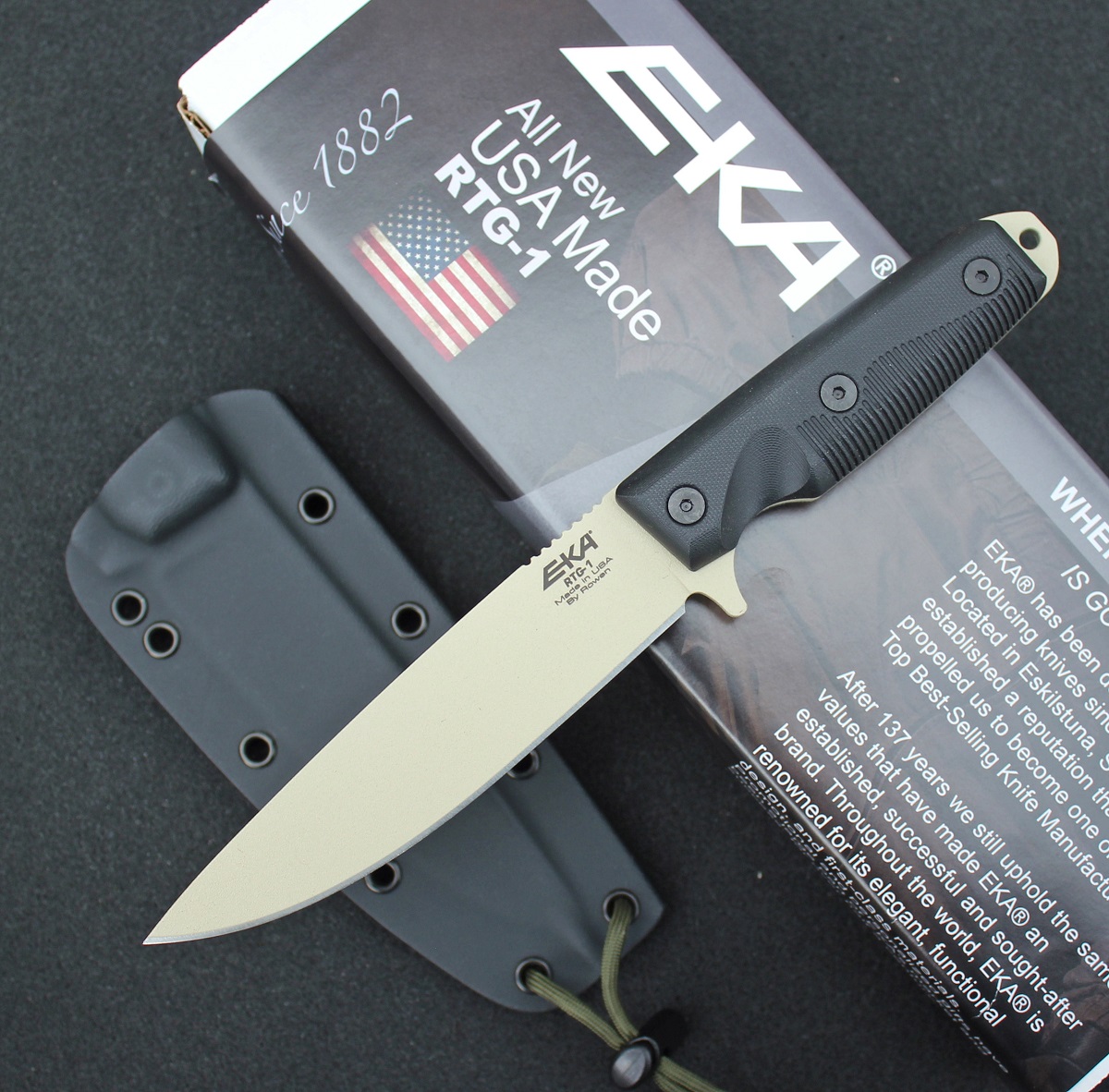
New Knife - EKA RTG-1

It was a long time ago since I presented a new knife from Swedish EKA here on the blog so it could be on time was my thought. The last time I reviewed something from them, it was one of their at this classic folding knife models in the form of a Swede 92. The most modern model I looked at was a Swede 8, which certainly belongs to the later generation of knives from Eskilstuna but is hardly new to the market. It was four years since I wrote about it and it was not completely new then either.

But now it is not just my "fault". In fact, EKA has not been very good at releasing new models or keeping up with trends for that matter. But something has changed and with it, some new knives have seen the light of day.

One of the latest is this fixed blade named RTG-1. A knife I thought looked interesting the first time I saw it. It made me associate with knives like Fällkniven F1 or maybe A1 and especially the Finnish Peltonen's Sissipuukko M07.

Ny tvättäkta svensk-amerikan från EKA
EKA RTG-1, a proper "Swedish American"


RTG-1, which incidentally stands for "Ready To Go", is an odd bird to be included in EKA's range. Otherwise, classic folding knives and some fixed blades that previously had a clear focus on hunting and outdoor life dominate. I am thinking of knives like EKA Swingblade and Nordic W12 for example.

Against this background, this and a few other models stand out by belonging to the modern "tactical" style. It can be discussed whether it is an advantage or a disadvantage and what should be included in that concept, but often it is about marketing that includes the military, possibly police (mainly in other countries than Sweden), and rescue personnel of all kinds. Sometimes they are called military knives, sometimes survival knives.

En friluftskniv för allehanda aktiviteter.
Well-designed knives do well as outdoor tools


But if they have a healthy design and are well made, you have a real tool ready for most things that can be expected to meet a knife. That was what I thought I saw in the pictures on RTG-1. The knife is solid without being overly large, the blade is simple and looks competent in my eyes. The materials seem well chosen as well. The handle sides in this version consist of black G10 and the blade is 1095 carbon steel with a coating. Those who think they recognize the type of somewhat rough surface from, for example, an ESEE are quite right. For example, if you turn on a "Candiru" and read, it says "Rowen". They are the ones who make this knife for EKA as well.

If you are unsure, it says "made in the USA" on the box as well, just in case. In other words, it's not something they are trying to hide. In this case, it also means a quality stamp and the first impression of the knife is very good. It feels solid, it is well balanced with a really sharp factory edge and the sheath is a very well-made one in Kydex. 

I look forward to testing this knife!


/ J 

#knivesandbikes #knivigtvarre

tisdag 10 maj 2022

Review ANV Knives M311 Spelter

  - a serious challenger from the Czech Republic

Acta Non Verba Knives or ANV as it is abbreviated is a brand from the Czech Republic that I presented here on the blog before. What was relevant then were folding knives of a few different types. Now it's time for a fixed blade instead. Nor is it just any knife but the M311 Spelter. A military and survival knife that was developed for the toughest conditions. Now I do not intend to devote myself to "survival" in that sense, but when I saw the balanced measurements, I realized that this is also an excellent knife for outdoor life in general.

After that, it only remained to see if my positive expectations had any bearing in reality.

ANV Knives M311 Spelter


M 311 Spelter is a knife that, like the Swedish Fällkniven F1*, was developed in collaboration with various units within the respective Armed Forces, including the air force. That background means that there are some common denominators between it, the M311 Spelter, and a number of other well-thought-out survival knives on the market. These are areas such as general dimensions, the design of the handle, and the functionality of the blade.

As usual in the case of ANV Knives, the knife can be built on their website, which gives many options when it comes to appearance. You can choose between seven different variants on the blade and three colors on the handle as well as three more colors for the sheath. Then you can start counting the number of combinations. In terms of appearance, most people are likely to be satisfied!

Acta non verba Knives offers only the best materials in this knife


Twitter version: ANV Knives M311 Spelter, a military and survival knife built from pure top materials to handle most things. A real home run!


Blade


Spelter is a knife that has a very advanced blade hidden behind a simple basic shape. It is a classic drop point used as a canvas for this work of art. Subsequently, it has been provided with a number of distinctive details such as a pronounced recess for the index finger, depression for the thumb at the base of the blade spine, and not least a swedge which does not start at the tip, which is rather unusual. In addition, a rounded blade spine can be added and the blade is blackened.

The dimensions are restrained, which means a blade length of 12 cm with a height of 3.7 cm. The stock thickness is 5 mm which is not excessive to belong to this class of knives. It gives a strong knife without it becoming heavy and clumsy.

The twelve-centimeter long blade is blackened by DLC


The steel is Swedish Elmax ** in this case. No doubt it belongs to the group of the so-called "super steels". Elmax Superclean is powder steel which, in addition to being able to get very sharp, is also extremely durable. This applies to both sharpness and toughness. This means that if it does not stay sharp forever, then at least for a very long time. A bit of maintenance in the form of a few strokes with a ceramic or diamond sharpener or rod and you do not have to resharpen your blade very often. 

My previous experiences with Elmax are that it is really rust-resistant but that like all steels it can get stains and therefore ANV has chosen to provide the blade with a black coating. Then there is probably some thought that reflexes should not be visible, but it is a trait I personally am less interested in. But it's true, the matte surface does not glisten if you point a flashlight at it in the dark.

In this case, it is DLC (Diamond-Like Carbon) that was used to make the blade black. It is theoretically one of the most sustainable alternatives available. It turns out to apply in practice as well. During the test period, it has not worn despite the fact that I beat on the knife a bit, among other things by batoning very dry hardwood. 

The blade steel is Elmax hardened to 60 on the Rockwell scale. It gives a blade that keeps its sharpness for a very long time


The blade has been provided with a high flat grind, a "saber grind", which ends with a decent factory edge. The knife was sharp on arrival but not one of the sharpest. The edge shaved hair with some pressure if it says anything? The thickness behind the primary edge is 0.8 mm.

This means that Spelter is rather thick behind the edge, which of course is a result of the intended area of use. In a knife of this type, durability is one of the priorities. I have chosen to sharpen the knife and in connection with that reprofile the edge slightly. Elmax can be thinner without risking being brittle. A heads-up when it comes to that bit though. This is a "super steel", which means that you have to invest some elbow grease to get the knife sharp again. On the other hand, that sharpness lasts for an extremely long time, as I said. 

Spelter has also been used to chop in both fresh and, in this case, extremely dry wood. All to see if the edge would bend or get damaged. The long handle allows you to hold far back to get more power when chopping


That detail together with the choice of material and the general appearance of the knife makes you want to test it hard. After all, this is a tough military/survival / outdoor knife, which means that I used it for typical outdoor chores. It includes cutting ropes and some thinner cortege and of course wood in lots of shapes. This means both fresh branches and dry wood. I have split wood both lengthwise and crosswise. The last literally was when Spelter was used to hammer through wood against the fibers. No sign of edge damage after that either. In addition, I have tested the strength of the tip by jamming it into various pieces of wood and prying it out sideways. It holds up for that too!

Thin fresh wood is of course not a challenge, but it shows that the M311 Spelter also works well for more detailed work. It is easy to shift grip and move forward and actually use the finger choil


"Batoning", or the noble art of splitting wood with a knife, poses no problem either


Then, of course, the knife has also been used to make fire. It includes preparing firewood, splitting small logs, and making some kind of feather sticks. That is not my forte. I also used the knife with fire steel. The latter must unfortunately be done with the edge. If you know that it is a recurring task, I recommend that you sharpen a piece of the swedge for the purpose.

In addition to that, I have of course used the M311 on non-natural materials including cardboard, plastic, jute fabric, and dirty nylon rope, which is something that wears extremely on the edge. It handles those materials gallantly. Then it is if not fantastic then fully compatible with onions as well. That is if you want to indulge in a little outdoor cooking. Even camouflage-colored warriors on two legs must eat.

Overall, this knife is just as versatile as I hoped and wanted!


Handle


There are a couple of different basic types of handles and a dividing line can be drawn between thinner handles and the fuller ones. This handle belongs to the latter variety. It really fills the hand and does it in an excellent way. It is not far from perfection. The length is 15 cm, the height is around 3 cm and the thickness varies between 1.9 cm to a full 2.8 cm.

Then this handle is very anatomically shaped to provide good ergonomics in a number of different grips. To begin with, there is a really good "forward finger choil", a recess for the index finger, which in combination with the finger guard provides high security if you use the tip or stab with the knife. Then ANV has chosen to let the handle taper off to improve the grip. The handle also includes a palm swell and then narrows again before it ends with a small edge at the back where the knife is both thicker and has a small beak to hold the hand in place. The handle also has a recess on the top of the handle for the thumb where a couple of solid grooves have been cut out to further improve the grip. That depression also has its equivalent on the blade mentioned earlier.

ANV has achieved a very well-thought-out handle that provides good ergonomics


A lanyard hole is found in the extended tang. It can also be used as an improvised hammer as long as it isn't steel in the receiving end. But for hammering a pole into the ground the knife works great.

It is thus a very advanced handle when it comes to shape. At the same time, it is amazingly simple and fits the hand very well. In pictures, I think it is reminiscent of knives from, for example, Bill Harshey, which is a good rating.

The handle is very well sculpted


The material that is so well shaped is Micarta of the highest quality. It is then screwed with four (two per side) M5 screws which, like the blade, are DLC-treated to hold better. The knife is a full tang knife as can be seen in the pictures and ANV has chosen to let the steel stand proud to round off the profile further. Here, too, the steel is well rounded. 

The most interesting question is whether all these forms can also be used in practice. The answer is short, yes it is possible. Not only does it work but it's excellent! This is one of the best handles I have come across when it comes to the variants that are built for many different grips. To begin with, this is one of the few handles with "choils" / finger recesses that actually work. It is large and rounded enough to house most size fingers at the same time as the angled front end of the handle means that you can still apply some force when cutting hardwood, for example. It is a very important feature that is often missed on knives that include this detail. In addition, there is the recess on the blade spine when you want to engage in detailed work.

Spelter has a handle that is flexible when it comes to different grips


As I said, the basic grips work excellently. In a hammer grip, the knife feels solid with its full shape that literally melts into the hand. At the same time, it is more difficult to generate power in that grip since the hand end up a bit away from the edge, but as I mentioned before, the angled front of the handle helps. The sides are also thinning at the front to facilitate a pinch grip. Something that is not clearly visible in pictures. 

Saber grip is just as effective and here you can choose how far forward you want to hold, with your thumb in front of or behind the finger guard. It is also possible to move the hand really far back to get a little more power behind the edge if you swing the knife to chop something.

In addition to the shape of the handle providing excellent grip, the pattern milled into the Micarta also contributes to increased traction. This means that there is less risk of slipping even if you have wet and/or cold hands. This knife has been used during both winter and spring and it works well even with a little thicker gloves on. 


Sheath


The sheath that comes with the M311 Spelter is of the "pancake type", ie one made of two pieces that have been pressed together. It provides plenty of attachment points around the edges if you need them. The footprint is larger than a taco-style sheath, but there are advantages and disadvantages to both types.

The material used is Kydex and the fastening device itself is a pair of folded plastic hobs. However, made of very tough plastic which seems to be really durable. But with these mounts, other systems can also be used if desired.

The fastening device takes all dimensions of belts and is equipped with quick locks so that the knife can be easily removed or secured elsewhere


The sheath comes in a few different variants as mentioned earlier and this version is some form of O D green with a light gray shade. It matches the knife very well. A spacious drainage hole is found in the bottom of the sheath.

The knife fits really snuggly in the sheath with very little rattling or other noises. The Kydex material squeezes the knife hard enough so that it is not dropped. Not even if you turn it upside down and shake it hard. On the contrary, the knife is a bit sluggish to pull when the sheath was new.

Speaking of which, there is an excellent thumb ramp to use for that purpose and just the right amount of the finger guard is visible so that you get a good grip directly from the sheath if you pull the knife quickly. There is no need to change grips, which is otherwise not entirely uncommon.

The knife sits high up on a belt


If you carry a backpack with a carrying strap, the knife may be moved to another location


I myself carry this knife in two different ways. If I'm just out walking or hiking, the knife is on the belt. But since it sits quite high up, it is not preferable if you carry some form of a larger backpack with a carrying strap. Then I attach this knife to the backpack straps instead. The straps are also "MOLLE-compatible". Something that is of less interest to me nowadays. But it makes the sheath easy to attach to other things as well.


Conclusion


My impressions of this knife can only be summed up by the fact that it is a really qualified challenger in the class, no matter what knife it's compared to. The design is well thought out, which results in many built-in features, which not least provides excellent ergonomics in many different grips. 

It has since been implemented in a consistent manner where some of the best materials available have been selected. The package includes Kydex, Micarta, and not least Elmax with DLC coating. Steel that beats most of the competition. The build quality is outstanding and shows the know-how that exists in this part of the world. More specifically, Bohemia in the Czech Republic.

ANVs Spelter is a very advanced knife that can handle most things


Then the knife looks good in a slightly brutal way. It has a serious look if you see what I mean. But it was, after all, the relatively restrained design, especially in terms of dimensions, that made me take a closer look at this knife. It is not full of gimmicks but the details that are there are there to improve the function. Basically, it is a fairly simple blade shape that is then provided with a number of exciting details. The blade works really well for mixed outdoor life and I am sure even for more serious applications if necessary. It is, after all, a knife made with the military, rescue personnel and the like in mind.

M311 Spelter has been used even in colder conditions and the handle is very functional even with gloves on


Then it can be stated that in addition to the eminent blade, the handle is very good. There are not many handles found on knives that include the word "military" in the description that is so comfortable to actually work with. Sure, if you are going to carve for two hours, a Mora Bushcraft is a bit better, but otherwise, this is a superb handle. I was a little worried that the pattern and the grooves that were there could give rise to a "hotspot bonanza", but my suspicions fell short.

ANV M311 Spelter is an extremely well-built knife and thus very good for all outdoor life


If it has not already been stated, I can only say that this is an extremely good knife in its category. It simply does not get much better. Different yes, but not better. Quality doesn't come cheap though. At the time of writing, ANV M311 Spelter costs around 320$ and about the same amount in Euros. Not cheap but it is also a premium knife with premium qualities. A knife you will have for the rest of your life.


Specifications:

Length Overall: 275 mm
Blade Length:  120 mm
Blade Thickness: 5 mm
Steel: Elmax, 60 HRC
Weight: 288/386g  knife/knife + sheath
Handle: Micarta
Sheath: Kydex

Produced by ANV Knives, made in the Czech Republic 


/ J 

But it is slightly longer than the mentioned model, so if it is something it should be compared to, it is in that case model A1. However, the M311 is slightly shorter and above all lighter than that knife.

** The website states that if you choose the untreated blade, Sleipner is used instead. It is, by the way, another Swedish super steel.