Visar inlägg med etikett 8Cr13Mov. Visa alla inlägg

måndag 29 juli 2024

Ny kniv - Cold Steel Mini Tac Bowie

Den här versionen av en "neck knife" var från början en kniv med tantoblad. Det kunde sedan fås i endera en sågtandad version eller med slät egg. Den har funnits på marknaden ett bra tag och verkar vara en säljande produkt för Cold Steel med tanke på att den numera även kan fås i det här utförandet kallat Mini Tac Bowie. Det nya är förstås det i mitt tycke mycket snyggare clip point bladet!

Cold Steel Mini Tac Clip Point


Designen kan annars tillskrivas Andrew Demko som under lång tid var chefdesigner för Cold Steel. Materialen som använts tillhör inte de mest exklusiva men känns ändå väl valda och påverkar naturligtvis prisbilden i positiv riktning. Den här lilla gynnaren kan fås för kring en femhundring för närvarande. 

Materialet som använts för handtaget är ett fiberplastmaterial kallad Griv-Ex som hittas i en hel del av Cold Steels produkter. Handtaget är mycket distinkt utformat med ett djupt urtag för pekfingret. Här misstänker jag att Herr Demko möjligen kan ha sneglat lite på en Fred Perrin-design. 

Det 92 mm långa bladet är gjort av kinesiskt 8Cr13MoV. Kanske inte det dyraste stålet men det är ändå gångbart, särskilt som det är mycket rostfritt och är lätt att slipa. Eggen var som ofta är fallet med Cold Steel riktigt bra. 

Fodralet är gjort av ett annat plastmaterial vid namn Secure-Ex. Även det hittas i många fodral från det här företaget. Det håller kniven på plats med ett rejält snäpp. En nödvändighet då den är designad för att bäras i en rem eller kedja runt halsen. 

Därmed förstås även att det inte är en extremt stor kniv det handlar om. Totallängden ligger kring 17,5 cm med en vikt på mycket låga 82 gram. 

Sammantaget är de första intrycket att det är en gedigen och kompent liten kompanjon. 


/ J - fördjupar sig i Cold Steel katalogen

#knivesandbikes #knivigtvarre

måndag 22 juli 2024

Ny kniv - Cold Steel Mini Leatherneck Clip Point

Cold Steels  knivar kallade "Leatherneck" är ursprungligen en tolkning av en klassisk Ka-Bar, den ikoniska amerikanska stridskniven. Cold Steels variant kom med två typer av bladform, det för stilen typiska Clip point-bladet samt deras kända American Tanto. Det finns i familjen även en Bowie-utgåva numera. En stor pjäs som sig bör. 

Men sedan finns en trio av knivar i miniformat konsekvent döpta till Mini Leatherneck. Förutom de nämnda bladtyperna kan den även fås med ett tve-eggat dolkblad. 

Cold Steel bjuder på en miniutgåva av en känd förlaga


Den här versionen har dock en clip point som mäter 89 mm vilket ger en totallängd på strax över sjutton centimeter, 172 mm. Då bladet gjort av 8Cr3MoV inte är tjockare än 3 mm så blir vikten så låg som 94 gram. Det gör att kniven möjligen kan användas som "neck knife". Men det kan diskuteras. Varför ämnar jag addressera i kommande recension. 

Cold Steel Mini Leatherneck Bowie


Hur som haver är det här en liten, rolig och tämligen praktisk gynnare från Knivshop för den som inte vill släpa omkring på en full stor Ka-Bar men ändå få lite vibbar av den typen av kniv. Sedan går inte sticka under stol med att prislappen är tilltalande. 


lördag 14 januari 2023

Review Spyderco Resilience Lightweight


 -  large and light, a folding knife for outdoor life

To date, I have reviewed about 35 knives from Spyderco. But even though I own several more, it has only been one from the "Tenacious series", which was their first venture into what they call "value folders". A category that means slightly simpler knives in terms of materials and manufactured in China. Everything to bring the price down and make them more competitive even in lower price segments. That family has since grown with models such as Efficient, Emphasis, Astute, etc. However, the line to their budget brand "Byrd" is fluid on that part although in this series you get a more pronounced Spyderco design.

It is one of the Value Folder knives we will take a closer look at today. The biggest actually, which goes by the name of Resilience.

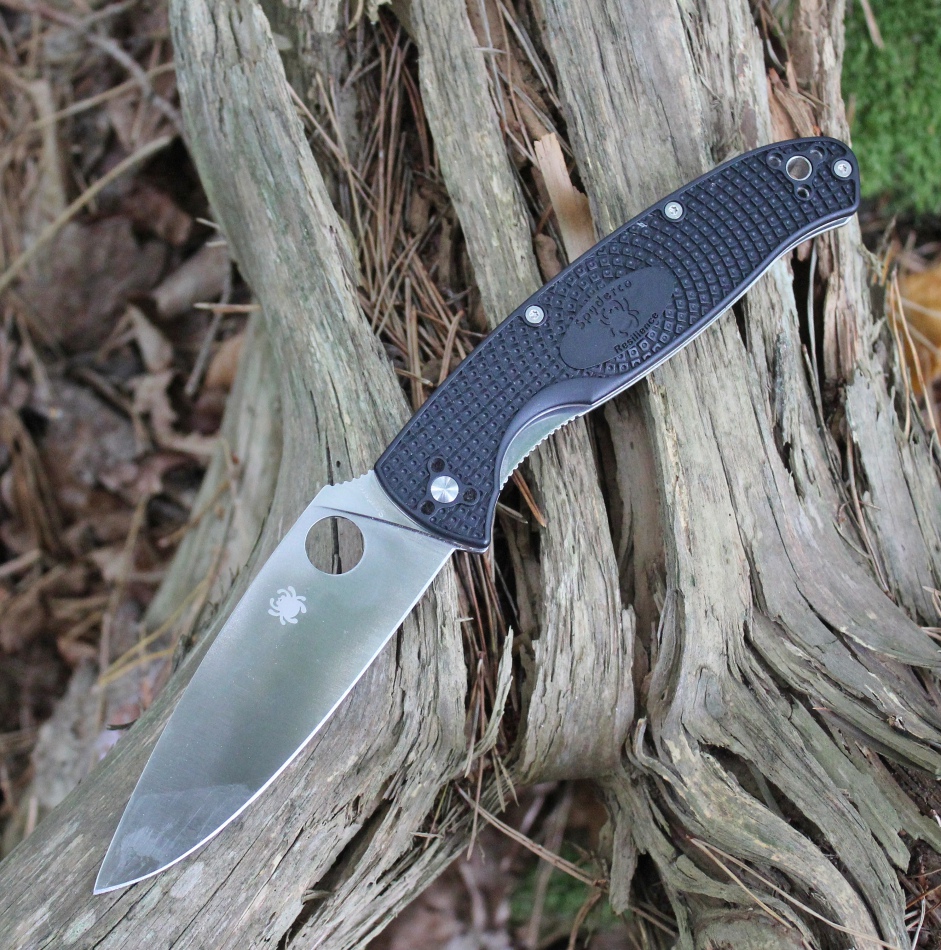
Spyderco C142BK Resilience Lightweight


What is new is that a series called Lightweight has been released where the models Tenacious, Persistence, and Resistance have received a treatment which means that the G10 sides in the handles have been replaced with FRN. In addition, Spyderco has launched a luxury version of Resilience with a blade in S35VN steel. It is of course more expensive and the question then is what is the point of a so-called "value line". But that is the subject of another post.

However, it is not that version but the simpler of the two FRN variants of Resilience that is in focus here. 

Resilience, a lightweight beast from Spyderco


Twitter version: Lighter meant not only less weight but also better. The ergonomics got a boost in the right direction and the Spyderco Resilience is therefore an excellent choice for those looking for a large folding knife at a relatively good price.

Blade


The blade of this knife is of course identical to the original model. This means one of Spyderco's basic shapes, a "leaf-shaped" blade which is in practice a drop point where the back line is slightly modified to accommodate the blade hole. That consideration makes the blade wider than many others, and in addition, a thumb ramp naturally occurs at the base of the blade. In this case, it is equipped with grooves for increased traction.

Then it is not a small blade we are talking about as it measures over a decimeter in length, more precisely 107 mm. The height is 32 mm and the blade thickness is 3.1 mm. There is not too much in relation to the size of the blade, height, and not least the fact that it tapers towards the tip.

Resilience offers a formidable blade


The material in both this FRN version and the previous one is 8Cr13MoV, one of the simpler Chinese budget steels that are sometimes condescendingly called "number steels". But with that said, it is not that bad for pocket knives. To begin with, it is fairly resistant to rust given that it has been treated correctly during manufacture. Then it actually takes a good edge, even if it doesn't last forever.

It is also not the world's most impact-resistant steel in my experience*. But as I often point out, the fact that it is relatively easy to grind is not something you should turn a blind eye to. Especially not in a utility knife. Not all knife users have access to modern sharpening systems with fixed angles and diamond stones, and that aspect is important. 

The steel is as before Chinese, but Sal's marking has been added and the text "China" has been made smaller


As is usually the case with knives from Spyderco, the blade is fully flat ground. It provides excellent cutting properties provided the manufacturer does not skimp and has too much steel right behind the edge. In this case, it is 0.6 mm. Not the thinnest but in return, it is a fairly large knife.

The factory edge gets approved but no more. The knife arrived sharp but nothing extremely good. The edge is reasonably even but is steeper towards the tip. 

One thing worth noting is that the blade is slightly angled downwards in relation to the handle. It makes it easier to use the edge and especially the belly of the blade when cutting. A well-thought detail.

The combination of good texture on the sides of the handle, a recess for the index finger, and a thumb ramp with additional grooves make it very difficult to slip whether you are working with or without gloves. Even if it is used to stab with. This means that you as a user do not hesitate when you need to puncture, for example, heavy plastic packaging or the like.

You don't have to be afraid to do that either, as the tip is unusually robust for sitting on a Spyderco. Otherwise, the blade is quite flexible in terms of areas of use. The fact that the edge is drawn all the way to the handle is certainly a disadvantage when the knife needs to be resharpened, but is in return a great advantage when cutting wood, whether it is dry or fresh because you get closer to the material. There you have both more power and control.

In everyday materials such as cardboard, plastic of various types, and fabric, Resilience is formidable as a cutting tool. The wide blade slides through the materials thanks to the flat grind which makes the transition to full blade thickness gentle. Then the blade shape is a great asset in all forms of outdoor cooking. That's a bonus in this case.


Handle


The difference between this new version and the original is in the handle. The construction is the same as before with a lightened steel frame that the sides are then screwed in. In this case with three screws in addition to the pivot screw, which of course makes the knife sturdy. Especially as the lanyard hole itself consists of a steel tube, which further strengthens the construction.

However, the material in the handle sides itself is completely new. Here, the fairly smooth G10 has been abandoned in favor of heavily patterned FRN or "Fiber Reinforced Nylon" as it stands for. The actual coarseness or friction does not come from the material but from the pattern, which is Spyderco's "bi-directional", which means that there are heels in the molded plastic that bite the hand regardless of which direction the load comes from. It provides a grip that is on the verge of being too good sometimes. However, those looking for that quality need look no further.

The handle offers plenty of space and a very good grip


Otherwise, it can be said that the knife is open in the back. The spacers found there are not shaped in any way which is a pretty sure sign of a more budget-oriented knife. I say "more" because Spyderco's are rarely cheap. The frame on which the knife is based is unusually strong with its 2 millimeters. It matches the size of the knife which attracts heavier usage. 

The open back reveals simple spacers and that the frame is lightened


The actual dimensions of the handle are enough for most people, even those with really big hands. The length is around thirteen centimeters and most of that can be used to hold around. The height is 2.9-2.4 cm and the thickness of the handle is 12 mm. This also makes the knife excellent for those who want to use it with gloves on.

 Resilience is a substantial but well-balanced folding knife


The fact that the handle is spacious means that all grips the undersigned can think of work. The thumb ramp with its grooves is both figuratively and literally made to place a thumb on, and thus the saber grip feels completely natural. Likewise, the hammer grip feels excellent, not least because the handle is quite high, which fills the hand better than slimmer handles. Then you can cut close to the handle and that is the grip at least I use the most.

The spacious handle makes it easy to vary the grip


For the same reason, a high but thin handle is advantageous. The edge is where you expect it, so to speak. With the giant "finger choils" that have become modern, the edge is moved far from the handle, which makes such grips difficult to work with. But that is not the case here. 


Opening and Lock


Like basically all Spyderco knives, Resilience also opens via a hole in the blade. After all, it is their signature and what is found on most of the non-flipper knives in their catalog. In this case, the hole works fine but everything else would have surprised me.

Good means that the location in relation to the handle makes the hole both easily accessible and that the blade can be easily maneuvered.

A blade hole, what else? But a very well-functioning one should be added


The sides of the holes are not chamfered, which Spyderco sometimes receives criticism for as they are perceived by some as too sharp. If you are one of those who think so, it is easy to make a turn with a sharpening stone on the inside. Otherwise, it provides a better grip and prevents the thumb from slipping as easily. Especially not with cold or wet hands. Something that is also in line with the knife's area of use.

A very strong liner lock


In the same way, this is a rather strong lock, especially for being a liner lock. This is achieved by having a lock bar that is two millimeters thick and with adequate height. It simply gives a greater area of contact between the blade base and the lock bar.

The lock bar has been provided with some deep grooves for a better grip and is easy to access when the knife needs to be closed thanks to a generous recess in the handle on the opposite side.

The function itself is excellent and anything else would have upset me even though the Resilience is not one of Spyderco's most exclusive knives. But they usually make good locks, and that is the case here too. The blade is held in place without play in any direction. Nor does it slip under load or react to lighter hits from the wrong direction, i.e. the blade spine. In short, it does what a lock is supposed to do. 


To Carry


All knives have their pros and cons and sometimes one or the other dominates. Sometimes it's a close call. As for how Resilience is to carry, the latter applies. Certainly, it is relatively light, but the word was relative. However, it is other dimensions that make it somewhat less sympathetic in the pocket. It is not extremely thick with a width of 12 millimeters. However, it is both long and, as is so often the case with Spyderco knives, quite tall. It measures 13.2 cm by 4.3 cm in those dimensions.

On this knife, I have actually chosen to have the clip mounted at the pivot screw


Another complicating factor is the pattern I praised above. It gives an extremely secure grip, but it also causes the knife to tear against everything else as well. But here is a small detail that Spyderco has implemented since a few years ago that must be highlighted. That's how they chose to have the small plate with the logo just below the clip. It reduces the problem of fabric being pinched between a rough pattern and a strong clip.

It's a strong clip that didn't work as well without the flat surface it rests on


The clip, it's recognizable. It belongs to one of Spyderco's standard variants. Although my impression is that they usually are a bit thicker and thus feel a bit clumsier on models made in China. 

It can be mounted in all four "corners". Sometimes I can find it doubtful if it is necessary. But maybe not on a knife this big. Namely, I belong to those who actually shift the clip on some large folding knives. Today, it has almost become "law" or at least the norm among knife enthusiasts to carry knives equipped with a clip with the tip facing up, i.e. the clip attached to the back end of the handle. It mostly applies to me too, but there are exceptions. In part, it may be about knives that become more comfortable in the hand due to the design of the clip or, as here, that size plays a role.

Because the handle is so long, otherwise the knife must first be pulled, and then one is forced to shift the hand forward on the knife to access the hole with the thumb before the blade can be opened. Personally, I find it easier to instead spin the knife a quarter of a turn to achieve the same.

The clip otherwise works well. The ramp is good, it doesn't feel much in the hand because the handle is so big and it holds the knife in place. The tension is quite strong but not unaffordable.


To Conclude


The first impression of either the original or this version of Resilience is that it's a big damn beast. It is one of Spyderco's largest folding knives. As I said, the blade is over a decimeter long, and the knife measures thirteen centimeters in the pocket. But then there was the weight. It is light and sometimes you talk about how much weight you have to "pay" for a certain edge length. Here, that ratio is very good.

Resilience belongs to Spyderco's larger folding knives. Here in comparison with the Military and Police 4


The question, however, is whether Resilience is too big as an everyday knife? For many it probably is, and for others, all knives are too big except for a Victorinox Classic. But at the same time, if you know you have big hands or just like substantial knives, this is a very good candidate. Then there are all the other uses for a knife in addition to acting as a pure pocket knife for everyday use.

Resilience LW kan även fungera som en EDC-kniv men då i den större kategorin
Of course, you can carry Resilience as an EDC knife, but preferably combined with something smaller


That's actually where I mainly see Resilience LW, that is, as a knife for the "other" tasks. Then I think most of an outdoor knife, regardless of what that means for you. Spyderco, in this case, has managed to pack in several important features that are significant in that context. The first is the weight, 125 grams in this case. It means less to carry, which is important if you are hiking or cycling, for example. But then the flat-ground, wide, and long blade gives very good properties even when, for example, outdoor cooking, whether it's more advanced tasks or if it's just slicing a piece of salami for a sandwich. This knife has replaced my old Military in that area.

Equally important is the grip which in this version with the FRN in the handle and fitted with this pattern is significantly better than the original. That, in combination with the fact that the edge is drawn all the way to the handle, means that you can use some force if necessary. Something that is especially nice when the firewood for that fire for said cooking needs to be provided. The fact that the lock is unusually strong for a liner lock does not make matters worse.

Then the geometry makes the blade exceptionally good for cutting materials such as cardboard and the like. The fact that it's a Spyderco means that you don't have thumb studs and the like that can hang up in the material helps. 

En stor men lätt fällkniv väl lämpad för friluftsliv
I mainly consider the Spyderco Resilience Lightweight as an outdoor knife


For those who think that the steel quality does not match the other characteristics but who like the model in general, there is, as I said, an upgraded version with CPM S35VN in the blade instead. A more expensive knife for sure, but otherwise with the same dimensions. And for those who hesitate about the price for both options, the original with G10 sides can actually be found at a lower price sometimes.

To everyone else, I can only say that Spyderco with the Resilience Lightweight has improved an already good model and is thus a good choice for those looking for a large folding knife for mostly outdoor life. Yes, and should you hesitate about the size, there is always the little brother Tenacious Lightweight. 


Specifications:


Length Overall: 239 mm
Length Folded: 132mm
Weight: 125 g
Blade Length: 107 mm
Blade Thickness: 3,1 mm
Blade Steel: 8Cr13MoV
Handle: FRN
Lock: Liner lock

Produced by: Spyderco, made in China


/ J 

* Something that I test thoroughly in throwing knives, among other things.
** This has caused me to sandpaper the surface on some models to reduce the friction somewhat. This applies, for example, to Manix 2.

måndag 5 april 2021

New Knife - Al Mar Eagle Ultralight FRN

It is light, big, and extremely fast this bird. We're talking about Al Mars' lightweight version of the Eagle model. Or the second lightweight version of this knife I might add. I have already presented the more exclusive frame lock version with titanium handles.

I liked and like it a lot, so when there is a very similar model but in a different price range, it will of course be interesting.

Al Mar AMK4126 Eagle 4" Ultralight


This knife has a similar name but has the suffix "FRN" instead of "Ti" at the end. It reveals one of the biggest differences between the two models. The handle material is fiber-reinforced nylon instead of metal. It also means that it comes with a liner lock instead of a frame lock. Furthermore, the blade steel is simpler. In this version you find 8Cr13MoV.

What is left is the elegant and tasteful design, the pointed blade, and the fine action. In fact, it is significantly faster than its more expensive sibling thanks to less pressure from the lock bar.

All in all, a very exciting knife in the larger EDC format. Especially as Lamnia.com has a sale on them at the time of writing and you can buy one for SEK 593. Without saying to much before the actual review I recommend you to get one!


/ J - expanding the flock

#knivesandbikes #knivigtvarre

lördag 24 oktober 2020

Knife Review Al Mar 3.0 S.E.R.E

 -  The model that shrank and changed role


Some of you may be familiar with Al Mars model S.E.R.E. 2020 or even read my review? Those who have seen that big and sturdy knife probably have no problem seeing the relationship with today's review objects. They are little siblings to that knife. They go under the designation 3" S.E.R.E 2020 O.D Green and S.E.R.E. 2020 G. Yes, today's review is "a two for one" because they are so close to each other.

Olika versioner
Al Mar 3.0" S.E.R.E 2020 OD Green/G


Of course, one question immediately springs to mind and that is where the differences between the versions lie? Without saying too much, I can reveal that it is about the included materials. Otherwise, they are just as similar as they appear to be.

Another and perhaps more interesting question that I will try to answer is what happens to the model when the format is shrunk? Sometimes that experiment works, sometimes it doesn't. In the world of knives, there are plenty of examples of both outcomes.

Now it should be pointed out that offering different sizes of the same model is not a new move on Al Mars' part. From the beginning or shortly thereafter, they have had a smaller model of their original S.E.R.E-Folder in the catalog. It provides almost forty years of experience in the field. Previously, they had the prefix "Mini" and I find myself more often than not calling these knives that too. It's kind of easier to say.

But the question was, as I said, if they are just "mini" or if there is more to it when you make them shorter. At first glance, it's just a matter of reducing the blade from 3.6" to 3" and the handle to a corresponding degree. This is the transformation number I intend to discuss here.

Two for one, two versions of the same model, one review 


Twitter version: 3.0, the S.E.R.E.-model for EDC use


Blade


The blade shape on these knives is exactly the same as on the big brother. It means a rather aggressive spear point reminiscent of a dagger in profile. However, it is only ground on one side but has a fairly large false edge/swedge towards the tip. Al Mar calls the shape "Talon", which can be a bit confusing as in knife blade typology it usually refers to blades that look like, eh... talons. This means a tip pointing downwards and a curved concave edge, which is not the case here.

The smaller version of the S.E.R.E. still offers a sturdy knife blade, even if the stock thickness is reduced. These blades are 3 mm thick instead of the four millimeters the larger blades boast. The blades are, as can be told by the name, 3" long, or 76 mm. The height is 22 mm. The finish is the same for both blades in this case and it is a semi-gloss satin. They can also be had in blacked-out versions for those who prefer it.

Al Mars' distinctive "Talon" blade offers a spear point with a distinct false edge


Let's talk about what gives the various knives their own identity. One of them is the materials used in the blades. For the time being, they are "color-coded" which means that the black-handled version features D2 steel. The hardness is stated to be 58-60 HRC. The green knife has simpler steel in the stainless 8Cr13MoV. The hardness in hem is a low 56 HRC which is significantly softer.

The advantage of the green version is of course that it is stainless, although I am not usually particularly impressed by the corrosion resistance of this particular "digit" steel. 8Cr13MoV usually gets stains if they are wet for too long, regardless of what is stated in the description. But it is in general easy to sharpen and actually takes a pretty good edge. This also applies to Al Mars knives. The problem is endurance. This one can not handle many meters of cardboard before it needs a few strokes on the strop again.

Model designation and country of origin can be found on the lock/backside. This version has 8Cr13MoV steel


The D2 version is much improved when it comes to persistence. On paper, this D2 is tougher steel that is also hardened to higher hardness. It turned out to be true in reality as well. At least as long as you stick to cardboard as a medium. It keeps the sharpness significantly longer. It became clear when we during the test period bought a new sofa that arrived in several monster-sized boxes that in no way fit in our small car on the way to recycling and therefore needed to be processed in some way.

This particular knife happens to be partly serrated which is a configuration I usually do not appreciate at all. I'm not very fond of this either. I do not see the point of that type of edge at all. Theoretically, it should be better for rope cutting, for example. In practice, that advantage is negligible if it does not happen to be about wet ropes at sea, and in that case, I want the whole blade serrated. On the other hand, the teeth get stuck in everything that remotely reminds of fabric and tape and they are not good for cutting wood either. Not to mention that they are more cumbersome than normal edges to both hone and sharpen. 

This version with D2 steel comes with a partially serrated blade.
An invention I have never been a fan of


The picture is a bit deceiving as most of the cardboard was cut with the green knife.
The saw teeth on the D2 knife gets in the way and you are forced to cut with the front part of the blade


When using the knives, one of the disadvantages of shrinking this type of knife becomes obvious. The original model of the S.E.R.E. folder was created for a very clear area of use, to act as a back-up in cases where soldiers have lost their fixed blade knives in survival situations of various kinds. Thus, the focus was very much on durability and it is also noticeable in these smaller knives. Not least on how the blade is ground. A low, flat, saber grind. As can be seen in the pictures, it results in a rather wide primary bevel to create a sharp edge. It also means that there is a lot of steel behind the edge and that the blade is quite thick. This is not ideal for at least my everyday needs. 

This type of blade favors strength over being thin and slice well. A somewhat unexpected and positive side effect of this is that both the big brother but also these smaller versions cut really well in wood, both dry and fresh. 

The tip is just as excellent as it looks. It is both sharp and strong at the same time. Penetrating cuts or drilling holes is something this blade does with ease. 


Handle


The second difference between these knives is found in the handles. Or maybe both difference two and three as the color is obviously not the same. So far, it is color-coding that applies. In addition to the knives with black handles have better steel, they also have better material in the handles than the versions that are colored OD Green or Coyote as the beige third available color is called.

The handle shape is taken straight from big brother


The construction is identical between the different sizes and versions. This means a very strong steel frame, in this case, it measures one and a half millimeters thick. The frame is also not lightened, which theoretically makes it stronger. The material is 420 steel.

The frame is screwed and has besides a single standoff a small backspacer. It doubles as an attachment point for the clip. An advantage that the almost completely open back gives in combination with a completely smooth inside is that the knife is easy to keep clean. The spring for the assist mechanism is hidden inside one of the sides so no dirt can get in there. At least not easily. 

A solid steel frame provides strength


The sides of the two knives have the same shape and appearance but are, as said before, made of two different materials. FRN or fiber-reinforced nylon for the green and G10 for the black model. The difference is not huge must be admitted. As I said on various occasions, FRN is a very good handle material but it does not feel very exclusive. The G10, on the other hand, is slightly better in some aspects. One is the difference in friction. FRN must be provided with texture to provide a good grip, otherwise, it can be perceived as slippery. In their lightweight series, Al Mar uses what they call Dragon Hyde pattern to accomplish that. Here they rely on the shape of the handle instead and for a smaller knife like this, I think that is enough. In the larger format, I want more grip as that knife attracts to tougher use.

G10 is rougher by nature, although the Al Mars version is not as sandpapery as it may be. Another advantage of this material is that it is more impact resistant than FRN. If you drop your knife or scratch the handle, the G10 handles such wear better. It is also slightly heavier, although in principle it will be negligible on a knife like this. Also, it is slightly stiffer.

Knife shrinking is a tuff trick to pull off. It almost works in this case


In general, the S.E.R.E 3.0" is comfortable to hold but the size at least limits me somewhat. The hammer grip works decent but is not perfect in my hand. This is where the shrunken format comes into play. The basic S.E.R.E.-folder handle is quite heavily sculpted with a finger guard, a ramp at the top, and a "beak" at the back. It gives an extremely solid grip in the original size but makes my hand get a bit squeezed due to the beak on the back of these smaller knives. Same thing with a saber grip with your thumb on the ramp. When I grip the knife that way my little finger ends up wrapped around the beak at the back and the corners of the handle inside my hand. It also works but is not ideal in any way. Especially if you are cutting and the knives start to swivel in your hand. 

In that case, it feels more natural to place the thumb against the top of the blade to press downwards when needed.


Opening and Lock


This knife opens with a flipper tab and that is the only way it can be done. It is mimicking the larger model but is more efficient. Actually, it is not the tab that is better, but the fact that there is more kick in the assisted opening. The spring doesn't have to accelerate as much mass, which of course gives a faster opening.

The existence of assisted knives is widely discussed. At least on knife forums. People, in general, seem to like them while many knife enthusiasts do not. I am fairly neutral about the phenomenon. But in this case, it is probably more or less a necessity. As I said in a previous review, the flipper tab on this model is a modern indulgence to a classic handle profile. This means that if the tab is to protrude sufficiently over the ramp that forms the front of the handle, it must either be very long or placed further back, as in this case. It does not provide optimal geometry for quick opening and therefore needs a little help.

The flipper tab works but could, just like on the big brother, be improved by being more chamfered and rounded and being provided with some grooves to prevent slipping.

The flipper tab is a bit angular but gives speed to the blade especially as the knife is assisted


Mini S.E.R.E., sorry 3.0" S.E.R.E 2020 has a very solid lock. To the size of the knife, the lock on this knife is really strong. This is enhanced by the fact that the entire width of the lock bar in contact with the blade base and that the lock bar itself has no recess or hole in it to make it spring. It gives an excellent lock. No lateral or vertical play is present. And even if the knife is provoked by pressure from the wrong direction (spine whack), the lock bar does not slide but retains its position.

A lock that is very robust for the size of a knife


However, the lock is not as joyful to disengage. The lock bar is quite strong and therefore offers some resistance. Besides, the lock bar sits flush to the frame and there is no recess on the opposite scale to facilitate accessibility. To move the lock bar, one has to insert the soft part of the thumb and press hard. It is not the most comfortable after a few repetitions let me assure you. Especially as the edge is quite sharp.

The advantage of such a design of a liner lock is that the risk of it slipping during twisting movements while working is negligible.


To Carry


These knives are very nice to carry. Well, except for a protruding angular flipper tab that is. But everyone who knows me by now is aware that it's not my absolute favorite method for opening folding knives for that reason, among other things. But otherwise, these knives offer dimensions that are not too bad. This means a length of 10.2 cm and a height of 2.2-3.1 cm. The width is relatively large for such a small knife with 14 mm.

Al Mar has made a very good clip which, however, scratches relatively easily


The knives weigh in at 114 and 121 grams respectively, which as a total weight is not too bad at the same time as it is quite a lot for a knife that only offers a three-inch blade. It is the black G10 version that is a few grams heavier depending on the more compact material in the sides.

The texture of the materials in the handles combined with a functional clip makes the knife easy to both pull and put away. To achieve a good clip, some criteria must be met. The first is that the space under the clip is adequate for different thicknesses of fabric. Number two is that the lip or ramp is large enough to be carried over the edge of a pocket. Three is that the tip of the clip does not point outwards. All these criteria are met here. 

When the knife is carried in a pocket, nothing of the handle protrudes


On the fourth criterion, the knives are good but only in combination with the relatively smooth handle materials they offer. It's about clip tension. In this case, it's on the verge of being too hard but it works and not only works but is actually excellent. You will have a hard time losing your knife. One thing that also contributes to this is of course that this clip is of the deep carry variety. It is attached to the back of the handle and the knife is completely hidden in the pocket and thus safe.

Less good is the fact that this is a painted clip and will therefore be scuffed after a while. Or get patina as some choose to put it. So not so high scores for that. But to get back on the plus side of things it is reversible which of course is good for the lefties out there but also for all who want to carry a knife in a left pocket. 


To Conclude


This is partly a text about the noble art of changing the format of a successful knife model. It happens to be harder than you might think. There are two main approaches. Either you make two models that are very similar to each other but still are two different knives or you just shrink/enlarge an existing model. But do the relatively small changes matter? In this particular case, it means a slightly thinner blade that is shortened by 1.5 cm and thus requires a smaller handle with a thinner steel frame. The answer to that question is that it actually does! Even more, than you might think.

These knives almost have the same tank feel as their big brother, but the area of use is definitely different. They have been transformed from all-round beasts for outdoor use to more EDC-oriented knives. The smaller size of course means less weight and that they are somewhat more discreet.

The little brother is more everyday adapted but still got the same no-nonsense look


There is an added element to this model that was not included in the original equation. It's the flipper feature I'm talking about. And there is one thing flipper tabs unfortunately almost always do, and that is steal space. Here they do not occupy too much but they are apparent and my index finger is pressed against them sometimes. The handle works for my hand size in the most frequent grips, but barely. So it didn't completely work just shrinking the handle straight off and combine it with a flipper tab. That means that if you have really big hands you might think again. For those with a bit smaller hands, however, I think this knife is really nice. 

But if you want to get a 3.0 S.E.R.E which of these versions should you choose? It depends on two things. One is of course how much money you want to spend as the D2 / G10 version is slightly more expensive.

But apart from that, it can be said that the differences between these models can be summarized in a balance between how rust-proof you want your knife versus how "tough" and durable steel you want in your pocket knife. For smaller blades like these, I probably almost always lean towards the on paper simpler 8Cr steel. I have never been a nostalgic person who appreciates either carbon steel or tool steel in folding knives. That for a specific reason, I do not want to spend time maintaining knives by having to oil them and clean up stains. The second is that, unlike some enthusiasts, I do not appreciate what they call "patina".

A third minor factor can of course be appearance. If you really like your OD green, the choice is easier. 

From tough combat knife to a solid EDC-knife. Al Mars' S.E.R.E-folder survived the format change


My bottom line is that Al Mar 3.0 S.E.R.E is a folder that keeps coming back for more. By that, I mean that they can handle fairly tough chores without giving in. Materials and construction also mean that you do not have to worry about them not being able to handle certain tasks. They are overbuilt for most EDC-tasks. So if it feels tempting and you, like me, have a weak spot for the vintage or rather the timeless design, this is the knife for you.


Specification 3.0" S.E.R.E. G and O.D Green/Coyote:

  • Overall Length: 178 mm
  • Length, Folded: 102 mm
  • Weight: 121 g (G10) and114 g (FRN), weighed by me
  • Blade Length: 76 mm
  • Blade Thickness: 3 mm
  • Blade Steel: D2, HRC58-60 and 8Cr13MoV, HRC56
  • Handle: G10 or FRN
  • Lock: Liner lock

Produced by: Al Mar, made in China


/ J 

onsdag 2 september 2020

Knife Review Civivi Fracture

- odd but charming


Modern slip joints are still a hot category. So hot that they basically formed a completely new and steadily growing branch of the knives' family tree. In the beginning, a few manufacturers chose to make modern knives in terms of technology, materials, and design, but without a locking function. Today, almost all major brands have at least one such model in their catalog. This also applies to Civivi, which is a sister brand to WE-Knives, but for those who are a little more price-conscious. Today's knife or rather knives represents this "budget brand".

Civivi-Fracture-slipjoint
Civivi Fracture


Since slip joints are so popular, not least in certain jurisdictions where locks are not allowed, why not look in that direction if you want to pay tribute to your fans with a knife model? To be honest, I do not know if that was the way of thinking in the development department in China, but there is reason to believe so.

Two for one, the models C2008A (green) och C2009E (black) from Civivi


To involve the aforementioned fans, a competition was also announced on Instagram to name the knife in question. The winning proposal was Fracture and It's the one or rather the ones I will examine a little more closely below. It will be a "two for one" as I have two versions of this knife available.

Otherwise, they are available in several colors such as gray, blue, black, green, and orange beside the two blade styles. 


Blade


Since this is a "two for one" review, the blade shape is not one but two as seen in the pictures. One more traditional drop point and the other is a distinct American tanto. But to be fair, none of them is actually that traditional since they are easily recognizable by the giant hole in the blade. It is of course mainly a design feature but also fulfills a practical function that I will talk about later. 

The length of the blades is 85 mm and the height is 24 mm just above the hump that is formed by the blade hole and then quickly narrows. A long and slender blade in other words. It is matched by an exemplary thin stock thickness of 2.5 mm, which means that these knives work well despite the rather low primary edge.

A long and narrow blade made of 8Cr14MoV 


The steel is a step down from what we are used to from Civivi or rather, it can be discussed. But anyhow, that's not what they usually do. They have switched from D2 to 8Cr14MoV in this case. Then they have made it a bit of a sport to find where it is stated on the blade. This can possibly be the smallest (barely) readable text I have seen on a knife blade and it can be found near the handle. By the way, it is the only marking on the gray stonewashed blades. The finish is smooth and well made.

Then comes one of the few differences between the knives. In addition to the obvious that the green has a more angular profile as a result of the Tanto tip, which also results in a "secondary tip", there is one more thing that is not as visible. In fact, I had to double-check to be sure. The Tanto version is flat ground while the drop point blade has a hollow grind. 

Besides the obvious difference in blade shape, there are different grinds on these two


The factory edges were more than decent on both knives, which indicates good quality control. Less good is how long the edges last. During the test period, I happened to receive a couple of complementary orders from IKEA and then you know what follows. First some swearing and hard work with an Allen key, and thereafter you will be left with some cardboard. A large amount of cardboard this time. I attacked the mound armed with a number of knives, including these two

Almost immediately a big difference could be felt between the two knives. 

The black, ie the hollow grind, cuts much better in cardboard than the Tanto knife does. At first I did not think there would be such a big difference in general. My idea was that it was tied to what material being cut. So imagine how surprised I was when the hollow grind turned out to be much better at woodcarving as well. 

In fact, if the knife had had a more purpose built handle for this, that is thicker, it would not have been to bad at whittling either. The blade hole doesn't matter in this case since deep cuts are not relevant anyway as you know.  

Both knives needs to be taken care of and honed regurlarly in order not to loose their sharpness. Honing rods and strops works fine on the rather soft steel. 

Both knives have competent tips, but if I compare  them, the Tanto tip is slightly sharper and a little stronger. However, it will mostly be a theoretical reasoning as I really do not recommend stabbing too hard in something with a slipjoint. But if you want to do some really detailed tasks, the angular tip is preferable.


Handle


I mentioned the concept of "modern slip joints" at the outset, and that idea includes a number of factors that place a knife in this category. One is of course the constituent materials but also how it's built. The materials in this case consist of a steel frame, bronze bushings and sides in G10. The sides is not the most coarse I have come across but is quite slippery. Given the shape of the handle the sides I wouldn't mind a little more traction. Something I rarely wish for I might add.  

A slim but well shaped handle with plenty of space even for bigger hands


The construction is recognizable from most better modern folding knives. It is based on a steel frame that is heavily weight reliefed. It is held together with three screws besides the pivot. One of the screws also acts as a pivot point for the back spring. This spring also means that this is a closed back knife. A lanyard hole is also found in the extension of the spring. Both frame and back spring have been provided with a gray color matching the blade. The same goes for the hardware and clip on the drop point version. The Tanto-knife comes with black screws and clip instead. 

The screw heads are thankfully standardized for both pivot and sides, T8. But you still need two  drivers for a complete disassembly as the clip screws are smaller T6s. 

The spring acts like a back spacer  


As can be seen the handle is very slim on this model. It measures around 24 mm at the highest point with the exception of the finger guard which swells to 26 mm. In addition, the grip is thin as the handle measures a mere 9 mm across the back. The finger guard steals a bit of the length of the handle, but there is still a spacious 95 mm left, which is enough for most, if not all, hands.

The handle is very comfortable but is not a hand filler, which come as no surprise given how thin it is 


Fracture is really comfortable to hold. You could even say ergonomic as long it is reserved for quicker tasks. The handle is simply too thin to be optimal for longer sessions. On the other hand, the clip feels very little because of that feature. The somewhat angular appearance of the handle gives a front part where two fingers fit in a shallow recess and then the others follow quite naturally. In the same way, the angle of the back of the handle gives a curvature that fits the inside of a hand fairly well. Overall, a handle that is more comfortable than it looks.


Opening and Lock


Fracture is something as unusual as a slip joint from Civivi. Most of their knives are otherwise flipper knives with liner locks with a few exceptions. But here both the features have been skipped, which simplifies the construction.

The opening is facilitated by, shall we say very spacious, hole in the blade. Whether it is a nail nick that run rampage or a hole with an asymmetrical shape can be discussed. But from an opening point of view, it works great. Anyone who does not get a grip on this blade probably lacks fingers.

The spacious hole in the blade is easy to grip when opening the knife


Then the hole can be used for one-handed opening even if a little dexterity is required


As a bonus, Fracture is excellent to open with one hand as well. However, I do not know if that feature is done deliberately. Or excellent is saying too much by the way. The back spring has some kick to it so in order to one-hand open the blade it's necessary to jam the thumb quite hard into the hole and keep pressure downwards while you move the thumb out and forward. Otherwise you risk losing the grip halfway, whereupon the blade wants to return to its original position and risks taking a bite at your fingertip doing so. So some caution should be observed.

Walk and talk on these knives is quite nice I must say. And that's good since these knives are large. If you want to benefit from such a long blade on a slipjoint, a good spring is required. "Pull", ie the force needed to get the blade out, is around 7. "Walk" or the opening movement is very smooth and corresponds to Civivis usually good precision in manufacturing. The explanation can partly be found in the fine bronze bushings used. Upon opening you are met by a distinct halfway stop. Again a detail I appreciate as the combination of a spring a and long blade otherwise can cut a fingertip when closing the knife.
 
Once out, the blade is held in place with about the same force as you find on the slightly larger Victorinox knives if you get what I mean. But considering that this is not Civivi's most common type of knife and they are thus something of a beginner in the field, I think they have succeeded well in modulating the spring force.


To Carry


Fracture has a slim handle was noted above. This is of course reflected in how the knife feels in a pocket. The length is eleven centimeters, which is quite long. But it is compensated by the other dimensions that are more modest, not least because protruding details are missing on this knife. However, the weight is really noticable, albeit in a positive way. The knives weigh in at 84 and 88 grams, which is not much. A result of a lot of material being removed from both the frame and the blade.

A simple clip that functions well 

 
The clip is a deep carry spring clip in steel. The knife is thus deeply burried in a pocket, which is both safe and discreet. The tension is really good and the ramp are both large enough and at  corrcect angle. That is, it does not point outward, not even slightly. That is otherwise a big no no for me. 

The clip is attached to the outside of the handle sides instead of in a notch, but the screws that hold it in place have flat heads and they are countersunk so the end result is still good. They thus do not steal space unerneath the clip. 

There is one obvious detail that differs between the two knives. The green Fracture has been given a black-painted clip. As you know paint wears with time, but it held up pretty well during the test period. 
But expect some patina after a while.

Functionally, this clip is really good. It may not win any prize for originality but it does its job. It keeps the knife in the right place and makes it easy to pull and put away. It can also be moved from right to left, which makes Fracture completely ambidextrous.


To Conclude


Fracture is a model I do not really get a real grip on, figuratively speaking. The literally grip is relatively good and easier to describe. 

What makes it feel a little elusive is that on one level it is a bit of a strange model. In an earlier text, I called it "weird". Meaning that it's a relatively large slip joint, which already makes it deviating and not a first choice for everyone. In addition, it is a model that is intended for two-handed opening but can be opened with one hand at the same time as it has an extremely modern and very distinctive design. The latter is refreshing but I do not think it appeals to the average slip joint enthusiast. All in all, it makes it stand out in the crowd.

Different styles for different tastes, Fracture comes in two blade configurations


So the question is - who is it for? I thought I saw the answer somewhere. I heard rumors that this is a more or less limited edition. Not in terms of volume as in a hundred pieces or so, but that it would be produced in one batch and then shut down. It remains to be seen but apparently it is a tribute to all the Civivi fans out there. That may be true as that impression is reinforced by the way it was named, via a competition where the winning entry was Fracture.

Then Fracture is a cheap knife. Or rather, affordable. Civivi is, as said, a sister brand to WE-Knives. They have a stated ambition to manufacture simpler knives but with high precision. Something they have become well known for. Although they have recently increased somewhat in price. But then this model is released. With a price tag of around $ 28, it is a significant step down the price ladder again. This may be why, in addition to slightly simpler steel, Civivi chose to invest in a slip joint that requires fewer components.

Civivi Fracture, a modern slip joint


But despite that, there is a lot that speaks for this knife. In Fracture, you get a very well-built knife where Civivi, as usual, has done as much as possible with the included materials. Several details testify to it like a good factory edge, bronze bushings, well-sharpened edges and corners, countersunk screws and a heavily lightened frame. In addition, it actually cuts really well, even with a large hole in the blade. But if you are looking for the best cutting machine of the two, you should definitely go for the hollow grind version.

If you like the looks and can consider a fairly large or at least long slip joint then this is an odd but very good candidate for you.


Specification:


Length Overall: 195 mm
Length Folded: 110 mm
Weight: 84 g / 88 g (clip point/tanto, weighed by me)
Blade Length: 85 mm
Blade Thickness: 2,5 mm
Blade Steel: 8Cr14MoV, 56-58HRC
Handle: G10, steel frame
Lock: none, slip joint

Produced by: Civivi, made in China


/ J