Visar inlägg med etikett Ultem. Visa alla inlägg

fredag 24 oktober 2025

Fredags-EDC CXLV "Colour"

Ett desperat försök gjordes att addera lite färg till en annars genomgrå dag. Det färglösa hittas inte bara ute, utan även inne och inte  minst i sinne. Men det går över det också. Det är i alla fall vad min psykolog säger. 

Själv misstänker jag att det tillfrisknandet skulle må lite bättre av sol. Sådär som det var för någon vecka sedan. Och får jag  inte sol vill jag i alla fall ha uppehållsväder, särskilt vill jag  ha det på söndag. Det finns en orsak till det. Då har nämligen VAIS nya sektion Växjö Sportkastning en pröva på dag uppe vid VAIS-torpet i Växjö. 

Alla som vill är välkomna till en liten  förevisning av kniv och yxkastning i lite olika varianter. Sedan får man förstås pröva lyckan själv också. 

För instruktionerna står undertecknad. Nu har jag förstått att man skall skryta om sina meriter på internet så jag får väl åtminstone säga att jag har några VM-medaljer varav en guld och är flerfaldig svensk mästare i No Spin. Vid sidan av det tillkommer en rad medaljer även i rotationskastning och numera till och med i yxa. Så något borde jag väl kunna visa. 

"Colour"

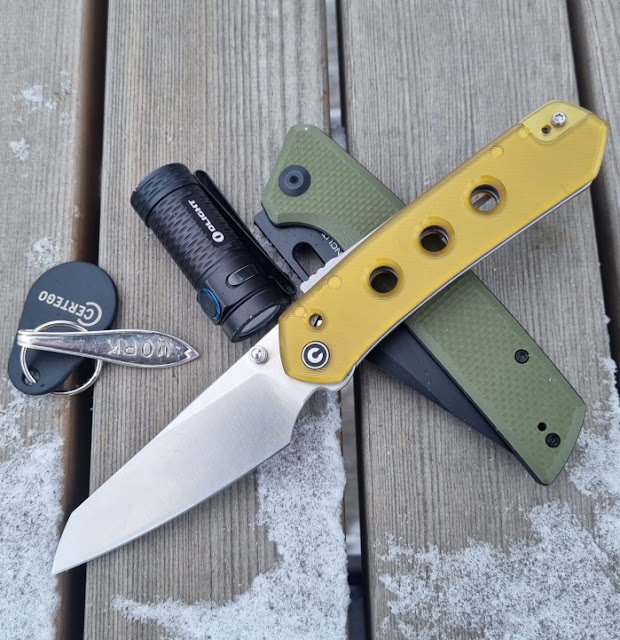
Färgen jag försökte addera till tillvaron består av knivar från ett av mina favoritmärken QSP som är represensenterade av den fällbara versionen av Canary, här med handtagssidor av Ultem. Det är en väldigt speciell form av "rymd"-plast med den speciella egenheten att den till skillnad från vanlig plast återfår formen om den utsätts för hög värme. Till en viss gräns får väl tilläggas i fall någon gör ett försök henmma. Smältes den till en boll lär den inte återgå till att vara ett knivhandtag. 

Tillsammans med den hittas den splitternya lilla dolken som döpts till Beetle. Ficklampan är någon billig no-name-historia från Lidl tror jag. Den fungerade märkligt nog alldeles utmärkt till att rota fram mina läderarbetssaker från en annars mörk bod. Det var nog dagens insats vad den beträffar. 

Själv har jag vissa planer på att försöka använda nyss nämnda attiraljer för att åstadkomma ett läderfodral till en av mina kastknivar. Fina kastknivar levereras nämligen utan dylika och just i det här fallet vill jag ha något som går att dra och kasta direkt ifrån passande en Zitoon Dague Commemorativé. 

Det återstår att se vad orken räcker till men vi synes i etern go´ vänner!

lördag 24 februari 2024

Review Civivi Vision FG


-  Snecx had a Vision


This knife from Civivi has already received a lot of attention in various contexts and rightly so. It is a knife that is right in time, especially with this handle material which is very trendy at the moment. But even without that, the design is interesting with a popular blade shape and not least a completely new lock type. In other words, there is much to study in more detail about Vision FG.

Civivi Vision FG


The title of course refers to the fact that this knife is a collaboration between Civivi and Snecx Tan from Malaysia and his Snecx Design Lab. The original version was called Vision and was a custom knife with an associated price tag. However, Snecx wanted it to be available to more people, and the idea for "FG" which stands for Field Grade was born.

The first production knives were and are made by WE with the suffix "R".* The materials used in them are more luxurious than in this case, the clip is different, and likewise the lock bar of the very special lock. He says himself that this knife is aimed at knife enthusiasts.

The next step was thus to further broaden the customer base and so Civivi Vision FG was born.

"Budget Snecx" med mycket fin prestanda


Short version: Civivi Vision FG shows that some visions shine brighter than others, especially if it's Ultem that shines. This is a damn good knife!


Blade


This blade shape** is very popular and is often referred to as "reversed tanto" by Civivi themselves on the website, among others. But I don't know, I personally think the term is misleading. It mostly shows that folding knife enthusiasts are not as familiar with kitchen knives as they are with other knives. If they were, they would recognize the look. If there is anything this blade resembles, it is a Japanese Kiritsuke. Google it and you'll see!

Although not everyone knows it, the inspiration for the blade shape comes from a kitchen knife


Either way, it's a very viable shape for an EDC knife. The edge itself has a slight curve, which makes it easier when cutting against flat surfaces. The cut part of makes the tip very effective can be added. Especially as it is found low, which makes it easier when cutting with the tip when, for example, opening a box or if something is to be shredded against a cutting board.

The blade is quite substantial and measures a hair under nine centimeters. The height is just over 27 mm at most and the thickness is 3 mm. 

The steel used is Nitro-V. A steel that I first became familiar with when I tested another knife from Civivi. That meeting was essentially positive and so is this one. It is a steel that is quite easy to keep sharp as it responds well to being stropped which is my main method of maintaining edges these days. It maintains sharpness well without being the most extreme steel in terms of endurance on the market. Stated hardness is 59-61 HRC, by the way, which is relatively high if it at least stays in the middle of that range, which explains that characteristic.

The finish is a glossy satin and the marking is exemplary and discreet as usual. You can use a magnifying glass to read the steel type far down on the ricasso and then find "Design by Snecx" on the lock side. The blade is otherwise completely clean. The only logo used is the Civivis "C" on the head of the pivot screw.

The blade is sparsely marked


Once in use, you can't help but be satisfied with the Vision FG. The blade is almost fully ground flat, which thins the thickness to 0.3 mm behind the edge. That's really thin, Civivi is starting to know how to make blade geometry by now. Not many other folding knife manufacturers can beat them in that area. When it is then combined with a sharp edge, the result is extremely good.

It is possible to use Vision for this type of task as well, but that is not its main strength

But when it comes to this kind of work, it's really good!


This blade makes the process short with all types of cardboard. It also bites well into fabric, plastic, and the like. If you then test the knife on various foods, you will notice that it is after all a small kitchen knife you are holding in your hand. It therefore cuts beyond expectations even in apples, celeriac, and the like, i.e. hard fruits and root vegetables.

Above all, this is an EDC knife, so Vision has been used extensively at work for opening various packages. This means some packing straps, tape, and a lot of cardboard and plastic of various hardnesses. From really thin to puncturing cooking oil cans so they don't "gobble" when you pour out of them. Whatever it is put up against, it can only be stated that it is a really good knife. Not least as it is very easy to pull, open, make a cut, and put away again. Exactly what is needed in these contexts. 


Handle


This handle is distinguished by four things. It is very yellow, it has holes in it, the lock bar is visible on the top and the shape is otherwise quite simple. If we start from the back with the appearance itself, it is almost a cigar-shaped handle with slightly angled ends. It is a very good foundation to stand on. The dimensions are 111 x 12 x 24 mm in terms of length, thickness, and height. Inside the knife is a stainless steel frame.

A rather uncomplicated handle shape which, however, offers some details and an interesting choice of material on the sides


Then there were the yellow semi-translucent sides. They are a result of choosing to use Ultem in this version. In its search for exciting news, the knife industry has borrowed some "high-tech" plastics from the space industry. Ultem is a brand name for PEI which is a variant of polymer plastic. It is light, strong, impact-resistant, and, for being plastic, can withstand very high heat without being deformed. The latter is perhaps of a more academic nature in this use. Or maybe for those who know that they sometimes forget their knife in a scorching oven.

The surface has fine lines that provide a reasonably good grip so you don't slip off the handle. Even the lock bar, which forms a thumb ramp, contributes to stopping the hand from sliding forward.

The Vision FG is not a very small knife and overall it is comfortable in the hand but...


Incidentally, that brings us to another one of the visible features - the holes. In addition to being a design element, they lighten the knife a bit and provide the fingertips and thus the hands with a better grip. Some people don't like holes in handles, I'm more neutral about that. They work well, especially as they are completely through. Although it only applies to three of the holes. The fourth, I suspect, exists for only one reason. It shows how the lock works. That together with the semi-transparent material allows you to study parts of the inside of the knife without disassembling it.

If you want to disassemble your knives, you can. In the stern, you will find a through screw with a T8 head and loosen it together with the pivot screw of the same size and you are well on your way.

Furthermore, there is a recess in the handle for attaching the clip on both sides. There is no hole for the attachment of a lanyard, but there is a bolt in the back that fulfills the same function.

...if the knife is not held in the left hand with the clip on the right side as in the pictures, the back end unfortunately often digs into the hand. It can be avoided to some extent by adjusting the grip but not completely


I often say that if you don't want to achieve something specific, keep it simple. This applies to both blade and handle when it comes to knife design. Snecx has done that here. The sides are flat, the back very slightly curved and the underside as well. The ends are rounded with a more pointed shape. Everything is nicely rounded and thoroughly comfortable. In addition, the knife is equipped with a rather substantial recess that acts as a combined "sharpening and finger choil". It is therefore possible to place an index finger there if you want to get even closer to the edge for increased control.

Any way to hold the knife works. Hammer grip is excellent although I would have liked to see the part where the index finger meets the handle even slightly more rounded for even better comfort. In a saber grip, the user can choose to place the hand far back with a thumb on the ramp that is naturally formed by the lock bar or, alternatively further forward. Other variations on grips, such as reverse grips, also work excellently. 

But then there is an elephant in the room and that is the clip. Not the piece of metal itself, but where it is placed. I don't agree at all with how it's done. Since it sits far back, it really shouldn't be found that high. It is possible to avoid discomfort if you adjust the grip in the hammer grip and sneak really far forward. Otherwise, it is not convenient. It is a hot spot. In a saber grip, the loop is always felt against the inside of the hand. The knife is significantly nicer to work with if the clip is removed.

But that detail spoils long-term use without gloves can be ascertained.


Opening and Lock


There is no getting away from the fact that the Vision FG is a knife whose handling is exceptionally good. The blade runs on ball bearings and weighs a bit so it swings well. I write swing as the blade moves completely freely when the lock is disengaged. It is at least as easy to handle as most locks with a transverse bolt (Cross bar locks a lá Axis) and actually smoother and easier to use than them. The reason for that is that here, too, it is the lock that holds the blade in place. There is thus no detent ball. 

Therefore, this knife can advantageously both be opened and closed by pulling the lock bar backward, which releases the mechanism. For those who value such things, the fidget factor is sky-high in this one. 

The thumb studs are exceptionally well-placed and work perfectly. Then it is just as quick to fold out the blade by releasing the lock


If you want to be a bit more traditional, there are a pair of double-sided thumb studs available. The function of them is also excellent. The shape is soft and comfortable against the thumb, they are correctly placed and protrude just enough. The knife's extremely smooth action also allows the user to choose between slow roll the blade, flicking it out with the thumb, or using an index finger on the back of the blade. Everything works equally good.

The lock is a subject by itself as it is a completely new type of lock developed by Snecx


Then we come to this knife's perhaps main asset in terms of innovations and that is, of course, the lock construction. It is called Superlock and is Snecx's own contribution to the increasingly growing lock flora.

But he has really done something good. This is a lock that is easy to use, performs its function excellently, and is not overly complicated. The construction is based on a lock bar that springs backward. It is a bit counter-intuitive at first as you are used to pushing back-mounted lock bars downwards, which you do not do here. On the WE version and the custom knife, you can even remove the lock bar if desired.

The function is very smooth while managing to hold the blade in place without a hint of play in any direction. A certain resistance is felt from the spring, but it is not difficult to release the lock. The lock bar itself has some small grooves on the front and some rougher ones on the top to increase traction.


To Carry


Ultem is not only an interesting material, but the surface also provides a knife that is easy to draw and put away. At least in this version with this pattern. Incidentally, this is not an unimportant feature for a pocket knife, as many tasks may consist of a quick cut or two, after which the knife must be put back in the pocket.

It is facilitated by the rather smooth material and the fact that the clip does not rest against the existing holes. This prevents the fabric from sticking.

What must be put away is, as I said, a handle of eleven centimeters which is not excessively thick and which weighs in at 117g. It is not a monster to be banished to the dark depths of doomsday pockets, in other words.

The overall height is 35mm and that comes from a combination of the handle height, how much the blade sticks out, and the fact that the lock bar rises slightly above the rest.

There's nothing wrong with the clip, possibly a little boring, but I'm not a fan of the placement


Both the clip in its current form and the origin can be discussed. The Vision originally had a back-mounted clip inspired by the CRKT Swindle. Now, I don't know how the Snecx variant works, but I didn't like the template at all. Although it can be said right away that the clip found on the Vision FG does not stand out in any way in terms of shape. On the contrary, it is one of Civivi's standard spring steel clips. Nothing bad about them, they work well.

Especially when, as here, the attachment point is recessed and flat T6 heads are used. This makes all the space under the clip available for fabric. In addition, it can be added that the tension is great. The tip certainly points outwards but the outermost bit is angled so it doesn't cause any problem. All very well thought out so far. Then this is a "deep ride" clip that makes the knife invisible once it's in the pocket. 

But then there was the problem I described above. The placement causes the bend that occurs due to the shape of the clip to cut into the hand in multiple grips. It is less good.

Otherwise, the clip can be repositioned to the left side if desired.


To Conclude


I would probably argue that Civivi and Sneckx are playing Robin Hood with this model. More features at a lower price for the people. Now it is perhaps not just goodwill that is the driving force behind them wanting more people to take part in this smart design and not least the innovative lock. There is of course money to be made. But this knife deserves good sales. This is a good example of a win-win situation. They sell knives and we consumers get a good product. And since it has been moved from the promised land of custom knives to Civivi, the price picture is completely different. That without the quality necessarily deteriorating.
The Vision FG features the usual high manufacturing quality from Civivi. It does not disappoint in that area


This is a damn good knife. Certainly, it is centered around a few fixed points where the handle material and above all the lock are the two main ones. However, the former can be varied and if you prefer G10, it is available. But now Ultem happens to be a good material but I know the translucent yellow shade doesn't appeal to everyone. The lock, on the other hand, I find it very hard to believe that anyone has any objections to it. It is easy to use, completely ambidextrous, which also applied to the entire knife, and strong. A very good lock, in other words.

Although it is technology and to some extent design that elevates the knife, the basic characteristics of a good tool are also in place. The blade is practical and works great for most tasks that don't include skinning a moose or carving wood figures as a profession. The beauty lies in the clean lines and the stylish satin finish and not in a plethora of details. However, the surface is prone to scratching.

The handle matches the rest of the knife with its technical slightly futuristic design language, which is perhaps more obvious on the custom knives in titanium, but which is still visible here, lifted by the Ultem sides that allow the inside to be visible. The shape is simple but comfortable and that's enough.

Even the sun has its spots, they say. As for the Vision FG, one of them is found in the clip or rather its location. The original is of a completely different type that I cannot comment on. The clip itself is of the usual Civivi type, but the position, which is far back and above the center line of the handle, means that it is felt in the hand in almost all grips. As long as you don't hold the handle tightly, or use gloves there is no problem. But if you cut hard, it will cause a hot spot. It feels unnecessary on an otherwise superb knife.
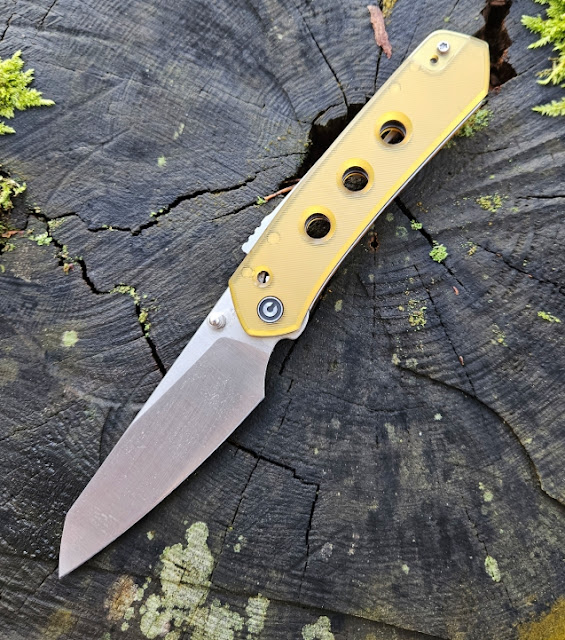
Civivi Vision FG is an everyday companion I highly recommend


Now it is possible to remove the clip and besides, it is not so bad that it somehow lowers the knife as a whole. It just detracts a bit from the otherwise bright radiance. The Civivi Vision FG is still a damn good EDC knife. If you have heard positive reviews, it is because there is reason for them.


Civivi Knives


Specification:


Length Overall: 202 mm
Length Folded: 113 mm
Weight: 117 g (weighed by me, stated 116g)
Blade Length: 90 mm
Blade Thickness: 3 mm
Blade Steel: Nitro-V, 59-61 HRC
Handle: Ultem
Lock: Super Lock

Produced by: Civivi, made in China


/ J - supporter of super lock

* There are also some knives produced by CKF. 
The same name is used for the blade of the famous Benchmade 940 pocket knife. As you can see for yourself, they don't have much in common apart from the straight clipped tip, and I personally think, as I said, that "reversed tanto" is misleading.


tisdag 6 februari 2024

Review - QSP Canary Folder


- a successful transformation

It should be pointed out at the outset that I also appreciate the original from QSP. Their Canary is a "neck knife" or perhaps rather small fixed blade for EDC use that I previously reviewed here on the blog. Overall a very likable little knife. I want to stress the word small as it really is and actually grew a size when translated to folding knife format.

Anyway, it made me curious as to how that model would perform when it got a joint in the middle. Here are my impressions of the Canary Folder.

QSP Canary Folder


In addition to me, QSP also seems to believe that it will be a success as the model is already available in ten different versions right from the start. This is the most luxurious variant as another option for handle material has been chosen. The others have been provided with sides in G10 in varying colors. I will return to what this splash of color is. 

Not only that but just before I was about to wrap up this review, QSP revealed that they are also expanding the Canary family with a larger fixed-blade version! It also looks promising.

This is an excellent little pocket knife with a golden touch


Short version: QSP Canary Folder, an orgy in everyday function!

Blade


The shape of the blade is of course recognizable from the original, everything else would be strange. However, some changes have been made. Above all, what was mentioned in the introduction has grown a size, from 63 mm to in this case 72 mm. The height is 24 mm and the thickness is the same as before, 3 mm.

The finish is a fairly glossy satin. All in all, a simple and straightforward blade as I sometimes put it. Usually, it's positive and so this time too.

The Canary Folder boasts the same simple drop point as its predecessor


There is a difference between the original which has a high saber grind and this knife which boasts a full flat grind. That, in combination with a relatively thin blade stock, means that the knife has good basic properties. Especially as the blade measures 0.4mm behind the edge. The edge was more than decent from the factory as it arrived very sharp, reasonably symmetrical if not perfect, and straight.

The steel used is 14C28N from Sandvik


All in all, that makes the blade an excellent tool for all kinds of small jobs. Sharp, FFG with some height gives decent geometry. The advantage of that is that the knife cuts relatively well even if it is not razor sharp.

A typical area of use, packaging opening at work


Speaking of sharpness, the blade keeps its sharpness well, but the steel could be more durable. It's especially noticeable if you are cutting hard plastic and the like. Then you notice that this is not the hardest of materials. The blade steel is one of QSP's staple products in the form of Swedish 14C28N from Sandvik. In return, this knife responds very quickly to being stropped. With a few quick strokes sharpness is restored.


Handle

I almost wrote, "Canary Folder has handle in G10". That is true for all versions released so far, except for this one, which instead has material that is trendy at the moment. The knife manufacturers have found "Ultem". Simply put, it is the brand name for PEI (a variant of polymer plastic). It is very strong in different ways and light.* Another perhaps less important characteristic in the world of knives is that it can withstand very high heat without being deformed. In short, it is an excellent handle material, which in this design is semi-transparent as seen. The yellow color seems to go with the territory as I have seen several different products made by Ultem in the same shade.

The handle shape is simple and uncomplicated but works great


In the handle sides, the same pattern with four holes that were on the original model is found. They actually serve a couple of purposes. On the one hand, they are a decorative element so the knife becomes visually more interesting and on the other hand, they make the knife lighter. Not least as the holes extend through both sides and frame on the presentation side. In addition, they strongly contribute to a better grip when using the knife. The fingertips have somewhere to rest.

Here you can clearly see that the material in the handle sides, Ultem, is semi-transparent. The color is greatly affected by how the light falls on the handle


So does the slightly bumpy surface that the handle sides are provided with. Otherwise, it can be said of them that they are beveled around all edges. This applies to both the outside and the inside. Overall, Canary Folder feels well-crafted despite its simple form.

The handle is 95 mm long and basically the entire length can be used to grip around. It widens to a smaller finger guard at the front otherwise it's fairly straight except for a small bump in the middle and a hint of ducktail towards the end.

Speaking of ends, there is also a hole in the stern for a lanyard that swallows a normal paracord for those who wish to attach one to their knife.

The Canary Folder is larger than the original but still belongs to the smaller group of knives. Even so, the handle holds a full grip even if it's just barely


A handle this simple can hardly go wrong. Or at least don't in this case. All the standard grips I usually try work not only well but excellently, whether it's a hammer grip, saber grip, reverse grip, the ice pick variant, or holding the knife in the pinch or with an index finger on the back of the blade.

Combined with neutral balance and low weight, the knife feels lively in the hand and is easy to work with. Then of course there are disadvantages, but they are linked more to the format than to the execution. A handle this thin can never be the most ergonomic for heavy work. Physics puts an end to that.


Opening and Lock


The Canary Folder opens with double-sided thumb studs. The way it is done is exemplary. The placement of them and the well-balanced resistance in the detent ball means that it is easy to both slow roll the blade and flick it out if desired.

The thumb studs on this knife work great


Then, of course, the smooth running is facilitated by the fact that this knife, like many others from QSP, has been equipped with ceramic ball bearings.

The studs themselves are barrel-shaped, which is one of the standard variants. They have the advantage that they do not feel sharp against the thumb. Then they are well positioned in such a way that they not only facilitate the opening of the blade but also so that they are out of the way when cutting with the knife. Well done QSP!

A liner lock provides safety


The lock is easy to access as the lock bar rises slightly above the handle


The lock is just as straightforward. QSP uses a liner lock and it's a technique they've mastered to perfection by now. More concretely, this means that the blade is held in place without play in any direction and that the lock is also very easy to disengage. It is also possible to point out that the lock works every time the knife is opened and that I have not had it slip at all. Not even with some moderately hard "spine whack" tests, that is, hitting the back of the blade.

The lock bar is easy to reach as it has been given a little pattern for better traction and rises slightly above the sides of the handle. The opposite side is also slightly recessed, which further increases access.


To Carry


Oh yes! This is one way of summarizing the characteristics of how this knife feels in the pocket. It doesn't really get that much better. The dimensions are discreet and then it is mainly the thickness that I think of. It is under 11 mm. When it is then combined with a thin blade and a light handle material, the end result is also light, more precisely 79 g.

The shiny steel clip is of the "deep carry" type and can be repositioned if the knife is to be carried on the left side


Then all edges and corners are rounded as they should be. There is nothing sharp or angular to be irritated by. In addition, a handle material that does not cause any problem with excessive friction even if there is some resistance. In this case, it mostly contributes to the knife sitting a little more securely in the pocket.

The clip is recognizable from other knives from QSP


The rather shiny steel clip is what mostly ensures that the knife stays there. It's one of QSP's standard clips but it's not a bad thing in this case. Good tension, plenty of space underneath, and a shape that makes the knife sit deep in the pocket. The mount is recessed into the side of the handle and although the screws don't have flat heads they don't stick out much. A small luxurious bonus is that the opposite side has a metal plate which means that there is not a big hole in the handle when the clip is not there.

Overall a very good clip. Especially as the tip, which certainly is a bit pointy, does not feel at all against the hand when the knife is used.


To Conclude


QSP is a company that appears to be in the "zone" at the moment. By that I mean, of course, that they have released several knives which are partly really capable but which have also reached many people and thus seem to sell well. This is one of them!

The short summary is that Canary Folder is an unusually successful transfer from one format to another. In addition, a little unusual as it is usually folding knives that turn into fixed blades.

In addition, there is something about the format itself that appeals to me. This is especially evident when compared to knives such as Cold Steel Hold Out III, Benchmade Bugout, and SRM 255. They are all thin and light and thus disappear in your pocket. In addition, they offer a lot of cutting strength to their size. But if the price is taken into consideration, one of these knives quickly disappears in the backwater compared to the other three.

It is with this type of knives Canary Folder can be compared. Lightweight "EDC" knives

 
The blade of the Canary Folder is simple and straightforward. But the nice proportions and the fact that it's practical still make it quite attractive, albeit in a quiet way if you can put it that way. The rest of the knife is also a sympathetic acquaintance.

For the simple reason that the handle matches the blade in terms of function and appearance. It gives a pleasing harmony. But there is one area that elevates the knife above many others, not least in this price category, and that is how it feels to open. Handling this knife is a pure joy.

Increasing the size and turning the model into a folding knife was a stroke of genius. The result is a really good and affordable pocket knife


Then I have already claimed that it is excellent in the pocket. You can't ask for much more from a pocket knife. There are always objections and one such is, of course, that it is not an exclusive knife, even if it feels well-made. The materials are not extraordinary and it is not full of exotic details. In return, it is reflected in the price. Seeing it makes you happy again.

Canary Folder is as likable as it looks. As the material in this design is something of a watershed, it can be pointed out that it is available in many other versions as well


Thus, provided that it is not a luxurious status item you are looking for but a competent folding knife, this is a particularly viable alternative. In fact, I can't think of anything negative at all. Of course, there are limitations, but they are tied to the format, not design, execution, or materials.

Especially when the price is currently around SEK 650 in Europe. Yes, or less if you don't choose this version with Ultem grips.


Specification:


Length Overall: 167 mm
Length Folded: 95 mm
Weight: 69 g (weighed by me, stated 69g)
Blade Length: 72 mm
Blade Thickness: 3 mm
Blade Steel: Sandvik 14C28N, HRC 59-61
Handle: Ultem
Lock: Liner Lock

Produced by: QSP, made in China


/ J - likes his birds

* Due to its excellent properties, including the fact that it is not particularly prone to mechanical fatigue, it is used in the space industry, among other things.

söndag 4 februari 2024

Recension QSP Canary Folder


-  en lyckad transformation

Det bör redan inledningsvis påpekas att jag även uppskattar originalet från QSP. Deras Canary är en "neck knife" eller kanske snarare fastbladare för EDC-bruk som jag tidigare recenserat här på bloggen. En sammantaget mycket sympatisk liten kniv. Jag vill trycka på ordet liten då den verkligen är det och faktiskt växte en storlek när den översattes till fällknivsformat. 

Hur som haver gjorde det mig mycket nyfiken på hur den modellen skulle te sig när den fick en led på mitten. Här följer därför mina intryck av Canary Folder.

QSP Canary Folder


Utöver mig verkar även QSP tro på att det skall bli en succé då modellen redan från början finns att tillgå i tio olika utföranden. Det här är den lyxigaste varianten då ett annat alternativ till handtagsmaterial valts. De övriga har försetts med sidor i G10 i varierande färger. Vad den här färgklicken är återkommer jag till. 

Inte nog med det, precis innan jag stod i begrepp att avrunda den här texten har QSP avslöjat att de även utökar Canary-familjen med en större fastbladad version! Även den ser lovande ut. 

Det här är en utmärkt liten fickkniv med en gyllene touch


Kortversion: QSP Canary Folder, en orgie i vardagsfunktion!


Blad


Formen på bladet känns förstås igen från originalet, fattas bara annat. Men vissa förändringar har ändå gjorts. Framförallt har det som nämndes i ingressen vuxit en storlek, från 63 mm till i det här fallet 72 mm. Höjden är 24 mm och tjockleken är densamma som tidigare, 3 mm. 

Finishen är en tämligen blank satin. Sammantaget ett enkelt och rättframt blad som jag ibland brukar uttrycka mig. Vanligen är det positivt och så också den här gången. 

Canary folder ståtar med samma enkla drop point som sin föregångare


Det föreligger en skillnad mellan originalet som har en hög sabelslipning och den här kniven som ståtar med en full flatslipning. Det i kombination med ett relativt tunt bladgods gör att kniven har goda grundegenskaper. Särskilt som bladet mäter 0,4 mm bakom eggen. Den senare var från fabrik klart godkänd då den anlände mycket vass, någorlunda symmetrisk om än inte perfekt samt rak.  

Stålet som används är 14C28N från Sandvik


Sammantaget gör det bladet till ett utmärt verktyg för allehanda småsysslor. Vasst, fullt flatslipat till rätt bra höjd ger hygglig geometri. Fördelen med det är att kniven skär relativt bra även om den inte är rakbladsvass. 

Ett typiskt användningsområde, förpackningsöppning på jobbet


Appropå det så håller bladet skärpan dugligt men stålet är inte extremt uthålligt. Särskilt inte om man skär hårdplast och liknande. Då märks det att det här inte är det hårdaste av material. Bladstålet är en av QSPs stapelvaror i form av svenskt 14C28N från Sandvik.  I gengäld reagerar den här kniven mycket snabbt på att bli striglad. Några snabba drag och skärpan är återställd. 


Handtag


Canary Folder har handtag i G10 höll jag på att skriva. Det stämmer nämligen för alla hittills släppta versioner förutom den här som istället har ett för stunden trendigt material. Knivtillverkarna har nämligen hittat "Ultem". Enkelt uttryckt är det varumärket för PEI (en variant av polymerplast). Det är mycket starkt på olika sätt samt lätt.* En annan kanske i knivvärlden mindre viktig egenskap är att det klarar mycket hög värme utan deformeras. Kort sagt är det ett mycket bra handtagsmaterial som i det här utförandet är halvgenomskinligt som synes. Den gula färgen verkar det som man får på köpet då jag sett flera olika produkter gjorda av Ultem i samma nyans. 

Handtagsformen är enkel och okomplicerad men fungerar utmärkt


I handtagssidorna hittas samma fyra hål som återfanns redan från början. De tjänar faktiskt ett par syften. Dels är de ett dekorativt element så kniven rent visuella blir mer intressant och dels gör de kniven lättare. Inte minst som hålen sträcker sig genom både sidor och ram på presentationssidan. Därutöver bidrar de starkt till bättre fäste när  man använder med kniven. Fingertopparna har någonstans att ta vägen. 

Här syns väl att materialet i skollorna, Ultem, är halvgenomskinligt. Färgen påverkas mycket av hur ljuset faller på handtaget


Det gör även den lätt knottriga ytan som handtagssidorna försetts med. I övrigt kan sägas om dem att de är fasade runt alla kanter. Det gäller såväl ut- som insida. Överlag känns Canary Folder välarbetad trots sin enkla form.  

Handtaget är 95 mm långt och av det kan i princip hela längden nyttjas för att greppa kring. Det vidgar sig till ett mindre fingerskydd framtill annars är det tämligen rakt förutom en liten bula på mitten och en antydan till ankstjärt mot slutet till. 

Apropå slut så hittas i aktern även ett hål för fånglina som sväljer vanlig fallskärmslina för den som önskar fästa en sådan på sin kniv. 

Canary Folder är större än förlagan men tillhör fortfarande den mindre skaran knivar. Trots det rymmer handtaget en fullt grepp även om det är knappt


Ett så här enkelt handtag kan knappt gå fel. Eller gör i alla fall inte det i det här fallet. Alla standardgrepp jag brukar pröva fungerar inte bara bra utan utmärkt vare sig det är hammargrepp, sabelgrepp, omvänt grepp, ishacke-varianten eller att hålla kniven i nypan eller med ett pekfinger på bladryggen. 

Det kombinerat med neutral balans och låg vikt gör att kniven känns livlig i hand och är lätt att arbeta med. Sedan finns det givetvis nackdelar men de är knutna mer till formatet än till utförandet. Ett så här tunt handtag kan aldrig bli det mest ergonomiska för tunga arbeten. Det sätter fysiken stopp för. 


Öppning och lås


Canary Folder öppnas med tumknoppar. Sättet det är gjort på är exemplariskt. Placeringen och det väl avvägda motståndet från "detent"-kulan gör att det med lätthet både går att smyga ut bladet och snärta fram det om så önskas. 

Tumknopparna på den här kniven fungerar utmärkt


Sedan underlättas förstås den mjuka gången att den här kniven som många andra från QSP har försetts med keramiska kullager. 

Själva knopparna är tunnformade vilket är en av standardvarianterna. De har den fördelen att de inte känns vassa mot tummen. Sedan sitter de väl placerade på så vis att de inte bara underlättar öppnandet av bladet utan även så att de är ur vägen när man skär med kniven. 

En liner lock står för säkerheten


Låset är lätt att komma åt då låsarmen sticker upp en bit i relation till handtaget


Låset är lika okomplicerat det. QSP använder sig av en liner lock och det är en teknik som de behärskar till fulländning vid det här laget. Mer konkret innebär det att bladet hålls på plats utan spel eller glapp och att låset tillika är mycket lätt att släppa. Det går även att påpeka att låset fungerar varje gång knivne öppnas och att jag inte fått det att glida överhuvudtaget. Inte ens med lättare "spine whack"-test, det vill säga att man slår på baksidan av bladet. 

Låsarmen är enkel att nå då den fått lite mönster för bättre fäste samt höjer sig en aning över handtagssidorna. Motstående sida är dessutom något försänkt vilket ökar åtkomsten ytterligare. 


Att bära


Oh ja! Så kan egenskaperna i fickan sammanfattas. Så mycket bättre blir det faktiskt inte. Måtten är diskreta och då är det framförallt tjockleken jag tänker på. Den är under 11 mm. När det sedan kombineras med ett tunt blad och ett lätt handtagsmaterial så blir även slutresultatet lätt, närmare bestämt 79 g. 

Det blanka stålclipet är av "deep carry"-typ och kan skiftas om kniven skall bäras på vänster sida


Sedan är alla kanter och hörn rundade som sig bör. Det finns inget vasst eller kantigt att irritera sig på.  Utöver det ett handtagsmaterial som inte orsakar något problem med överdriven friktion även om visst motstånd finns. I det här fallet bidrar det mest till att kniven sitter lite säkrare i fickan. 

Clipet känns igen från andra knivar från QSP


Det tämligen blanka stålclipet är det som mest ser till att kniven stannar där. Det är ett av QSPs standardclip men det är inget dåligt i det här fallet. Bra spänst, gott om utrymme under och det gör att kniven sitter djupt i fickan. Fästet är försänkt i handtagssidan och även om skruvarna inte har platta huvuden sticker de inte upp mycket. En liten lyxig bonus är att motstående sida fått en metallplatta som gör att det inte är ett stort hål i handtaget när clipet inte sitter där. 

Sammantaget ett mycket bra clip. Särskilt som spetsen, som förvisso sticket ut en smula, inte känns alls mot handen när kniven brukas.  


Sammanfattningsvis


QSP är ett företag som förefaller vara inne i ett "stim" för tillfället. Med det avser jag förstås att de släppt ett flertal knivar som dels är riktigt dugliga men som även nått ut till många personer och därmed förefaller sälja bra. Det här är en av dem! 

Den korta sammanfattningen är att Canary Folder är en osedvanligt lyckad överföring från ett format till ett annat. Därtill en smula ovanligt då det oftast är fällknivar som förvandlas till fastbladare. 

Därtill är det något med själva formatet som tilltalar mig. Det syns inte minst om den jämförs med knivar som Cold Steel Hold Out III, Benchmade Bugout och SRM 255. De är alla tunna och lätta och försvinner därmed i fickan. Därtill erbjuder de mycket skärstyrka i relation till sin storlek. Sen kan prisläge diskuteras och då försvinner snabbt en av de här knivarna i bakvattnet jämfört med de tre andra.

Det är med den här typen av knivar Canary Folder kan jämföras. Lättvikts"EDC"-knivar

 
Bladet på Canary Folder är enkelt och okomplicerat. Men de trevliga proportionerna och det faktum att det är praktiskt gör det ändå tämligen attraktivt, fast på ett stillsamt sätt om det kan uttryckas på det viset. Även resten av kniven är en sympatisk bekantskap. 

Det av det enkla skälet att handtaget matchar bladet vad gäller funktion och utseende. Det ger en tilltalande harmoni. Men det finns ett område som höjer kniven över många andra, inte minst i den här priskategorin och det är hur den känns att öppna. Att hantera den här kniven är nämligen en ren fröjd. 

Att öka storleken och förvandla modellen till fällkniv var ett snilledrag. Resultatet blev en riktigt bra och prisvärd fickkniv


Sedan har jag redan hävdat att den är utmärkt i fickan. Så mycket mer kan man inte begära av just en fickkniv. Invändningar finns alltid och en sådan är förstås att det inte är en exklusiv kniv det handlar om även om den känns välarbetad. Materialen är inte extraordinära och det kryllar inte av exotiska detaljer. I gengäld avspeglas det i priset. När man ser det blir man glad igen. 

Canary Folder är lika sympatisk som den ser ut. Då materialet i det här utförandet är något av en vattendelare kan påpekas att den finns i många andra utföranden också


Därmed kan konstateras att förutsatt att det inte är en lyxig statuspryl du söker utan en kompetent fällkniv så är det här ett synnerligen gångbart alternativ. Faktum är att jag inte kan komma på något negativt alls. Visst finns begränsningar men de är knutna till formatet, inte design, utförande eller material. 

Särskilt när priset för närvarande ligger kring 650 SEK i Europa. Ja, eller mindre om du inte väljer den här versionen med Ultem-handtag.  


Specifikation:


Längd utfälld: 167 mm
Längd hopfälld: 95 mm
Vikt: 69 g (vägd av mig, uppgiven vikt 69g)
Bladlängd: 72 mm
Godstjocklek: 3 mm
Bladstål: Sandvik 14C28N, HRC 59-61
Handtag: Ultem
Lås: Liner Lock

Producerad av: QSP, tillverkad i Kina


/ J - gillar sina fåglar

* På grund av sina utmärkta egenskaper inklusive att det inte är särskilt benäget att drabbas av mekanisk utmattning gör att det bland annat används i rymdindustrin.