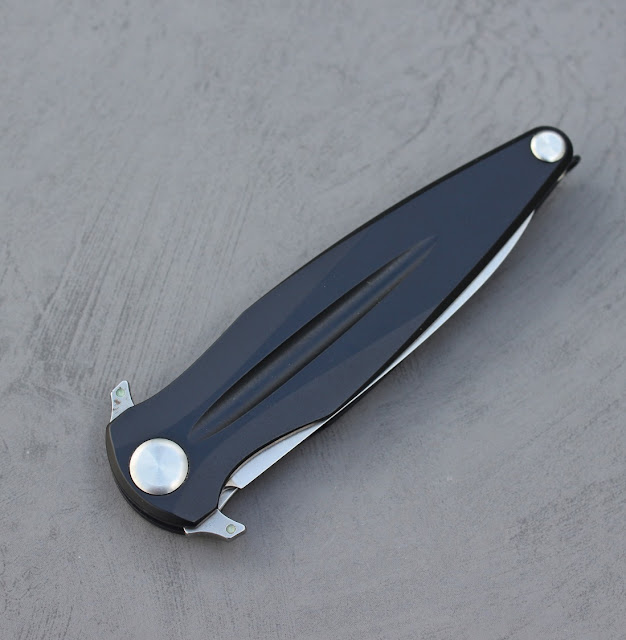
Visar inlägg med etikett folding dagger. Visa alla inlägg

fredag 24 oktober 2025

Fredags-EDC CXLV "Colour"

Ett desperat försök gjordes att addera lite färg till en annars genomgrå dag. Det färglösa hittas inte bara ute, utan även inne och inte  minst i sinne. Men det går över det också. Det är i alla fall vad min psykolog säger. 

Själv misstänker jag att det tillfrisknandet skulle må lite bättre av sol. Sådär som det var för någon vecka sedan. Och får jag  inte sol vill jag i alla fall ha uppehållsväder, särskilt vill jag  ha det på söndag. Det finns en orsak till det. Då har nämligen VAIS nya sektion Växjö Sportkastning en pröva på dag uppe vid VAIS-torpet i Växjö. 

Alla som vill är välkomna till en liten  förevisning av kniv och yxkastning i lite olika varianter. Sedan får man förstås pröva lyckan själv också. 

För instruktionerna står undertecknad. Nu har jag förstått att man skall skryta om sina meriter på internet så jag får väl åtminstone säga att jag har några VM-medaljer varav en guld och är flerfaldig svensk mästare i No Spin. Vid sidan av det tillkommer en rad medaljer även i rotationskastning och numera till och med i yxa. Så något borde jag väl kunna visa. 

"Colour"

Färgen jag försökte addera till tillvaron består av knivar från ett av mina favoritmärken QSP som är represensenterade av den fällbara versionen av Canary, här med handtagssidor av Ultem. Det är en väldigt speciell form av "rymd"-plast med den speciella egenheten att den till skillnad från vanlig plast återfår formen om den utsätts för hög värme. Till en viss gräns får väl tilläggas i fall någon gör ett försök henmma. Smältes den till en boll lär den inte återgå till att vara ett knivhandtag. 

Tillsammans med den hittas den splitternya lilla dolken som döpts till Beetle. Ficklampan är någon billig no-name-historia från Lidl tror jag. Den fungerade märkligt nog alldeles utmärkt till att rota fram mina läderarbetssaker från en annars mörk bod. Det var nog dagens insats vad den beträffar. 

Själv har jag vissa planer på att försöka använda nyss nämnda attiraljer för att åstadkomma ett läderfodral till en av mina kastknivar. Fina kastknivar levereras nämligen utan dylika och just i det här fallet vill jag ha något som går att dra och kasta direkt ifrån passande en Zitoon Dague Commemorativé

Det återstår att se vad orken räcker till men vi synes i etern go´ vänner!

söndag 12 oktober 2025

New Knife - QSP Beetle

The latest knives I have presented from QSP have been characterised as being medium to large and thoroughly practical. I am thinking of the recently reviewed Turtle Punk, but especially the Ripley. Now it gets a little more fun!

This thing is definitely bigger than you might first think. But it is certainly not boring. Let me introduce a fairly new knife called Beetle!

QSP Beetle

So far, it is available in five variants. One looks "normal", one is blacker than the night, and three are very colourful. Sometimes a little colour is needed in life, so I chose the striking combination of black and red.

In addition to the colour scale, the knife is recognisable by its slightly chubby silhouette and, of course, by the fact that it is a folding dagger. Certainly not double-edged in the original, but since the entire blade is hidden in the handle when the knife is closed, it is possible to sharpen the other side as well if desired.

About the knife, it can also be said that it is built around a colourful but lightened steel frame with sides of G10. It is a liner lock, and the blade is opened with a flipper. To facilitate this, the blade rides on ceramic bearings.

Beetle - a knife that is anything but boring 


The blade that emerges is a rather bulging spear point, but if you cover the upper half of the blade, what remains is quite practical. The length of the blade is 75 mm, which is matched by a width of just over 28 mm at most. The thickness is 3 mm, and the steel is 14C28N. A material QSP uses to an increasing extent in its mid-range knives, I have noticed.

The entire knife measures 180 mm when opened and 105 mm when closed. The weight is around 117 g.

Overall, a fun little folding dagger that is anything but boring! It is actually nice to hold as well. I will come back to you with more detailed thoughts about the other properties in the future.


/ J - likes some bugs

#knivesandbikes #knivigtvarre

tisdag 10 december 2024

Review Cold Steel Counter Point I


-  a folding dagger

Boot daggers have always been a popular format. They may not be the most practical knives, but they have 'it' regarding looks. However, daggers can be perceived as a bit aggressive. A folding version can be an advantage, as it looks less dangerous before it is opened.

Today, we will examine closely one of the models in  Cold Steel's range of that kind, the Counter Point I.

Cold Steel Counter Point 1


The number I, in this case, stands for the intermediate size, although now in the catalog, it is called Counter Point 4. There is also a little brother who is quite discreet with the addition "II." It has a seven-and-a-half-centimeter blade. Big brother Counter Point III, also called XL, is a badass in true Cold Steel spirit with a blade of about fifteen centimeters.
 
This is a model that has been around for a while, we're talking more than ten years and has therefore gone through a couple of different stages of development. The oldest knives were made in Japan and with a simpler domestic steel in AUS8. After that, American BD1 from Carpenter was used for a while. However, that steel turned out to be quite difficult to get hold of, which is why Cold Steel has now again landed in Japanese steel, even though the production has now landed in Taiwan. Another change is that the handle now has a very rough surface compared to before.

Despite the changes, the basis is the same, a very robust knife with a special appearance that I would like to present herewith.

There is no doubt as to which category of knives the Counter Point falls into


Short version: Cold Steel Counter Point, a quintessential CS product, that looks a bit provocative but is well-built and actually is more practical than you think


Blade


The Counter Point series has a very typical blade which is the very thing about this knife. It is, of course, about a distinct "spear point" with a strong false edge, which makes the blade look almost symmetrical. Just as it should on a dagger.

The length of the blade is actually debatable. Measured to the lower part of the handle, you end up just over ten centimeters or 102 mm. Then the distance that appears slightly smaller to the center is the handle that protrudes into a point. The reason for the measurements is simple, they want to guard against jurisdictions that do not allow lengths of blades over 4". In the USA, for example, such restrictions exist locally.

The blade is then 2.8 cm wide and has a maximum thickness of 3.4 mm.

In the unfolded position, a 102 mm spear point blade with a high flat grind is revealed


The grind is flat and quite high to be a saber grind due to the relatively wide blade. The knife is quite thick behind the edge with 0.6-0.7 mm. It provides a sturdy and durable edge but means that the Counter Point I may not be the best knife for the most delicate tasks but more for heavier work. Especially with this handle. But on the other hand, that is hardly surprising considering the appearance.

Overall, the blade shape sacrifices some practicality in favor of a specific aesthetic. But actually not as much as one might be led to believe. If you forget the double-edged look and imagine the back a little thicker instead, you will be left with a blade with the point in the right place and, as I said, with a fairly high saber grind.

The steel used is Japanese AUS10A


It actually makes this knife somewhat more practical than its appearance suggests. Especially as the factory edge was very capable. This becomes clear when dealing with everyday materials such as cardboard and thinner plastic. The Counter Point copes with that and all other daily tasks in an excellent way, although there are other knives that of course cut better if the feel of the cuts and the resistance of specific materials are compared. In return, there are not quite as many who penetrate this well. If you want to stab your knives into things, this is the knife for you. But that hardly surprises anyone. 

This isn't a winner for dealing with EDC tasks, but it doesn't make a fool of itself either. Even when cutting wood, this is not a bad knife. Especially not since the edge stretches relatively close to the handle. However, it is not possible to use "push cuts" there, as the thumb studs end up in the way. No Mora knife perhaps, but it is absolutely possible to use this knife for all kinds of work around a campfire as well.

The blade is strong enough for that and then you have the true strength of this knife which it is time to talk about now


Handle


When I reviewed a fixed-blade knife the other day, I mentioned that there were two types of handles, thin and thick. If that knife* belonged to the thin ones, then the Counter Point is definitely a representative of the second category. Especially for being a folding knife. We are talking here about a full 1.7 cm, which beats most other folding knives.

The length of the handle is 12.7 cm, of which eleven centimeters is available grippable surface behind the distinctive finger guards. The height of the handle is 2.2 cm as a minimum and 3 cm as a maximum, except at the end where it widens to 3.3 cm. The handle is quite heavily shaped in that direction. Especially with the substantial recess for the index finger. In fact, if it weren't for it, the entire handle would be almost as symmetrical as the blade in classic dagger fashion with a bulging center section.

The handle is built around a frame on which strongly shaped cleats in fiber-reinforced nylon are screwed


Underneath the shaped sides is an aluminum frame. It is heavily drilled, something that is hard to miss because the holes are continuous. The function of the frame is twofold, on the one hand, they stiffen up the handle, although it is hardly needed given the sturdy sides. In part, they act as an attachment point for the lock.

As I said, the large holes in the side are hard to miss. They actually serve multiple functions. The weight is of course reduced with them, but thus the balance is also improved. In addition, the holes improve the grip, especially in the saber grip, as the fingertips can rest in them.

A very massive handle that is a whopping 17.3 mm wide


Speaking of grip, a material called Griv-Ex is found in the handle sides. One of several variants that Cold Steel has used in recent years. It is about advanced plastic or, more precisely, fiber-reinforced nylon in some variants. Durable and practical but maybe not something you get excited about.

The surface looks almost glittery and this is due to the pattern which looks clogged. It provides a really good grip, almost similar to sandpaper. As mentioned earlier, it was a change from previous generations of Counter Points. Now, however, it is not news per se as the upgrade took place already in 2019.

If something is to be said about plastic in knife handles, it is that I generally do not appreciate the material but that there are some exceptions and this is one of them.

The sides are slightly arched and strongly beveled. That part is also without a pattern, which makes the handle slightly softer against the hand. They are screwed in three points in addition to the pivot screw. The size of the screw heads is the same scrap T6s that most people use. There is also a stop bolt and a through bolt for the lock that supports the handle even more.

Counter Point has a solid and comfortable handle


The Counter Point I is a knife that is fairly neutrally balanced with a slight back weight. The balance point is found in the middle of the recess behind the finger guard.

This is a knife that is good in any grip but superb in the saber grip. That's where the handle locks the best. The thumb naturally ends up against the ramp on the back and the index finger gets a good position in the recess intended for this purpose, while the fingertips of the middle and ring fingers poke a little into the holes on the sides. Something that is not visible in the picture as I hold the knife in my left hand and the clip is in the way. The material also bites the skin and the bell shape of the rear end rests against the soft parts of the hand. The knife is really stuck in that grip.

Reverse grips also work well


Even in a hammer grip, the knife is comfortable. As said, the curves are found in the right places and the increased width makes the knife both comfortable and even ergonomic. It's more the blade style that means the user may not work for hours on end with this knife but the handle can take it.

In addition to that, reverse grips work unusually well. A notch on the end of the handle gives the thumb somewhere to rest and the large surface makes it comfortable. Good if you are now going to stab something. 


Opening and Lock


Counter Point opens with thumb studs, period. No modern inventions like multiple opening methods and other nonsense. In fact, the wide and thus sloping false edge makes it impossible to get a proper grip to fold out the blade even with two hands.

The thumb studs are of a classic barrel shape and are really well placed. It's lucky because they're the only way to get the blade out


In addition, the force in the lock is so great that "Spydie flicks", i.e. flicking the blade open with the help of the index finger on the back of the blade, are not possible. All that remains is the thumbs up as I said.

They are symmetrical which is not always the case. On several of Cold Steel's knives, they are asymmetrical with a higher right side and a lower one on the left. They can be unscrewed with a little force and turned over even for the left-handed.

And since the lock, being a back lock construction is ambidextrous, so is the entire knife. Especially as the clip can be repositioned.

Here you can see the detail that distinguishes Tri-Ad locks from conventional lock backs, in this case, the heavily dimensioned stop pin


The lock is of course a Tri-Ad lock, anything else would have been strange as it is an Andrew Demko invention that Cold Steel is very proud of. Often called, especially by themselves, the world's strongest folding knife lock. It may or may not be, but strong it is and so also in this case.

What sets it apart from a more traditional back lock is that Demko added a stop pin that is sandwiched between the blade and the lock bar. This means that the force from the blade goes into it instead of pressing directly against the lock, which is the reason why almost all standard locks** of this type have a small but noticeable up-and-down movement. Of course, there is no such thing here. In fact, this knife almost feels like a fixed-blade knife. That's how solid it is.

It is noticeable when the lock is to be released because the spring tension is strong. However, it is nowhere near as over the top as the first variations of this lock were. It was about marking territory and making the lock as macho as possible. Another peculiarity that Tri-Ad locks have is that you have to press quite hard because the locking lug sits deep. The advantage of it in combination with the aforementioned bolt is that it extends the life of the lock. In fact, it is self-centering to some extent, so no backlash occurs after wear. It wears in rather than out.


To Carry


Sometimes, or rather quite often, I tend to claim that knives must be good at something. Of course, the reverse also applies. There's no nice way to say it, but Counter Point I is really chunky. A damn shameless one too.

The handle is almost thirteen centimeters long, the thickness is, as I said, a whopping 1.7 centimeters, and to that must be added a height of almost four centimeters, 37 mm, in the closed position. Overall it makes you feel like you tried to hide a walrus in your pocket. And you don't get such a damn long edge for that volume either. We are talking about 9.7 cm to be exact. 

The clip is one of Cold Steel's short standard types. It has a good ramp, far too high tension, and the friction against the handle is too high


So you have a solid seal in your pocket. However, not an excessively heavy one. Large holes, light material on the full sides, and a blade where a fair amount of the stock thickness has been sanded off means that the Counter Point weighs 135 g. Whether heavy or light, but in between in terms of dimensions.

It's not a shy knife. Three centimeters of the handle is visible and the clip shines as the sun


But the situation in the pocket doesn't get better because we have a classic Cold Steel clip here. It is like most made of spring steel. It is also quite small and very shiny. In other words, it is clearly visible. Especially as the placement makes a lot of knife stick out of the pocket. We are talking closer to three centimeters, which is not something I appreciate. We can discuss the topic of easier access to the knife at another time.

The clip apparently has to compensate for its small size by being extremely strong. You certainly won't lose your knife once it's in place, but it's really hard to get it there. Especially as Cold Steel insists on leaving the pattern on the handle where the clip meets the side. It literally eats fabric, I can tell you. Therefore, this clip needs some tweaking to work better. The pressure needs to be released a little and some sandpapering is needed where the handle and clip meet.

Then it's better, but despite that, it remains that the angle towards the attachment means that the edge of the fabric does not reach all the way in, whereupon even a little more of the knife sticks up. Better is that it is attached with a full three screws and that it is found in a recess. In other words, it sits still and does not move. The clip can also be moved to the left side or dismantled if desired. 


To Conclude


Cold Steel is a company that has often been controversial. This applies to some of their products as well as their advertising, especially the one that was made some twenty, or thirty years ago. It has not aged with dignity one can say.

Part of what attracted attention, albeit in a positive sense, is that they have a very broad model program. There you can find everything from fairly practical knives to the most eye-catching ones. Sometimes the entire range is found under a single knife model. Such is the case with the Counter Point family.

The smallest is a small pocketknife although it has a lot of attitude, the middle brother is massive and the big brother is a pocket sword that measures a little over a foot open. But what binds them together and makes them both noticeable and attractive is, of course, the pronounced aesthetics. The stated goal of former Cold Steel owner and designer behind this knife, Lynn Thompson, was to create a folding boot dagger. And he did!

Cold Steel has succeeded in creating an easily recognizable silhouette


Thus, it should be the first thing you look for to like this knife. One should also appreciate handles that have been lightened by having holes drilled through them. I know it's a watershed moment among knife enthusiasts. Some don't mind it or like the phenomenon, while for others it's downright discouraging.

But if you combine the holes, the rough surface of the Griv-Ex material, and the design of the thick handle, you get a knife that provides an incredibly firm grip. In general, the undersigned is not fond of plastic, either in nature or in knife handles. But there are a few exceptions and this is one of them. In this specific design of this knife model, it works great. 

The blade shape is not the best for "EDC" or everyday use. But it's actually better than you might think, so don't let that stop you from buying if you like the look. It is a fully competent working knife.

Appearance notwithstanding, the Cold Steel Counter Point I is an excellent working knife. IF you have big pockets that is


There you have the selling points. A stylish, semi-brutal, efficient, and also very well-built knife is what you get. The package includes a very strong lock, a solid handle as well as a really strong blade with a durable edge for being a dagger. Quality is emphasized through well-chosen materials rather than being exclusive. The entire knife feels and is very solid.

If that sounds like something for you, just go for it. For that pleasure, you can currently pay from around 90€ in Europe.


Specifications:


Length Overall: 229 mm
Length Folded: 127 mm
Weight: 137 g
Blade Length: 102 mm
Blade Thickness: 3,5 mm
Blade Steel: AUS10A
Handle Material: Griv-Ex
Lock: Tri-Ad

Produced by: Cold Steel, made in Taiwan


/ J - appreciate a nice dagger

* Which happened to be the Al Mar B-21, a fixed blade whose handle at its widest point measures 13.5mm compared to the Counter Point's 17.3mm.

** There are a few that don't have it but it requires incredible precision in manufacturing. One such knife is Lionsteel's TM1 which is the best lockback I've come across other than the Tri-ad Lock.

måndag 12 augusti 2024

New Knife - Cold Steel Counter Point I

The other day I wrote about "diving into the catalog" and it was  Cold Steel's line of products I was referring to. First up in the "testery" is this model called the Counter Point 1

Like almost everything else they make, this knife comes in several different versions. Especially since it's not a new model. Today it is available in three basic configurations where the blades are 3.4 or 6 inches long. This is the intermediate model which, with its ten centimeter blade, is not a small knife. Then you can imagine for yourself how big the 6" knife is. A true Cold Steel product.

Cold Steel Counter Point 1


The materials in the knife are not the most exclusive but are well chosen. The steel in the blade is AUS10 which is the finest in that series. One of the main features is that it is highly resistant to corrosion. But with just the addition "10" it should be a couple of notches up in general from AUS8, which is a more frequently used steel. It's new to me so it will be exciting to see how long it stays sharp.

In the well-proportioned handle, Griv-Ex is found, which is some form of polymer plastic. Maybe not the funniest of materials but very durable and practical.

There is no doubt where the inspiration for this knife comes from, it is a folding dagger!


The knife opens with double-sided thumb studs and locks with the oft-used Tri-Ad Lock. Often called one of the world's strongest locks for folding knives. It can always be debated, with my experience being that it's extraordinarily good. Not least because it does not develop a blade play over time, which other back locks can do.

Then something must be said about the actual shape of the knife. The heritage from a classic stiletto in the typical bayonet-grind blade is clear and there is no doubt that this is a folding boot dagger. But if you look at the blade in isolation, you will see that it is basically a regular flat-ground blade with a medium-high grind and an unusually aggressive swedge. Pretty practical after all!

The knife comes from the Swedish online store Knivshop and this Cold Steel venture is a collaboration with them. I'm curious to see how CS's newer knives stack up against the slightly older ones I have.


/ J - cooling himself with cold steel in the summer heat

#knivesandbikes #knivigtvarre

lördag 2 september 2023

Review MKM Flame Light


-  A foldable mini dagger

Most of the time, it's the immediate practical considerations that determine my opinion of a specific knife. However, aesthetics are never unimportant. If I can choose a good-looking and practical knife, it goes ahead of an ugly and equally practical knife. But sometimes appearance has to play an even bigger role. As in this case.

A dagger-inspired blade is rarely the most practical option if you're not going to stab things all day. Even so, I chose this version Flame Light. A knife from Italian MKM  - Maniago Knife Makers.

MKM Flame Light


This design from Michael Zieba has been around for a while in MKM's catalog as Flame and there are no less than ten versions to choose from. Somewhat confusingly, one version is made in green Micarta, which makes it deceptively similar to a "Flame Light". Only a few grams separate the models. But since it is out of stock on the website, I suspect that this new version simply replaced it.

"Light" means Micarta in the handle instead of titanium and carbon fiber which is found in the original "Flame". The handle is currently available in three different colors, black, natural and green. To further increase the options, there are also two different blade shapes to choose from. 

Tillverkad i Maniago, Italien


Short version: MKM Flame Light, for those who want a little more Shakespeare in their EDC rotation


Blade


It is hard to miss that it is a small dagger blade. Almost completely symmetrical if it wasn't for the fact that the blade is single-ground. In this embodiment must be added. For those who want even more functionality in the blade, a pointed drop point blade is also available.

The blade length is approximately 72 mm and the thickness a modest 2.5 mm. The height or perhaps the width of the blade is 14mm at the widest point, the blade base near the ricasso. Then the blade quickly tapers to a distinct tip.

The dagger-shaped blade is 72 mm long


Otherwise, the blade is characterized by a pronounced "fuller" or blood groove, which for some inexplicable reason it is also called. The blade finish is an excellent stone wash and the blade is marked with MKM's logo on one side and opposite is found Zieba's name along with "Made by MIKITA". 

It's a little complicated because MKM is a collective name as the name suggests and the knives are manufactured by a small conglomerate of well-known manufacturers from Maniago

The blade is recognizable by the distinct fuller


The steel used is M390 as in most knives from MKM. It is a very exclusive steel that for a knife enthusiast needs no further presentation. It is consistently good on most parameters such as ability to take and hold an edge, corrosion resistance, impact resistance and so on. Then it can always be discussed how much use you get from a super steel in a small pocket knife with a dagger blade. But on the other hand, we have cars with hundreds of horsepower and that may not always be completely necessary either.

Something more important is a good geometry for a knife to cut well and the Flame Light version doesn't have that to be honest. Certainly the blade is thin but on the other hand the primary edge is only 5 mm. This means that the thickness behind the edge ends up around 0.8 mm. It is enough and then some even for a solid chopper or survival knife. Then you can figure out for yourself that this knife is not the world's best knife for slicing salami. The geometry also means that the tip is actually not as thin as it looks. Good for strength but deteriorates the properties when a splinter has to be removed, for example.

What the knife does better is to penetrate plastic and open packages, for example. It does it with style and that's where this knife's main raison d'etre lies. 


Handle


"Have a Cigar" is a song by Pink Floyd and that title can be used to describe the handle of the little knife. A completely symmetrical handle with elegantly rounded shapes and arched sides. The length is pretty much exactly 10 cm and height and width are according to my caliper 18 mm and 13 mm respectively.

The handle is fairly neutral


The material on the handle sides is, as previously mentioned, Micarta. It is almost green-black when the knife is new but darkens as the knife is used like all knives with this handle material. In this way, it is a living material that ages and acquires a patina over time. The quality of the material is excellent and Mikita has treated it well. The edges that exist, on the inside of both the blade groove and the open back, are well sanded and rounded. The same can be said about the chamfered edges.

As you can see, the Flame Light is not a big knife


The construction is fairly straightforward with an internal steel frame. It is greatly relieved on the non-locking side while on the other you find the liner lock.

The knife is held together by only two screws. An adjustable pivot screw and one that holds the handle together towards the end. There is also a third screw that holds the clip in place. All three are thankfully the same size, namely T8.

Most grips work more or less well


A handle this small and slim can never get top marks in terms of ergonomics or even comfort. But on the other hand, simplicity of this kind can never go wrong either. It can clearly be compared to a smaller Swiss army knife, for example. This means that all grips work about equally well or possibly poorly. The length here allows anyone without huge hands to get all their fingers on the handle. But the small volume means that the handle does not fill the hand significantly. But the knife is not made for hard work either, so it kind of goes with the concept. So I refuse to criticize the knife for that.


Opening and Lock


The flipper tab on this knife is very small and discreet. It comes with the format and the symmetrical look. It is one of the finger guards that acts as a flipper. The height of it is a modest 3.5mm or thereabouts. In addition, it lacks grooves and corners and the edges are rounded. This means that it can be a little difficult to hit correctly if you are not accurate.

One of the most discreet flipper tabs I've seen


If you do that, however, you are rewarded with good speed and flick of the small blade. Something that is not entirely easy to achieve with so little weight to work with. But the combination of ball bearings and well-balanced resistance in the detent ball is a successful concept.

It also doesn't really matter how you approach the flipper, to pull back or push down. Because it is so small, the movement is still something in between.

The liner lock doesn't make much of a fuss either


The lock is a well made liner lock. It holds the lightweight blade in place with authority. No play in any direction, nor does the lock bar slide if improperly loaded. Moderately perhaps I should add. Just as I refuse to review this knife as an outdoor knife, I refuse to subject it to any kind of fatigue test.

The lock is not the easiest to release but with that said it is not very complicated either. Opposite handle side is slightly recessed for ease of access and there is a very nice pattern on the lock bar to increase traction. It is enough to fulfill its function.


To Carry


Of course, I was about to start with and it must remain, this knife is exemplary in a pocket. Just look at it! Completely streamlined with minimal protruding parts and a stated weight of 55 grams. According to my scale, it was 54 grams.

The clip is mounted on the back end of the handle, which means that the knife sits very deep in the pocket


The soft Micarta sides are also very practical in a pocket as in they do not rub against fabric or cause friction when the knife is to be pulled or tucked away.

Despite the small format, there is relatively much space under the clip


To these positive qualities must be added a very good clip. It doesn't feel significantly against the hand when the knife is used and above all it keeps the knife in place in the pocket so you don't risk losing it. The material is steel and it is attached to the rear end of the handle with a single screw. Even so, it sits firmly in place without moving sideways. Something I appreciate.

The ramp is also good, which is enough even for relatively thick fabrics, and the space under the clip is also adequate.


To Conclude


It is not entirely easy to summarize my impressions of this knife. It kind of gets both criticism and praise at the same time, but it depends more on the design than the execution. The materials and the way they were used are top notch and they have also spiced it up with several small details that enhance the overall impression. Examples of such are the anodized ring of titanium around the pivot screw and how well rounded and soft everything is. Even the corners that are not completely visible. They know what they are doing in Maniago.

But that's not where the negatives can be found with this knife.

Flame Light is a small EDC knife with a lot of attitude


The disadvantages can of course be attributed to the diminutive format, especially as it is combined with a pure dagger blade with its low saber grind. It can never be as all-round and practical as, say, a flat-ground drop point. It neither cuts nor even stabs things equally well. This is the closest thing to a miniaturized stiletto.

But there is also the strength of the knife! This is not a knife for the outdoors or the construction site. Whether carving hiking poles or wooden spoons or opening pallets with insulation with precision. This is a pure EDC knife for small tasks and nothing else. It does it in style though, and is pretty to look at when it does. This is a small work of art that can also be used for some practical tasks. Good thing, as it's a pronounced design choice that doesn't shy away from it. If the same general appearance is desired but more practical, there are, as I said, other versions.

Personally, I usually combine it with a second and somewhat more efficient knife from, for example, MKM.

What am I doing here, the knife seems to think. Flame Light from MKM performs better in an office than in a forest environment


However, for those who appreciate this kind of look and can't get enough of small daggers, folding or not, the Flame Light is an excellent knife. The design from Zieba is very appealing and the execution really good. Maniago Knife Makers has quickly climbed to become one of my favorite folding knife brands.


Specification:


Length Overall: 176 mm
Length Folded: 101 mm
Weight: 54 g (weighed by me, stated 55g)
Blade Length: 72 mm
Blade Thickness: 2,5 mm
Blade Steel: M390
Handle: Micarta
Lock: Liner lock

Produced by: Mikita, made in Italy


/ J

#knivesandbikes #aliaspostmortem #knivigtvarre  

torsdag 27 april 2023

New Knife - MKM Flame Light

Small and pointy, you know dagger shape is it really THE most practical blade shape on a folding knife? Well, it's not, but is it pretty? Yes, it is! And for that very reason, I have this version of the MKM Flame Light. A knife designed by Michael Zieba.

If you don't like small knives with dagger blades, Flame Light is also available with a flat ground drop-point blade.

Maniago Knife Makers Flame, a Zieba design
MKM Flame Light


Otherwise, there is very little that has changed with the addition of "Light" to the name. Of course, the knife has become a few grams lighter because the titanium side is gone. The difference between the all-titanium version and this one is particularly noticeable. Then the weight has been reduced from 70 g to 55 g. In the versions that already have a presentation side in Micarta, the difference is even smaller as the starting point was only 59 g.

Mainly it is the lock that has changed. Instead of a frame lock, there is a liner lock that holds the blade in place. Something I don't mind at all. Any disadvantages that would exist are erased by the symmetrical appearance achieved with two sides in the same material. In this case, you can choose between three shades of canvas-Micarta.

Otherwise, the materials are recognizable as the pivot collar is made of titanium and the blade is made of M390 steel. The clip is somewhat simpler, made of spring steel instead of titanium as found in its slightly more expensive relative.

The length is just under 18 cm, 176 mm of which the blade measures 72 mm. A small knife in other words. But very pretty if I do say so myself! In addition, very well made it seems. A report will come sometime in the near future.


/ J - going for looks this time

#knivesandbikes #knivigtvarre

torsdag 26 augusti 2021

Review ANV Knives Z400

The other day, I reviewed a folding knife with a cleaver-inspired blade. I then wrote that among more impractical blade types, it's not my favorite. If I'm going to step away from the more practical stuff it's because of pointier sources of inspiration like daggers and stilettos. One such knife is made by Czech ANV, or Acta non verba Knives, called Z400. A knife that offers inspiration from a classic dagger.
 
Modell Z400 från Acta non verba knives
ANV Z400


Sometimes I hear those who claim that a dagger must be double-edged to be viewed as such. This is not true as there are many historically daggers with only one sharp side. A well-known example is Rondel daggers. Then there are those who have no edges at all. But that's another discussion. 

Folding knives of this type are almost never double-edged. They can not be due to the simple reason that part of the blade is exposed in the folded position.* ANV's contribution to the category called Z400 is an excellent example of a folding dagger that, despite its symmetrical appearance, is only ground on one side. That also makes it legal in jurisdictions that don't allow double-edged blades.

Z400 offers Swedish steel in a blade made in the Czech Republic


Twitter version: ANV Z400, A sheep hidden in wolf clothing or rather an EDC knife hidden in a dagger.  


Blade


The symmetrical blade shape is what defines this knife. That and that the knife blade is slightly larger than you imagine by just looking at pictures. It measures 100 mm in length, is just over 25 mm wide and the thickness is 3.5 mm. A fairly large blade in other words, or at least long.

In addition to the shape, this blade is characterized by a cut-out in the blade. As is often the case with ANV's products, the blade finish is available in a couple of different variants. In this case, it is a nice semi-polished stonewash. The alternative is a blade blackened by DLC coating. The marking consists of ANV's stylized logo on one side and the name, country of manufacture, and steel type on the opposite. I think the logotype is very attractive but the rest of the information could be more discreet.

Acta non verba knives
One decimeter long, symmetrically ground blade but with only one edge


The steel used is from Uddeholm in the form of Sleipner. It is actually tool steel found in the same category as D2 but is said to be more rust-resistant than those steels. It also has a finer structure and is slightly tougher. But that discussion is more theoretical when found in a dagger that can also be used as an EDC knife. But that it is also somewhat more easily to sharpen may be of interest.

The factory edge was nicely made but could have been sharper


Especially since the factory edge was capable but not the best. It was even and symmetrical which is a very good start. But it was not sharp enough. Something you can fix yourself, but ANV could have done a little better in this area I believe. 

When used, the knife feels exactly as it looks. Blade geometry is one of the most important aspects of how a knife behaves. It often trumps steel quality. Here, the geometry undeniably suffers from the format. Since this is a flat-ground blade, the Z400 is quite thick behind the edge, about 0.8 mm. It is almost inevitable with a primary grind as low as 12 mm if you don't make the blade hollow ground. But in return, the blade becomes significantly thinner and thus more fragile then.

No, no, no, wood carving is not what this knife is best at

Much better! No throws but I have practiced some pierce cutting and stabbing


Of course, those numbers affect how the knife behaves in daily use. Honestly, it is not the best at cutting into certain materials such as cardboard and the like. Z400 is a little better when it comes to handling hard plastic, softer floor mat and straps, cable ties, and the like. Then a sharp edge is enough and the geometry does not affect the performance as much. It is equally clear that the knife penetrates well. So "killing" plastic boxes or punching holes in plastic bottles and plastic cans etc goes smoothly. 

Z400 is not even allowed to enter my kitchen. A knife that boasts a very low flat grind, in practice a saber grind with a steep edge angle and includes a large hole in the middle of the blade and in addition has a pair of protruding finger guards do not belong there. That is besides opening packages and remove the plastic around cheese. For package opening, it is a good knife.

Just for fun, I sat down in the garden with some pieces of wood and tried to carve. We leave it at that. This knife spoke to me after it nibbled a little on the wood, then both I and the knife came to the conclusion that it was unnecessary work for both of us. 


Handle


ANV allows the buyer to build his own knife on the website. This means that you can choose between different variants of handle materials. What can be seen in the pictures is "Dural" which is what they call the aluminum alloy they use. If you want more traction, you can instead choose G10 which is available in several different colors.

The shape of the handle follows the blade and is thus drop-shaped and symmetrical. Something that is enhanced by the clip's placement in the middle and the recess that runs along the middle of the handle sides. The sides are softly arched and the edges are rounded in a good way. No sharp edges on this knife.

The handle is both nice and comfortable and slightly slippery


The construction is, if not unique, special as ANV also on this model only uses a single liner found on the lock side. Otherwise, it is the handle sides that create stability. Then the knife is assembled with just two screws, the pivot screw itself for the blade and one at the end of the handle. The latter fulfills several functions as it simultaneously acts both as a standoff, bracket for the lock bar, and attachment point for the clip. It gives a very clean look. It's also a knife which is a textbook example of what is meant by "open back". Since the inside is smooth, it is therefore extremely easy to clean the knife if you need to do so.
 
ANV Z400 öppen konstruktion
A folding knife will not be more open back than this

The aluminum handle is hard anodized, which gives a durable surface that is also quite slippery. What gives grip is instead the handle shape itself. The depression for the index finger provides support and then the handle swells in the middle to fill the hand, whereupon it then tapers towards the back end. The notch that is found in the middle of the sides is decorative, but it is also where the fingertips end up when you close your hand around the handle and they thus contribute to better grip.

The spacious handle allows most grips


The handle on the Z400 is large and spacious. It measures a full 128 mm when the knife is folded and as much as 120 mm of that is grip area or maybe even a little more since the finger guards are angled forward. Thus, it is no problem with space not even for larger hands. It also means that all common grips are working. Especially hammer grip, which is excellent due to the handle swelling in the middle and the absence of sharp edges and corners. A saber grip with the thumb behind the upper finger guard also works well due to the long handle and the finely rounded corners of the finger guards.

Then a thumb or forefinger can be placed on the blade back if you stretch the finger a bit, but since that side is thin due to the false edge, it does not provide much support. Of course, it is also excellent to turn the handle and use the knife with the edge directed towards the body as it is symmetrical. Even in an ice pick grip, the handle works. Since the handle is flat, a thumb can also be placed on top of the pivot screw and the knife can thus be held in a pinch for lateral cuts.

I might add that for those who are looking for a grip with optimal friction, I recommend the G10 version instead.


Opening and Lock


The Z400 is a knife that opens in two ways. Mainly it is a flipper knife and it's the upper finger guard that acts as a flipper tab. It is angled backward in an excellent way and although the tab is not excessively large, it works well. This applies both if you press down (push button) or pull the tab back (light switch). It is a bit slippery as it lacks grooves but the function is still satisfactory. It is possible to slip off with the index finger, but this rarely happens.

The combination of the grease supplied by ANV and the Teflon bearings makes this knife very smooth to open. So far, I have not discovered any disadvantage of not having stronger bronze bushings. On the contrary, the knife has become noticeably better to handle over time. What it shows is that not all knives need to be built the same way to function properly. Read "equipped with ball bearings".

One finger guard acts as a flipper tab and the other as a "wave opener"


This knife can also be opened via another method. This is where the two luminescent inserts come into play. They are found on model Z100 in the flipper tab, on Z200 in the recess in the blade, and here on Z400 that detail reappears on both finger guards. On ANV models they mark where the knife should be opened. This explains the green luminous dot on the flipper tab, but not the one found on the other finger guard if you follow the logic. But the explanation is simple, it acts as a "wave function". If the knife is carried far back in the pocket and pulled obliquely backward, the blade will unfold automatically on the way out. Personally, it's not something I'm particularly fond of, but it can be easily avoided by not pulling the knife at an angle backward or moving it forward slightly.

A liner lock that is odd in that it is very solid for right-handers but not for the left-handed


This is a liner lock but not the most common type. As with other folding knives from ANV, it is built with a one-sided liner that also acts as a lock bar. An unusual but not unique solution. It is then attached to the rear of the two screws that hold the handle together.

The function is consistently very good with a small exception. The lock bar is strong enough and the tension is well-tuned, which means that it falls into place with a strong and trustworthy sound. A sound that is amplified by the aluminum handle. Once the lock bar is in position, it holds the blade in a firm grip without play in any direction. But here comes the exception. To make the lock easy to disengage, and it is, the lock bar rises above the rest of the handle. This means that if the knife is held in a firm grip with the left hand, the lock bar moves ever so little and a bit of play up and down occurs when you grip the blade with your right hand and wiggle it. In the right-hand, it is the opposite. There, the fingers reinforce the lock and there is no tendency of lock slip at all.


To Carry


This knife is one of the few relatively large knives that are easy to carry. The only drawback is the length of almost 130 mm folded. But otherwise, the handle is slim with 12 mm thickness and not excessively wide despite double finger guards. They measure 42mm in width but the handle itself is only 29 mm at its widest.

Then this knife is light with a weight of 115g. The G10 version is even a few grams lighter than that. It is not much for a blade of one decimeter.

The removable wire clip is attached at the rear at the only body screw


However, the material and the clip are what makes the knife easy to carry. The hard-anodized aluminum surface does not provide much friction when the knife is to be put away or removed from a pocket. The finger guards can't be neglected and sometimes they want to hook onto other things in your pocket. Especially on the way up and since they are made to act as a "wave feature". You have to be aware of that function. That's one thing I have against that kind of feature in general. The other is accidental opening. One day you do not think about it and that's an accident waiting to happen. 

The Z400 is not visible in the pocket at all


The clip is of the same type found on the Z100. This means a "deep ride loop over clip". A long name to describe a wire clip attached to the back of the handle and which lets the knife sit deep in the pocket. So deep that none of the handle is actually visible. Because the material in the clip is also thin, it is as discreet as a knife can be in that case.

Speaking of thin, the clip could have been made sturdier. As it is now, it moves a bit sideways and that scratches the aluminum surface. In addition, it can bend if it gets a harder hit. So far I have slammed it a couple of times but was lucky that the hit was loose enough for the clip to spring back into position again.

The clip is movable from right to the left side but as I wrote earlier, the lock is not perfect for lefties so I don't really recommend this knife for left-handers despite the ambidextrous opening methods.


To Conclude


This type of knife is not the most common on the market. It happens that dagger-inspired folding knives appear from time to time, but not all brands have them and they probably do not belong to the best sellers. There is, of course, an explanation for this. A blade with this shape is not the ultimate in all contexts. That is if not all your daily needs require you to poke something. But with that said, there are other qualities that can attract buyers. Not least for those who either collect knives or at least have more than one. When what is "most practical" has already been acquired, you can let other desires guide your purchases. One such is aesthetics. In that area, I have a weak spot for a nice dagger shape. That's exactly what the ANV Z400 is.

In addition to the look, Acta non verba Knives with Z400 once again offers a well-built knife with a range of brand-specific details. It contains several of the elements I presented in my review of the more everyday model Z200. This includes, for example, how they have chosen to mark where or rather how the knives are opened by providing them with luminescent inserts. They also have a construction that is recognizable with only two screws that hold the knife together, a one-sided liner that also acts as a lock, and the wire clip with its unique attachment. Then Teflon bushings also appear instead of ditto in bronze or ball bearings. I mention this detail since I know it is a red flag for some. But with a little wear and a dot of the accompanying grease, the knife becomes smoother and faster over time. I, therefore, do not feel that this knife needs ball bearings to be really quick.

Acta non verba Z400 is a knife that does not do well in the forest but can be used for EDC


As steel, ANV has chosen Sleipner. It turned out that the idea that it should be more rust-resistant than D2 is more of a theoretical than a practical one. It was a few hot weeks this summer when the knife was tested, which resulted in some minor rust stains on the blade near the ricasso and on the flipper tab. Tool steels such as D2 and Sleipner are sometimes referred to as "semi-stainless" but my experience is that that statement should be taken with a grain of salt. Or by the way, don't! They get worse stains from salt. Instead, use a little oil to maintain them from time to time and there will be no worries. For this knife, I would probably have preferred more stainless steel like the N690 ANV often uses. 

Then the factory edge could have been sharper. It feels a little like they thought "it's a dagger anyway, no one will actually use it" and quit halfway. It is quick to fix yourself but I prefer if the manufacturer does it for me on a new knife. 

Z400 you buy because of the look. Otherwise, there is also the Z200


The edge angle and the rest of the geometry that comes with the blade shape and how it is carried out lead those who are looking for the most practical EDC knife in another direction. If that is what you are looking for, choose another knife from ANV's range. Preferably models such as Z100 or Z200.

You choose this knife for other reasons, mainly its appearance. You choose Z400 because you like a classic dagger blade and like to use one as an EDC knife, even if it means some concessions on the performance side. Because even if it is not a knife for outdoor use or even at the grill, it of course works for all small tasks that need a sharp edge and a good tip. It is only when you work with a knife when you really have to cut something for a longer period of time that the limitations show. And it's not discreet at all, on the contrary, the look is very "loud" and demands attention. So it's not a knife you pull out among colleagues on the company excursion's team-building day the first day at the new job.

Then it should be added that as usual, this is a very well-built knife. All edges and corners are rounded where they should be, screws are of good quality, the blade is centered, and so on. Quality from Bohemia in the Czech Republic. Very nicely packaged quality as well! 


Specification:


Length Overall: 230 mm
Length Folded: 128 mm
Weight: 115 g (aluminum version, weighed by me)
Blade Length: 100 mm
Blade Thickness: 3,5 mm
Blade Steel: Sleipner
Handle: Aluminum
Lock: Liner lock

Produced by: ANV, made in the Czech Republic


/ J 

* There are a few exceptions such as Gerbers CF and other knives where the entire blade is hidden in the handle in the closed position.