Visar inlägg med etikett Italian knives. Visa alla inlägg

lördag 29 mars 2025

New Knife - A.G.A. Campolin Pattada

Resòlza is one of the names for a very famous knife pattern from Italy, or rather Sardinia, to be precise. There are three basic variants, each with a slightly different blade shape.

This type has blades that mimic the shape of myrtle leaves and is known under the name resolza Pattadese. Pattada is simply a place on the island that is also very famous for its knives.

This knife bears the name Pattada even though it is made in Maniago. This is an automatic version and comes from the famous company A.G.A Campolin

A.G.A. Campolin Pattada


Given that it is a tribute to the knife type and a new production of a model from the sixties, it has the classic long, slender blade shape that goes with it. More unusual is that a modern stainless steel, N690, has been chosen. A steel that may not be the finest on the market, but is fully functional and significantly better than most that can be found on simpler variants of Italian automatic knives. This makes this knife also usable as a utility knife.

The handle is available in a couple of different variants, but the most classic is either horn (it should preferably be ram's horn to be authentic) or wood. In this case, ebony is used. As you probably know, it varies in color from dark brown to almost black.

The bolster is made of nickel silver and houses the button that both releases the blade and acts as a lock button. Very practical with everything in one.

A very classic silhouette with origins from Sardinia


The knife is a total of 21 cm long, so not completely small, but still on the lower end for a Resolza, which can be significantly larger. The blade length is 8 cm, and the weight is quite low at 99 g.

It should be said that the blade has a relatively good snap, and there is very little play in the open position. None sideways actually. The knife is well built but in a more classic way. That is to say, it does not have the precision that, for example, a perfectly produced modern knife from say Civivi or similar companies does. But in return, AGA Campolin's knives are assembled by hand in the same way as they have always been. It gives the knife a completely different feel. Simply more personality.

It is a very beautiful knife, in my opinion that adorns its place in the collection. If you want one, you should probably act now, as AGA Campolin is not always available and does not always keep all models over time.


/ J - goes automatic

#knivesandbikes #knivigtvarre

tisdag 19 mars 2024

New Knife - Viper Knives Orso 2

It must be said that this knife is quite similar to another creation from Jens Ansø that I previously reviewed, the MKM Goccia. That model, in turn, is strongly reminiscent of Fox Ziggy. There are, of course, explanations for that.

Apart from the easily recognizable design language, they have in common that they are production versions of Jen's custom knives. The same applies to the Orso, which shares a name with the custom knife of the same name. To make that model available to more people, he has once again chosen to collaborate with Italian Viper Knives.

Viper Orso 2 CG


Although this model, as I said, strongly resembles mainly Goccia, there are several differences. For starters, the blade on the Orso is a straight blade instead of a drop point. Neither is the blade steel the same. In this case, a steel type is found that is completely new to me, Lohmann LO-QPM20-4. It's a powder steel of some kind hardened to 59-61HRC. It will be interesting to see how it performs!

However, the material on the presentation side is the same, at least in this version of Orso. Here you will find canvas-Micarta. But as is so often the case with knives from Viper, they are available in several different variants. In this case, no less than six. Everything from completely black knives to knives completely made of titanium.

Orso 2 is a frame lock variant of the predecessor


By the way, that's where the difference between Orso and Orso 2 comes in. The latter is a frame lock, unlike the first edition which is a liner lock. Concretely, this also means that the lock side of this knife is made of titanium. The same material is also found in both the milled clip and the back spacer.

The length is just over twenty centimeters, 208 mm of which the blade is 87 mm long. The weight of the knife in this version is 125 g.

As you already understand, I appreciate Jen's style in general and this one in particular. I have pretty high expectations for this knife and the Viper usually doesn't disappoint. But I will return with a report regarding the outcome a little later.


Viper Knives


/ J 

#knivesandbikes #knivigtvarre

lördag 2 mars 2024

New Knife - Viper Knives Twin

Some knives are more beautiful than others, that's just the way it is. This is one of them! Once again, Viper Knives has teamed up with Fabrizio "Silver" Silvestrelli . The result speaks for itself. This knife called Twin is a so-called "modern traditional". That is to say, this one borrows both design and partial technology from older times, while all production and materials are both modern and among the best available.

Viper Knives Twin


The name "Twin" is not just taken out of thin air but is meant to be that it is certainly not an identical twin, but rather a little brother, to "Turn" which I previously reviewed. It is clearly visible in this picture!

Twin with big brother Turn, both designed by Silvestrelli


The handle shape is almost identical, but as you can see, a few things are missing on the Twin. It has no clip and no thumb studs. It comes from the fact that this is a classic two-handed open slip joint. The knife thus lacks a lock in the real sense.

Twin comes in five different designs. This version has ivory G10 sides. The bolsters and frame are made of titanium. It contributes to a very light knife. The weight is a low 88 grams. That's for a knife that measures 176mm in total length. The blade length is 77 mm. A handy little pocket knife in other words.

In addition to the exclusive handle, so is the blade as it is both finely crafted with a good finish and an excellent factory edge and made of M390 steel.

In other words, it's a little praline that doesn't just look good, it seems to be good as well. There will be a review, of course. 


Viper Knives


/ J - Excited

#knivesandbikes #knivigtvarre

torsdag 29 februari 2024

Ny kniv - Viper Twin

Somliga knivar är vackrare än andra, det är bara så det är. Det här är en av dem! Ännu en gång har Viper Knives slagit sina påsar ihop med Fabrizio "Silver" Silvestrelli . Resultatet talar för sig själv. Den här kniven kallad Twin är en så kallad "modern traditional". Det vill säga den här lånat både design och delvis teknik från äldre tider medan all produktion samt materialen är både moderna och bland det bästa som finns att tillgå. 

Viper Knives Twin


Namnet "Twin" är inte bara taget ur luften utan syftar att det förvisso inte är en enäggstvilling, utan snarare lillebror, till "Turn" som jag tidigare recenserat. Det syns tydligt på den här bilden!

Twin med storebror Turn, båda designade av Silvestrelli


Handtagsformen är närmast identisk men som ni ser saknas det några saker på Twin. Den har inget clip och heller inte några tumknoppar. Det kommer sig av att det här är en klassisk tvåhandsöppnad slip joint. Kniven saknar således lås i egentlig mening. 

Twin kommer i inte mindre än fem olika utföranden. Den här versionen har sidor i elfenbens-G10. Bolster och ram är gjorda i titan. Det bidrar till en mycket lätt kniv. Vikten är låga 88 gram. Det för en kniv som mäter 176 mm fullt utsträckt i strumplästen. Bladlängden är 77 mm. En händig liten fickkniv med andra ord. 

Förutom att handtaget är exklusivt är även bladet det då det både är fint arbetat med god finish och en utmärkt fabriksegg och gjort av M390-stål. 

Det är med andra ord en liten pralin som inte bara ser bra ut, den förefaller vara det också. En recension kommer förstås!


Viper Knives


/ J - exalterad

#knivesandbikes #knivigtvarre

onsdag 8 november 2023

Review Lionsteel L.E. One


- an Italian Karambit

In the introduction to this knife, I said that it is special. Of course, it still is. Mostly due to L.E. One from Italian Lionsteel is a typical Karambit. As far as I know, this is their first attempt in the field. I also called this type the western karambit with a nod to that they shrunk and became foldable to be easier to carry than the original knives found in Sumatra. They have since been popularized by being spread via Indonesia and martial arts such as Pentjak Silat to the rest of the world.

It's also special in that his knife is marketed as an EDC knife, something that is open to debate. Namely, it is avoiding the big elephant in the room that is spelled out s e l f d e f e n c e.*

Lionsteel L.E. One 


But the step from a simple rice cutter to a sophisticated knife from Italy is quite a long one. In addition to history and time, the transformation goes via Ernest Emerson, who is responsible for the design in this case. L.E. One is a knife built with all the technology that Lionsteel has at their disposal. This means, among other things, a very special handle construction, a so-called super steel in the blade, and multiple opening methods.

In addition to the version with a brown handle, the knife is available in three additional colors and with a blackened blade if desired. At the time of writing, the price is €224 on Lionsteel's website and thus probably a little less in stores.

An Emerson-designed Karambit


Short version: Lionsteel L.E One, a knife that allegedly is an EDC knife but definitely has some tricks up the sleeve


Blade


Like all other karambits, the L.E. One has a characteristic blade which is what defines them. It is strongly curved and the edge is found on the inside of that curve. There are double-edged variants, but it cannot be done on a folding knife. If the blade shape is to be translated into knife terminology, it is a Hawkbill.

The blade is 8.2 cm long but gives an impression of being larger very much depending on the shape and the height which is 2.7 cm at most. Otherwise, it is characterized by many details such as a pronounced swedge, a reinforced tip, a blade hole, a hook, and a thumb ramp.

The finish is a nice stone-wash which has then been slightly polished. The marking consists of Lionsteel's logo on the presentation side and Emerson's on the other. 

The blade is made out of the latest super-steel, Magnacut


The blade has a low saber grind with a height of only 1.5 cm (just over half an inch). Is that enough to transform 4 mm of steel into a thin edge? Unfortunately not since this blade has a full 0.9-1 mm of steel behind the edge. Add to that a very steep edge angle and you have a knife that, of course, does not cut well at all. There is no other way to put it.

The factory edge was nothing to brag about either. The LE One was simply not very sharp when it arrived! As I said, the edge is extremely robust, so cutting with this knife as it arrives straight out of the box is out of the question. With one exception, the tip is both sharp and strong enough to puncture most things.

The Emerson logo is found on the lock side


It is a bit of a pity that a little more effort was not put on the edge for two reasons. I know it's a karambit but it still needs to be sharp to serve any function even if it doesn't have to be "slicy". It's not a chef's knife. But if it is to be able to cut through clothes and leather, for example, it must be quite sharp. This knife was not. Furthermore, Lionsteel markets the LE One with the argument that it could also be used for some EDC tasks. Now, however, I am completely convinced that it is only to avoid discussion about the actual area of use.

Then it's a shame for another reason and that's considering the steel in this knife. It's something as hyper-advanced as CPM Magnacut. It belongs to the last generation of super steel which, in addition to properties such as keeping an edge if not for ages for a very long time, also has decent impact resistance, but above all, it is extremely resistant to rust, almost stainless.

"Power Cut" This electric cord to the old cooker took more than one cut to sever


Even with the existing edge, however, this knife excels in one area, or rather two. It opens cartons and boxes as well as opening blister packs in hard and tough plastic with ease. 

The other area is that it is also excellent for jabbing into a larger piece of meat like pork belly. Then you can do whatever you want with that information. 


Handle


The handle on the L.E. One is very advanced. This applies to both construction and function. Or rather, the way it is made is both simple and at the same time rather difficult to manufacture. 

Namely, it is what is usually called an "integral". It simply means that the handle is made from a single piece of metal. It is not simple when you then have to get a lock function and insert bearings and more into the handle. The technology Lionsteel uses to make their knives in this way they call "SOLID".

The handle is large and roomy


A more common material for this type of handle is titanium. But Lionsteel has made a name for themself by combining the technology of making integral handles with, among other things, aluminum and so also in this case. In the LE One, Ergal aluminum is found. In addition to the machining time needed to mill out the necessary cavities, the loop is also milled from the same piece of metal. A couple of different patterns are then found on the outside. Partly a striped pattern and partly a check pattern.

The handle is formed from a single piece of Ergal aluminum


Since this is a karambit, the knife can be gripped in a wide variety of ways. In this case, the space is enough to hold the knife in a standard hammer grip, for example. Then the ring is not used at all. You can also, of course, hold the knife in a saber grip with your thumb on the designated ramp. Both grips are not just good but excellent.

If the little finger is instead placed in the ring, the hand ends up further back. The thumb then has some problems reaching all the way to the ramp, but in return, the range increases and it becomes basically impossible to drop the knife.

Although L.E. One is a karambit, it can be gripped in the usual way and is then quite comfortable to use


You also have a more typical grip with the blade down and the edge and point forward


In a more classic grip for the knife type, the index finger ends up in the ring and the next two fingers fit in the rear recess in the handle. The little finger ends up in front of the "hump". The thumb has a comfortable resting place on top of the ring where there are also some milled grooves for better grip.

Spinning the knife also feels good as the ring is both large enough and rounded on the inside.


Opening and Lock


L.E. One is a knife that can be opened in almost any way. That is an achievement in itself. There are certainly a couple of "main" methods if you can put it that way. But we can start by saying that of course you can open this knife with two hands, something I'm sure no one does.

Here you can see the plethora of opening possibilities that are available


Then there is a front flipper which may not be completely ideal if it can even be considered as such. Next, we come to the main opening techniques which are three. A flipper tab, a blade hole, and not least an Emerson Wave. The latter is for those who don't know the hook-like protrusion on the back of the blade. It does two things, it eats cloth for breakfast but mainly it's supposed to make sure the blade folds out the moment the knife is drawn.

In addition to all this, the LE One is also equipped with Lionsteel's REF technology which means that the flipper tab itself can be removed if desired. Incidentally, I have recently done so for two reasons. On the one hand, I don't want quite so many details to protrude from the knife, and on the other hand, the function is not the very best. Or rather, it works but isn't lightning-fast. However, you can both push the tab down and pull it back, but then you have to be determined to make it work. Even so, it is not entirely intuitive in my opinion.

I simply prefer the blade hole when it comes to folding the knife out manually or I rely on the Emerson-wave function which is absolutely excellent. The blade hole is oval in shape and has suitably rounded edges to provide a good grip without being uncomfortable to use.

Manufacturing an aluminum frame lock requires knowledge and precision. Lionsteel is one of the few companies that venture into that combination


The frame lock engages well and feels very strong


The knife has a frame lock, which is perhaps not so unusual. But this one is made in aluminum which is less common. Of course, the tip of the lock bar needs to be reinforced with steel, which is done here. It has also been provided with an overtravel stop, which is necessary. If the lock bar is bent out of position, it will be very difficult to correct with an integral construction.

About the lock-up, it can be said that it is very firm and feels really solid. No palpable movement at all. The lock is not the easiest to disengage due to the fact that the lock bar is a little slippery while being very strong and offers resistance. But on this type of knife, I'll gladly take it. Safety first in this case. 


To Carry


Assessing a Karambit at this criteria is a bit special. Namely, they are all basically lousy to carry around compared to a regular folding knife with the same blade length. 

So in this case L.E. must be discussed from two other points of view, firstly how it compares to other knives of the same type and secondly if it is easy to pull and put away. It is the first mentioned that is important with this type of knife.

The clip is made of spring steel and can be moved to the opposite side


What makes this knife troublesome in a pocket is, of course, that it is extremely wide at more than five centimeters (two inches) and that there are things sticking out everywhere like the front flipper, flipper tab, and a large ring.

The weight, however, is quite decent due to the handle construction and material. The knife weighs in at 134 grams. But compared to a standard knife with an eight-centimeter blade, it's not lightweight either. But as I said, not a problem. But in return, the handle is over 14 cm long, which is substantial no matter how you look at it. 

The ring and combination of smooth surface and good clip make the knife very easy to draw


In addition to the outer dimensions, it is of course how much is visible when in a pocket that is the big divider. Given that and what it signals, this isn't something you carry openly in an office environment or similar. It is difficult to explain to the colleagues, L.E. One really doesn't look like a pen, if you put it that way.

The clip is a simple folded steel clip whose attachment is recessed in the side of the handle. It is removable which in this case is absolutely necessary for a very simple reason. It is that if you are going to use the knife as a Karambit and use the Wave function, you cannot have the clip where it is mounted from the factory. Then you end up in the "wrong" grip when the blade is folded out. With a Karambit, you often want to have it in the reverse grip, even if that is not the only option. In order for it to be removable and to be able to be combined with the handle material, it is attached with a through bolt in steel.

In any case, the clip works very well. Here you also don't want too much friction between the fabric and the handle, because it should be quick and easy to pull the knife. 


To Conclude


As unusual as the type of knife is for Lionsteel, as unusual is the intended area of use as it is said to be an EDC knife, i.e. a pocket knife intended for daily use. At least that is how it is presented on the website. Whether that's true or whether it's said to appease potential legislators, I'll leave unsaid. But in essence, it is nothing more than a knife with a hawkbill blade. Yes, and a ring at one end, of course. So the question is how good is it for that purpose?

Unfortunately, the answer is "not particularly". Despite extremely fine materials and many subtleties, the knife fails from that point of view in a very specific area, namely the blade. It is, with its geometry and shape, most suitable for a couple of tasks in that way and that is box opening, cutting rope, cable ties, packing tape, etc. But it might be enough if you regrind the extremely fine steel, the knife is not bad at all for these areas of use. That's good.

L.E. One works for EDC but is advantageously supplemented with something less aggressive and more versatile like a Lionsteel TRE for example


But let's address the brown elephant in the room. This is primarily a knife for "self-defense" that can be used for other things. I put the term in quotation marks as I am willing to argue about whether there are actions that can even be carried out with a knife without ending up in trouble with justice. Sure, if we use "what if" arguments in absurdum it works. And then this is a good knife. It was certainly quite a long time ago, but I have some experience of training both against and with a knife for that purpose.

L.E. One is extremely solid, the tip is very aggressive and it is incredibly quick to pull as the Wave function works very well. So those criteria are met with flying colours.

Lionsteel L.E One is an interesting Karambit with both advanced construction and Magnacut in the blade

But the roots of the knife type are found in agricultural implements, even if the path from there to the high-tech Lionsteel L.E. One is very long. Along the way, the knife became foldable, and got the latest materials and technologies but also a quick opening and a hint that it could be an "EDC knife". The result is an interesting and well-built knife that is competent but not in all areas.


Lionsteel Knives


Specification:


Length Open: 210 mm
Length Folded: 145 mm
Weight: 134 g
Blade Length: 82 mm
Blade Thickness: 4 mm
Blade Steel: CPM Magnacut
Handle: Aluminum, integral
Lock: Frame lock

Produced by: Lionsteel, made in Italy


/ J 

Whether it is even possible to defend oneself with a knife and at the same time follow the law is the subject of another discussion that I have brought up on different occasions. My thesis is that it is rather an escalation of the violence that has been introduced unless a series of very specific conditions are met. But it is an extensive conversation, so I ask to come back to the subject.

torsdag 23 mars 2023

Review Viper Turn Essential


- a modern interpretation of a classic that shed skin

Time for a snake again. Specifically, a viper in the form of Viper Turn Essential. I think it feels like yesterday that I presented a knife from them but that could be because I carry Italian knives quite often.

However, it's actually been a year since I reviewed a knife from the Maniago-based company and it was a fixed-blade hunting/outdoor knife. I haven't reviewed a Viper Knives folding knife since the end of 2021. Therefore, I think it's about time!

Turn Essential Brown Canvas Micarta
Viper Turn Essential


This is a fairly new model for 2023. Or that's not quite true. Rather, it is a variation of a knife that has been on the market for a couple of years. If I remember correctly, the original Turn was introduced towards the end of 2020. But it is a knife that has a front bolster, something that is missing from the "Essential" models.

This procedure is something that Viper has practiced for quite some time. First, they release a model, usually with a bolster, then perhaps some luxury version of it with, for example, a pattern welded blade or titanium handle, and then a slightly simpler version of the same knife. Even relatively early models such as Timeless are available in versions with or without bolsters, and the same can be said of, for example, GentKey, and Novis. Turn is thus one of the latter to receive that treatment.

Now "basic" or Essential in this case does not mean any direct lowering of the level of either material or build quality. It is the same high finish and cares about the details and the materials are of the highest quality in both blade and handle. Then, of course, the basic form signed by Fabrizio "Silver" Silvestrelli is the same.

Turn är designad av Fabrizio Silvestrelli


Twitter version: Viper Turn Essential, modern, and classic in beautiful harmony. A compact and well-built folding knife in top material for the forest walk or perhaps as a sturdy EDC knife.

Blade


Drop point Viper calls this shape. I'm not really inclined to agree. If anything is a quintessential clip point, it's this knife! Especially as the clipped part of the blade is enhanced in terms of appearance with a solid swedge. But of course, if by "drop point" you only mean that the tip is found below the center line of the knife, then that is correct.

The blade is not gigantic but still stable with just over eight centimeters or more precisely 82 mm in length. The height amounts to a maximum of 28 mm and it is matched by a thickness of 3.5 mm.

The marking of the blade consists of the model name and logo on the presentation side of the blade in classic Viper style. It's not something I have any particular opinions about. Those who want to see completely sterile blades, however, have to look away. Steel type is also found on the ricasso of the same side. Silvestrelli's marking is found on the opposite side. The finish is a glossy satin.
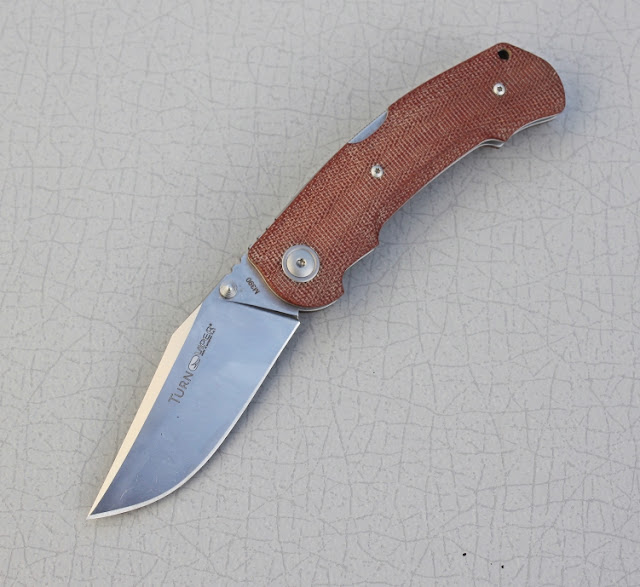
Clip point
At least I consider this to be a clip point


The type of steel found in the blade is the one that Viper uses in all their finer knives and it comes from Böhler/Uddeholm and has the now-known designation M390. Steel that at this point does not need much introduction. Without going too deep into technicalities, it is, provided it is not too soft hardened, one of the best steels available for folding knives. In practical terms, it means that it is resistant to rust, takes a very fine edge, and above all, lasts a damn long time. The degree of hardness is stated by Viper as HRC 59-61.

Turn Essential has a very high, in practice completely flat grind. The only flap part is found at the ricasso around the thumb studs. The part of the blade spine that remains after what can most closely be compared to a "harpoon tip" is strongly rounded in the usual Viper fashion. It gives a luxurious feel and is soft to put the thumb against, although the front part of the lock bar and the back of the blade have received a series of well-executed grooves.

The blade has been given a glossy satin finish


A sharp blade with a nice flat grind usually bites well in most materials and that also applies in this case. That goes for everyday materials such as cardboard, tape, and plastic packaging of varying thickness and hardness as well as cable ties and nylon straps. The same can be said about tamp and rope.

Then it is noticeable that this is high-end steel as it is fairly durable. Unlike some reviewers, I don't delve too deeply into the details of steel composition. I note more how it appears partly initially and partly over time. Although the latter requires even longer trial periods than in this case. 

Knives that are used need to be resharpened after a while anyhow. With M390, you generally don't need to do this very often. Especially not if a knife is used as an "EDC"/pocket knife. They are rarely used for longer periods of time. It's not a professional knife or the like we're talking about.


Handle


It is the very appearance of the handle that is the big and otherwise only difference between "Essential" and the original version of Turn. As mentioned in the introduction, it had a design with a titanium front bolster, which this knife apparently does not have. Instead, a piece of Brown canvas Micarta extends over the entire side of the knife handle. If you don't like that color, there is also black Micarta, which almost looks gray in pictures, and two shades of G10 and carbon fiber to choose from. 

Handtag i brun Canvas Micarta
Handle sides in Micarta


The micarta is of very high quality and also finely executed. In this case, this means that the sides are properly sanded and that they are elegantly arched. Then the frame and sides are well polished but despite that, there are some sharp corners that are more dependent on the design than the execution.

The sides are screwed in place with two small T6 screws with round heads. This a choice I may not be entirely fond of but in return, the screws are of high quality and Viper is still one of the extremely few brands I know that even prints the grade of steel on their screws on the website. In addition to those screws, there is an adjustable pivot screw fitted with a luxurious titanium collar.

The backspacer of this knife is made of polished stainless steel that has been properly rounded. In it and through the sides of the handle is a small hole that acts as a lanyard hole.

The frame is also made of steel and it has not been weight relieved, which together with the lock construction makes the knife somewhat heavier than it should have been. It also shifts the weight towards the handle.

A very well-built handle, but the edges could have had a stronger chamfer for better ergonomics


The comfort and ergonomics of this knife are a strange three-step rocket. In the picture and in a quick test, the knife appears to be excellent in that area. The size feels just right, full without being excessive, the sides are, as I said, shaped, the fingers find their places and the back is elegantly curved to fit the hand better.

But in step two, some details are discovered to think about. The first time I held this knife I was actually not excited at all. On the contrary, I experienced several corners as potential problem areas/hot spots. This is applied to both the front and rear "platforms" for the index and little finger, as well as the back edge of the finger guard and the clip. All have distinct terminations in the form of edges. To make sure it wasn't just me, I lent the knife to a good friend who thought much the same. However, expressed a little differently. He is not a knife enthusiast like me. 

The handle works well as long as you don't work for too long and with challenging chores


Next comes step three, actually using the knife. And then it's perfectly fine again! Certainly all the edges I just listed come to mind. But in some strange way, Turn Essential works anyway. With a normal hammer grip, all four fingers actually find their place and the knife sits securely in the fist. It's just a matter of grasping "carefully" if I can put it that way.

The same applies to an even greater degree if the knife is gripped in a saber grip. Then it is necessary to remove the index fingers a little, a few millimeters back is enough, from the finger guard so that it does not feel uncomfortable. In addition, the back end of the knife with the associated clip must be placed in the right place inside the hand, whereupon the same applies there. The thumb then naturally finds its grooves on the back of the blade and the knife is relatively comfortable to work with.

Possibly, I can imagine that some of these details require less precision for those with smaller hands or if you wear gloves.

But then it should be pointed out that everything I wrote above applies to light use. After all, if you cut wood for a while, the transitions from the handle sides are somewhat too angular. This especially applies to the little finger but also to the thumb. It's not pleasant after a while. Those parts would have needed stronger rounding in order to handle more challenging tasks. 


Opening and Lock


Thumb studs are the way to open Turn, if you don't feel like using both hands, of course. The classic style of the knife attracts the latter. It is also very easy as the blade, despite being a back lock, runs on ball bearings. It's not a very common combination. Yet, I might add. But it gives a very smooth action.

Turn is opened with thumb studs that are found close to the handle

Pyramid shaped thumb studs
The typical pyramid shape gives slightly sharp thumb studs


The studs are double-sided, which together with the lock construction makes the knife completely ambidextrous as far as those bits are concerned. The thumb studs, well, I'm not quite friends with them. Those who are familiar with luxury knives recognize the shape from, for example, the CRK Sebenza. This means in plain language that they are pyramidal. It certainly gives a very good grip on the thumb, but they are not comfortable for me to use. Especially as in this case, they are placed quite close to the handle.

However, the placement provides enough leverage which, in combination with the bearings, makes the knife easy to open. This is especially true since the resistance to be overcome on this type of knife comes from the back spring and not from a traditional "detent ball".

One way to escape the sharp point, however, is to twist the knife in the hand and instead of placing the thumb on top of the thumb knob, press against the side of it. I felt smart when I figured it out and it makes the Turn much more convenient to open.

This knife boasts a very good back lock


The back lock construction on this knife is one of the best I have come across right away. It only gets to see itself beaten by another Italian from a different brand but in the same city. I won't say more. Either way, the lock snaps into place with a reassuring sound and holds the blade rock solid. The small play in the vertical direction that can sometimes be felt in back locks is almost completely non-existent here. The same applies laterally, but there the knife can of course be adjusted if desired. In other words, the feeling is extremely solid.

Releasing the lock is also very easy. The resistance is well-balanced and the lock bar is rounded for increased comfort while also being equipped with some small notches for a better grip.


To Carry


The Turn Essential is a compact little rascal. The combination of a closed back with a back lock and a steel frame leaves its mark. The weight is therefore 125 grams. Not heavy per se, but it's more than you would expect for a knife this size anyway. The construction also affects the balance. The balance point is found right at the second step for the fingers. The knife is thus slightly back-heavy.

The titanium clip is attached to the rear end of the handle, which gives a so-called "deep carry loop over" clip


The measures are otherwise not a deterrent in any way. The length of 10.8 cm and the thickness of 1.4 cm certainly make it a little chubby but not excessively so. But sure, you feel like you have a knife in your pocket. It cannot be denied. But that knife does not have sharp edges or corners that disturb the hand if it has to go into the same pocket. Something I appreciate.

The tension found in this titanium clip is good and the ramp is sufficient


One of the reasons for that is the eminent clip made of titanium. It is of the "deep carry" type, which means that the knife sits very deep in the pocket. What people think about differs. I belong to those who usually but do not always advocate that type of clip. But there are pros and cons to most solutions. This variety which attaches to the rear end of the handle and then bends forward in a "loop" tends to feel more in the hand when working with a knife. That's the case here with what I've touched on before. But it's not so bad as it usually ends up outside the hand when you grab the knife. In other grips, you have to compromise a bit. If you really want to use the knife for heavier tasks, there is always the option of removing the clip.

Removing the clip works as said, but changing position is not possible, to the detriment of those who are left-handed. The spring in the clip is very good and keeps the knife in a firm grip in the pocket. The ramp is sufficient to work with most fabric edges. 


Conclusion


In fact, the first impressions of the Turn Essential, that it is a compact, robust, and well-built knife, stand up even after the honeymoon impressions have passed. It is a solid build, which is reflected in, for example, a good fit between the lock bar/back spacer/frame, nicely rounded blade spine, and arched and well-executed sides. Then it can be added that the action is very smooth and the lock particularly well made. The blade is also well-ground and centered. They know what they are doing in Maniago. 

Then, of course, the materials are of the highest standard. It is canvas Micarta, M390 steel, and details such as clip and pivot collar in titanium. Turn Essential is and feels luxurious.
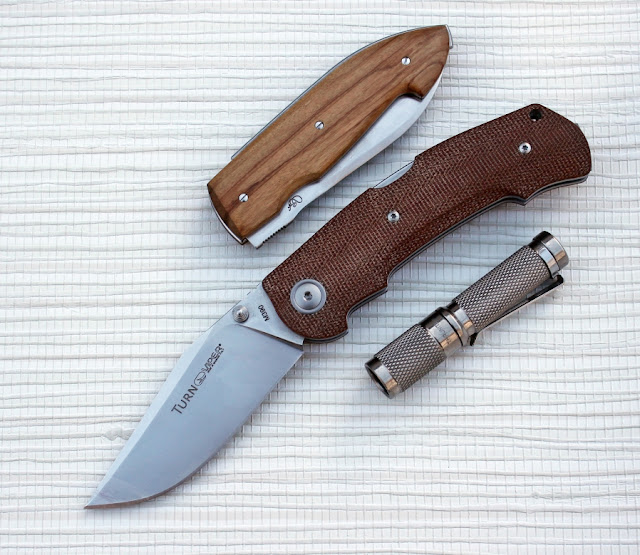
En bra EDC-kniv
With the Turn, Viper Knives has succeeded in making a really good back lock knife that also works in an EDC role


However, all that glitters is not gold. There are things that could be better. Some details have to do with personal preferences and some are choices in the design that can perhaps be discussed. The first is, the concept with thumb studs and a back lock, others may prefer a flipper-opened knife and liner or frame lock. Having said that, it can be stated that if you are to use a classic back lock construction, this is how it should be done. It can't be anything other than top marks on that front. 

Other details are more general, such as those related to ergonomics. I've said it before and I'll say it again. There is a danger in shaping a handle this much. Namely, it can limit comfort depending on hand size and shape. In this case, there are a number of edges to consider. They disappear if you wear gloves, but I don't see gloved hands as the most natural in an EDC context, and actually not outdoors either.

Somehow I feel this knife is made for someone with smaller hands than me. Without knowing exactly, I suspect that the average Italian is somewhat smaller than the average person in Sweden. Maybe it's a delusion or not. And then the outer edges should be rounded more if the knife is to be used for outdoor activities. It may look different depending on where you are in the world. But in Sweden, it often means cutting wood in various ways and it can be heavy.

Viper Turn Essential is a quality knife with a strong personality


Viper Turn Essential is more of a solid workhorse than a lightweight when we talk about folding knives. But then again, you do find the knife in the "Outdoor & Hunting" section of their website. That's something I agree with. Turn is not overly large and heavy but possibly on the heavier side for most EDC use although that is highly personal as well. 

But if that's what you're looking for and you don't have huge hands, this is a luxurious option that I can highly recommend. 


Viper by Tecnocut
 Viper Knives


Specifications:


Length Overall: 188 mm
Length Folded: 108 mm
Weight: 125 g
Blade Length: 82 mm
Blade Thickness: 3,5 mm
Blade Steel: Böhler M390
Hande : Canvas Micarta
Lock: back lock

Produced by: Viper Knives, made in Maniago, Italien


/ J - may soon have to expand the terrarium