Visar inlägg med etikett micarta handle. Visa alla inlägg

söndag 13 april 2025

New Knife - Civivi Yonder

This has to be the most brilliant name for a knife in a very, very long time. It comes from Civivi, of course, and is called Yonder. That's what the title reveals. But what it doesn't reveal is that the phrase "Yondering" is inspired by or comes from the author Louis L'Amour. It stands for embarking on a journey into the unknown, driven by an inner compass.

Of course, it arouses interest, especially since it's also an award winner. Yonder won the "Blade Best Buy" in 2024 and was designed by Zac Whitmore the year before, in 2023.

Civivi Yonder


In terms of appearance, I think it resembles another knife that has received a lot of attention in recent years, which is the Baby Banter. But this design differs in several ways, such as the lock type, blade shape, and, not least, something I think is an advantage: Yonder also lacks a "forward choil". This increases the edge length.

This may be necessary in this case, as the entire knife only measures 168 mm in length, of which the blade accounts for 73 mm. The steel used is Sandvik 14C28N. You don't get much of it as the thickness has been kept down to just over two millimeters. The 95 mm long handle is made of Micarta, and the knife is open at the back. This gives a weight of just 78 grams.

Yonder gives a very sympathetic first impression


The package is rounded off with a removable steel clip and a lock in the form of a "Cross bar lock" which together with the thumb studs also constitute opening methods.

Then it can be added that the blade shape is a bit exciting as it is an interpretation of a classic "Spey blade" but with a curved edge.

Then it only remains to be seen if my "Wanderlust" is brought to life by this little rascal. Whoever lives will see!


Civivi Knives


/ J - feel like going out...

#knivesandbikes #knivigtvarre

måndag 25 november 2024

Review QSP Unicorn


-  the straight-back knife

It is noticeable that I have been in a "Micarta period," as several knives with that handle material have been acquired recently. This version of Unicorn is no exception. This knife features a greenish-brown color. 

With this knife, QSP has released a model that follows several current trends quite well. I am talking about the opening methods and the lock. Let's see what that means in concrete terms!

QSP Unicorn


Some of QSP's models come in many variants, but not the Unicorn. You can choose between the Micarta presented here or a two-tone G10. Then, the choice is between a very loud lime green accent color or a more discreet purple. 

The three handle variants can be combined with a black blade if you so prefer. 

Unicorn is a knife whose design is dominated by one specific element, there are holes in both the handle and blade


Short version: QSP Unicorna knife whose appearance is dominated by holes and otherwise follows several modern trends for folding knives

Blade


A knife named after a unicorn must be somewhat unique. This applies especially to the horn, one must assume. Here, QSP has chosen a knife blade with a straight back. That is not the most common on pocket knives today. The blade type has pros and cons but is not as all-round focused as some other variants. Much of that stems from the sweeping big belly that ensues.

In addition to the shape, there are a couple of other details that stand out. One is of course the blade hole and the other is the partial false edge. It starts in front of the hole but ends before the tip. Thus, it is an aesthetic addition. That it ends the way it does reinforces the point.

The straight blade shape is not quite common on EDC knives today


They claim that the blade is 83mm but I end up with 80mm no matter how I measure. The height is 26.5 mm and the stock thickness is three millimeters. Together with the steep belly, it makes the blade almost rectangular. The grind is flat and high. In principle, the blade is "FFG" or fully flat ground. Behind the edge, the Unicorn is 0.6 mm thick, which is a lot.

The steel used is the common Sandvik 14C28N. Steel which I often point out is one of my favorite materials among those that cannot be counted in the "super steel" category. By that, I mean that this steel largely behaves like, for example, an S30V with a slightly lower edge holding capacity. 

This steel can otherwise handle some abuse without chipping from the edge, rather the edge rolls in that case so it is not fragile. It is also easy to sharpen and maintain. 

The knife is exceptionally discreetly marked, but those with good eyesight can read that the blade is made of 14C28N


Once put to work the Unicorn is, unfortunately, a "meh" knife for me. Some of it has to do with personal preference. Then it is mainly the location of the tip that is not appreciated. If boxes are to be opened, for example, you have to angle your wrist significantly to be able to use the tip. The alternative is to turn the knife upside down, of course.

The advantage of this shape is that the blade is easier to use against, for example, cutting boards if desired. But my biggest objection to this particular blade is that it is so thick behind the edge. It gives a steep secondary edge which, despite decent sharpness from the factory, does not cut as well as it should with this tall blade combined with a wide bevel. 

It's not that the Unicorn doesn't cut at all but just not as good as I expected. This applies to paper materials such as cardboard, foodstuffs, and plastics of various kinds. But of course, the edge will be a little stronger compared to if it had been thinned out. But it's a weakening I'm happy to take.  


Handle


Unicorn does not offer any surprises in terms of construction, but some details. This particular design has sides in Micarta as already mentioned in the introduction. They have also been given some love and care. Certainly, the sides are flat and not curved, but the edges have been beveled all around and polished sympathetically.

Then there is a pattern that frames the main design element of this handle.

The handle is characterized by a certain blockiness, the Micarta sides and the three large holes


I'm talking about the three substantial holes found in the middle of the sides. They extend all the way through the handle, which means that in addition to boosting the appearance, they lighten both the sides and the frame.

It is polished steel and attached at two points in addition to the pivot point and in this case the locking mechanism. Otherwise, the knife is open in the back, which also keeps the weight down. As usual, the sizes are T6 for the screws in the handle and the clip, and a slightly more substantial T8 is found in the pivot screw, which of course can be adjusted.

QSP chooses to place the logo on the screw head on the presentation side, which is a good solution, especially as the screw is D-shaped, which means that it does not spin if you want to tighten it or disassemble the knife. 

The back is open and two hourglass-shaped spacers are found here 


The handle is 108 mm long and just over nine centimeters of that can be gripped. That is, what is found behind the finger guard which consists of the front part of the handle reinforced by the flipper tab.

The thickness is 12.6 mm, which together with the other dimensions and a fairly box-like exterior gives a full handle. Especially as the height goes from about 22 mm as a minimum to 28 mm at the stern.

The Unicorn is well-balanced thanks to the holes but the handle never became a personal favorite

It could be hunky-dory if it weren't for a couple of things that are not appreciated. One of them is that the handle in my hand feels a little too square somehow. It should be pointed out that it has nothing to do with the actual shape. There are knives that pull even more in that direction without feeling like it, even among QSP's models. There is something about the proportions that haunts the knife.

But mainly it's the clip that messes with my grip anyway. It already starts in a standard hammer grip as the clip cuts into the hand directly. Something that actually decreases if you press a little harder when working with the knife. When the knife rotates in the hand, the clip ends up closer to the fingers instead, which is preferable. 

Unfortunately, it gets even worse with a saber grip. Then the corner of the clip ends up directly against the hand and the tip also against the palm. It is possible to adjust the grip slightly to reduce the discomfort, but it cannot be removed completely. Not nice at all! 


Opening and Lock


It is in this area that the trendy details mentioned in the introduction are found. First up is the opening, which in the name of consistency is double. Or triple depending on how you look at it. The flipper tab is of course there. Then I briefly mentioned the hole in the blade, which is method number two. The third follows from the lock type and simply means that you hold down the lock button and the blade swings freely. But don't tell any legislators as that makes all knives of this type "gravity knives".

The knife can be opened in several ways, but the flipper is the one that dominates


Then, the knife can always be opened with two hands, of course. As for how well the different ways work, there are mixed ratings. If we start with the most obvious, the flipper, the function is decent. Like many other brands, QSP has moved towards reducing the size of its flipper tabs. It is a good trend but requires well-thought-out geometry because the leverage will be reduced. There are no problems in this case. Especially not as the blade runs on ball bearings and is quite light. The speed thus becomes satisfying. Less good is that the edges of the flipper are rounded and the grooves found there are a little too polished, which means that from time to time I miss when I open the knife.

The two-hand opening is not much to dwell on. There is a piece of blade and a blade hole to pinch so there is no problem.

Speaking of blade holes, it is one of the less successful details of the knife. It barely works at all as an opening method while being too large to exist purely for decorative reasons. Possibly it can be used if you have very narrow thumbs and long nails.

There are several faults with this blade hole. To begin with, it is narrow and sits too close to the handle, which means that there is not much to hit to begin with. That characteristic is significantly enhanced by the thick handle sides, which are also not beveled for ease of access. In fact, it's so bad that the edges instead hide part of the already narrow hole. To add to the burden, the edges are also nicely chamfered. Elegant yes, but that means they become slippery.

So if you are to be able to use the hole at all, you have to put the knife completely flat on its side in your hand press your thumb straight down towards the hole, jam the soft parts of the tip of the thumb in the hole and then try to make a semi-circular movement with your finger. It becomes somewhat easier if you learn to aim at the back of the hole. However, it is not intuitive. It can be used with a flick of the finger from the back of the handle, but the resistance in the lock is a bit too great for that. So even there you sometimes miss. 

The blade hole is a bit too rounded, narrow, and partially obscured to be good


If the ways to open the knife were so-so, the lock and closing the knife is all the better. This is a button lock as stated and as such it works great. The blade sits as it should without movement in the open position. The button is also reasonably easy to access while sitting so deep that there is no risk of the lock accidentally releasing.

The ball bearings allow the blade to move freely when the lock is released, making it easy to close the Unicorn. Thus, this is an excellent lock. I like the lock type in general and this is a good representative.


To Carry


Even in a pocket, the Unicorn is a typical medium knife. It is neither exceptionally good nor bad in any way. What disqualifies it from being at the top is the volume. The knife is somewhat rectangular when folded and measures three centimeters in height. Except where the fin is found, there we end up at 36 mm. It's approaching Spyderco levels, which is to say, not good. If you add the thickness of 12.5 mm and the length of over a decimeter, you will understand why I am talking about volume.

The Unicorn has a very shiny deep ride-type pocket clip


On the positive side, however, is the weight. It's a relatively low 115 grams. Okay, it's not the lightest either, but we have a quite wide blade that measures eight centimeters in length to take into account. 

In addition, the sides are kind to fabric and not so coarse that they make it difficult to pull or put the knife away.

The clip is neatly attached to a recess on the side of the handle.


Two things are visible here. Partly the neat solution with a plate to cover the slot not used by the clip and partly the nasty corner of the clip that hurts the hand


The clip is one of QSP's simpler standard clips. A spring steel clip with good tension, an ok ramp, and plenty of space underneath. It is attached with two screws, one of which also helps hold the handle together. The clip is also recessed in the side of the handle, which means that it does not move sideways at all, while at the same time, there is more space for fabric. A very good way to solve that problem.

Unfortunately, there are also negative aspects. The fact that no part of the handle is visible when the knife is carried in the pocket also means that the clip is very annoying to grip. The location combined with the shape of the handle is the culprit. There is simply a corner that sticks out from the handle and it's not nice to hold around as mentioned before.


To Conclude


Unicorn is one of those few models from QSP that didn't really win my heart. It is strange since all the basic conditions are there. As usual with knives from this company, it's very well-built. On that point, I have no negative objections at all.

That characteristic manifests itself in several different ways. The micarta, which is a favorite material by the way, is of excellent quality and it is well treated. Both shaped and polished as it should be. "Speed ​​holes", as those decorative holes in the handle are sometimes called, can be viewed differently. But here they are nicely done and of course, they reduce the total weight. The steel is also one of my favorites in this price range.

The lock is of high standard and works perfectly. Even the flipper does its job in a perhaps not perfect but still capable way.

Speaking about looks, the Unicorn doesn't disappoint in that area either. In other words, only positive things so far. So why don't I like the knife?

Unicorn is an EDC knife that is actually somewhat larger than you might first think


The reasons are found partly in a personal preference and partly in two design shortcomings.

Namely, I've come to realize that I'm not particularly fond of straight blades, at least not on my EDC knives, for several reasons. Firstly, the tip is found very far up in relation to the knife's supposed center line. This means that to use it, you must either turn the knife upside down or angle your wrist very much. Then the blade shape gives a very distinct belly. A shape I don't have much use for daily. It performs best on hunting or skinning knives or other applications where you benefit greatly from sweeping long cuts.

But then we come to two areas that QSP normally never misses. The first, mentioned above, is that the blade hole does not work very well at all. It is difficult to reach, narrow, and partially obscured. It also happens to be my favorite way along with thumb studs to open a knife. Therefore I react strongly when they are not properly executed. 

The second point is of course the clip and its placement. Someone with significantly smaller hands than me may avoid the discomfort it causes. If the whole hand fits on the handle, I think the problem disappears. But as it is now, it is not comfortable in my hand.

With a straight blade that is slightly thicker behind the edge and a bit wider handle, the Unicorn is also suitable for outdoor use


With UnicornQSP has nevertheless achieved a solid build. If you have smaller hands and prefer a knife with multiple opening methods but value flipper opening and a good button lock, this might be the knife for you. The choice of materials and build quality are good, and the slightly more robust appearance and blade shape make it suitable for outdoor activities as well.


QSP Knife


Specifications:


Length Overall: 191 mm
Length Closed: 108 mm
Weight: 115 g
Blade Length: 83 mm
Blade Thickness: 3 mm
Blade Steel: 14C28N
Handle Material: Micarta
Lock: Button lock

Produced by: QSP, made in China


/ J - looking for my cup of Tea

lördag 2 september 2023

Review MKM Flame Light


-  A foldable mini dagger

Most of the time, it's the immediate practical considerations that determine my opinion of a specific knife. However, aesthetics are never unimportant. If I can choose a good-looking and practical knife, it goes ahead of an ugly and equally practical knife. But sometimes appearance has to play an even bigger role. As in this case.

A dagger-inspired blade is rarely the most practical option if you're not going to stab things all day. Even so, I chose this version Flame Light. A knife from Italian MKM  - Maniago Knife Makers.

MKM Flame Light


This design from Michael Zieba has been around for a while in MKM's catalog as Flame and there are no less than ten versions to choose from. Somewhat confusingly, one version is made in green Micarta, which makes it deceptively similar to a "Flame Light". Only a few grams separate the models. But since it is out of stock on the website, I suspect that this new version simply replaced it.

"Light" means Micarta in the handle instead of titanium and carbon fiber which is found in the original "Flame". The handle is currently available in three different colors, black, natural and green. To further increase the options, there are also two different blade shapes to choose from. 

Tillverkad i Maniago, Italien


Short version: MKM Flame Light, for those who want a little more Shakespeare in their EDC rotation


Blade


It is hard to miss that it is a small dagger blade. Almost completely symmetrical if it wasn't for the fact that the blade is single-ground. In this embodiment must be added. For those who want even more functionality in the blade, a pointed drop point blade is also available.

The blade length is approximately 72 mm and the thickness a modest 2.5 mm. The height or perhaps the width of the blade is 14mm at the widest point, the blade base near the ricasso. Then the blade quickly tapers to a distinct tip.

The dagger-shaped blade is 72 mm long


Otherwise, the blade is characterized by a pronounced "fuller" or blood groove, which for some inexplicable reason it is also called. The blade finish is an excellent stone wash and the blade is marked with MKM's logo on one side and opposite is found Zieba's name along with "Made by MIKITA". 

It's a little complicated because MKM is a collective name as the name suggests and the knives are manufactured by a small conglomerate of well-known manufacturers from Maniago

The blade is recognizable by the distinct fuller


The steel used is M390 as in most knives from MKM. It is a very exclusive steel that for a knife enthusiast needs no further presentation. It is consistently good on most parameters such as ability to take and hold an edge, corrosion resistance, impact resistance and so on. Then it can always be discussed how much use you get from a super steel in a small pocket knife with a dagger blade. But on the other hand, we have cars with hundreds of horsepower and that may not always be completely necessary either.

Something more important is a good geometry for a knife to cut well and the Flame Light version doesn't have that to be honest. Certainly the blade is thin but on the other hand the primary edge is only 5 mm. This means that the thickness behind the edge ends up around 0.8 mm. It is enough and then some even for a solid chopper or survival knife. Then you can figure out for yourself that this knife is not the world's best knife for slicing salami. The geometry also means that the tip is actually not as thin as it looks. Good for strength but deteriorates the properties when a splinter has to be removed, for example.

What the knife does better is to penetrate plastic and open packages, for example. It does it with style and that's where this knife's main raison d'etre lies. 


Handle


"Have a Cigar" is a song by Pink Floyd and that title can be used to describe the handle of the little knife. A completely symmetrical handle with elegantly rounded shapes and arched sides. The length is pretty much exactly 10 cm and height and width are according to my caliper 18 mm and 13 mm respectively.

The handle is fairly neutral


The material on the handle sides is, as previously mentioned, Micarta. It is almost green-black when the knife is new but darkens as the knife is used like all knives with this handle material. In this way, it is a living material that ages and acquires a patina over time. The quality of the material is excellent and Mikita has treated it well. The edges that exist, on the inside of both the blade groove and the open back, are well sanded and rounded. The same can be said about the chamfered edges.

As you can see, the Flame Light is not a big knife


The construction is fairly straightforward with an internal steel frame. It is greatly relieved on the non-locking side while on the other you find the liner lock.

The knife is held together by only two screws. An adjustable pivot screw and one that holds the handle together towards the end. There is also a third screw that holds the clip in place. All three are thankfully the same size, namely T8.

Most grips work more or less well


A handle this small and slim can never get top marks in terms of ergonomics or even comfort. But on the other hand, simplicity of this kind can never go wrong either. It can clearly be compared to a smaller Swiss army knife, for example. This means that all grips work about equally well or possibly poorly. The length here allows anyone without huge hands to get all their fingers on the handle. But the small volume means that the handle does not fill the hand significantly. But the knife is not made for hard work either, so it kind of goes with the concept. So I refuse to criticize the knife for that.


Opening and Lock


The flipper tab on this knife is very small and discreet. It comes with the format and the symmetrical look. It is one of the finger guards that acts as a flipper. The height of it is a modest 3.5mm or thereabouts. In addition, it lacks grooves and corners and the edges are rounded. This means that it can be a little difficult to hit correctly if you are not accurate.

One of the most discreet flipper tabs I've seen


If you do that, however, you are rewarded with good speed and flick of the small blade. Something that is not entirely easy to achieve with so little weight to work with. But the combination of ball bearings and well-balanced resistance in the detent ball is a successful concept.

It also doesn't really matter how you approach the flipper, to pull back or push down. Because it is so small, the movement is still something in between.

The liner lock doesn't make much of a fuss either


The lock is a well made liner lock. It holds the lightweight blade in place with authority. No play in any direction, nor does the lock bar slide if improperly loaded. Moderately perhaps I should add. Just as I refuse to review this knife as an outdoor knife, I refuse to subject it to any kind of fatigue test.

The lock is not the easiest to release but with that said it is not very complicated either. Opposite handle side is slightly recessed for ease of access and there is a very nice pattern on the lock bar to increase traction. It is enough to fulfill its function.


To Carry


Of course, I was about to start with and it must remain, this knife is exemplary in a pocket. Just look at it! Completely streamlined with minimal protruding parts and a stated weight of 55 grams. According to my scale, it was 54 grams.

The clip is mounted on the back end of the handle, which means that the knife sits very deep in the pocket


The soft Micarta sides are also very practical in a pocket as in they do not rub against fabric or cause friction when the knife is to be pulled or tucked away.

Despite the small format, there is relatively much space under the clip


To these positive qualities must be added a very good clip. It doesn't feel significantly against the hand when the knife is used and above all it keeps the knife in place in the pocket so you don't risk losing it. The material is steel and it is attached to the rear end of the handle with a single screw. Even so, it sits firmly in place without moving sideways. Something I appreciate.

The ramp is also good, which is enough even for relatively thick fabrics, and the space under the clip is also adequate.


To Conclude


It is not entirely easy to summarize my impressions of this knife. It kind of gets both criticism and praise at the same time, but it depends more on the design than the execution. The materials and the way they were used are top notch and they have also spiced it up with several small details that enhance the overall impression. Examples of such are the anodized ring of titanium around the pivot screw and how well rounded and soft everything is. Even the corners that are not completely visible. They know what they are doing in Maniago.

But that's not where the negatives can be found with this knife.

Flame Light is a small EDC knife with a lot of attitude


The disadvantages can of course be attributed to the diminutive format, especially as it is combined with a pure dagger blade with its low saber grind. It can never be as all-round and practical as, say, a flat-ground drop point. It neither cuts nor even stabs things equally well. This is the closest thing to a miniaturized stiletto.

But there is also the strength of the knife! This is not a knife for the outdoors or the construction site. Whether carving hiking poles or wooden spoons or opening pallets with insulation with precision. This is a pure EDC knife for small tasks and nothing else. It does it in style though, and is pretty to look at when it does. This is a small work of art that can also be used for some practical tasks. Good thing, as it's a pronounced design choice that doesn't shy away from it. If the same general appearance is desired but more practical, there are, as I said, other versions.

Personally, I usually combine it with a second and somewhat more efficient knife from, for example, MKM.

What am I doing here, the knife seems to think. Flame Light from MKM performs better in an office than in a forest environment


However, for those who appreciate this kind of look and can't get enough of small daggers, folding or not, the Flame Light is an excellent knife. The design from Zieba is very appealing and the execution really good. Maniago Knife Makers has quickly climbed to become one of my favorite folding knife brands.


Specification:


Length Overall: 176 mm
Length Folded: 101 mm
Weight: 54 g (weighed by me, stated 55g)
Blade Length: 72 mm
Blade Thickness: 2,5 mm
Blade Steel: M390
Handle: Micarta
Lock: Liner lock

Produced by: Mikita, made in Italy


/ J

#knivesandbikes #aliaspostmortem #knivigtvarre  

onsdag 5 januari 2022

New Knife - Viper Gianghi

New year, new times, and thus new knives. First out or to be completely honest last, is this knife from Italian Viper Knives is called Gianghi. It's an old Persian word for "hunter", by the way. I wrote "last" because it was actually one of the last to arrive at the end of 2021. Something that was proven by the fact that the first task it was faced with was to trim the Christmas tree and the last one was to prepare and slice the beef fillet for New Year's dinner.

However, I have not had time to present it until now.

This Italian beauty comes with a high-quality leather sheath


Gianghi is designed by Fabrizio "Silver" Silvestrelli. Not only known for his many collaborations with Viper Knives but also as a custom knifemaker. In addition, he happens to be chairman of Italy's knife makers guild. His knives are often characterized by flowing, elegant lines and a distinct design language. It certainly applies to this knife.

Gianghi is a knife from Viper Knives designed by the Italian master Fabrizio Silvestrelli


Gianghi is available in a couple of different configurations with handles in wood or Micarta and blades with a satin or stone-washed finish. This version called "CV" comes with a combination of a stone-washed blade and handle in gray Micarta. Incidentally, the handle is one of the most comfortable I have used. It is pleasantly three-dimensionally sculpted and provides a very good grip with its deep recess for the index finger. Extra security is provided by both a finger guard forwards and a "duck beak" which means that you do not slip backward. The sides are mounted with three screws with torx heads. The knife is otherwise a full tang knife. It also contributes to making it very well balanced.

The blade is a nice drop point made of N690. In addition to being nice to look at, it is extremely practical. It is suitable as the knife is aimed at hunting and other outdoor activities such as camping and hiking.

The package ends with a well-sewn and sturdy sheath in brown leather. Overall, the knife gives very sympathetic first impressions. It's extra fun as it's my first fixed blade from this brand! A review will, of course, follow. 


/ J - kicks of the new year

#knivesandbikes #knivigtvarre

torsdag 16 december 2021

Review Sencut Episode

- a very nice acquaintance

This knife called Episode is my first encounter with the Sencut knife brand. A brand that is both new and old on the market if you can put it that way. Namely, they are a sister brand to Civivi, which in turn is WE-knife's department for more budget-oriented knives. But as they became more and more refined and thus climbed in price, they obviously thought that the abandoned niche needed to be filled, and then Sencut was added. In general, it can be said that the production quality is close to Civivi, but the materials are somewhat simpler and they have chosen to limit sales to Amazon to keep the price down.
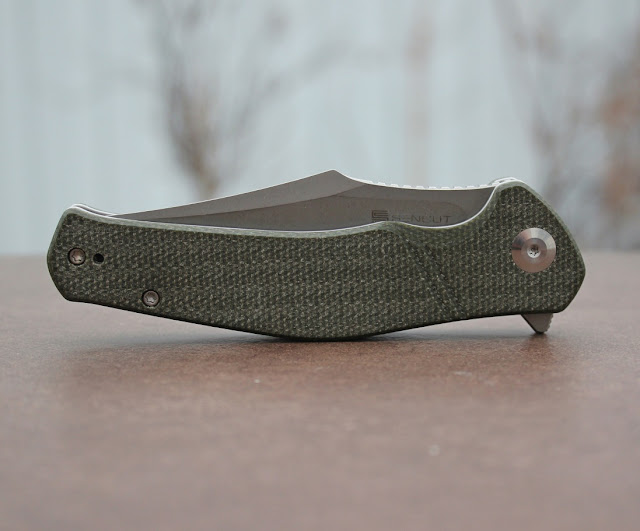
Sencut Episode in Green Micarta
Sencut SA04E Episode 


First, it can be said that Episode is very similar to another model from Sencut called Snap which was released almost simultaneously. But the difference is that the latter is slightly more laid back in its design with a less aggressive drop point blade and a straighter handle. The Episode has a bolder, more challenging shape on the blade and a more curvy handle.

Sencut Episode is available in several versions. For those who do not like green Micarta, there is also a brown variant in the same material. In addition, the knife is available with G10 handles in the colors burgundy, black, or jade (uncolored) G10. The burgundy knife has a blackened blade which gives a dramatic contrast. Those combinations should cover most flavors.

Harppon tip
Episode offers dramatic lines


Twitter version: Sencut Episode, a knife that is a good introduction to the brand with both good build quality and excellent handling. Even better is that it cuts well and looks good while doing so!


Blade


One of the things that are most noticeable with Episode is the rather dramatic blade. The basic shape is a clip point, but the look has been enhanced with a dramatic swedge that ends in what is usually called a "harpoon" tip and the space for the thumb behind it is curved, which further emphasizes the design.

The finish is a smooth and well-executed stone wash. The marking is almost as discreet as the sister company's and this means that the name Sencut together with the logo is found on one side of the blade but in a very discreet format. In addition, you can read the steel type on the ricasso, very close to the handle, but it almost requires a magnifying glass.

The clip point blade is just under nine centimeters long


But if you have such or very good vision, 9Cr18MoV can be read. It is one of the things that distinguishes this knife from knives from eg Civivi. But the question is whether it is a deterioration compared to the 14C28N that is often found there. This Chinese steel should not be confused with the much simpler steel in the "8Cr" family. It's a bit like comparing 440A to 440C. This steel is very stainless like its simpler cousins, but my experience is that it keeps the sharpness much longer at the same time as it is easy to sharpen. Overall, not bad budget steel at all.

Especially not in this embodiment. The stock thickness is only 3 mm. In addition, the blade is almost completely flat ground and since it's 28 mm high, there is plenty of room to thin out the blade to the 0.5 mm it measures behind the edge. The edge was also fairly even and sharp out of the box.  A more than decent factory edge in other words. As so often on knives, however, they have missed a bit in the transition from ricasso to blade (plunge line). The sharpening choil that exists could simply have been slightly larger.

For those with very good eyesight, it can be read that the blade steel is 9Cr18MoV


The length of the blade approaches 3.5 inches or 8.85 cm, which means that it's somewhere in the middle when it comes to EDC-oriented knives. The edge length is sufficient for most chores and the knife is sturdy enough so that you do not shy away from slightly heavier work. Although there are other areas that make me think that the Episode is not the ultimate folding knife for outdoor life.

However, as the everyday companion, it's intended as it is excellent. The relatively broad blade means that the blade is sturdy and cuts straight into, for example, cardboard of different thicknesses. It is also facilitated by a blade that is thin behind the edge. The same properties also mean that Episode cuts plastic and fabric in an exemplary way. When it comes to tape and package opening, the almost upswept tip is an advantage in my opinion as I often turn knives upside down and use the back of the tip to avoid glue residue on the blade for such tasks. 

That said, tougher material doesn't pose any problems either. It was tested on a rubber hose and a piece of old car mat with good results even if it takes its toll from the edge. I do not belong to those who want to kill knives by, for example, cutting car tires and the like for the sake of it. I don't see the point. For such chores, if they were relevant, there are Mora knives.

Incidentally, the pointed blade makes all packaging opening go smoothly. The only thing you need to pay a little attention to is that the tip is very thin. So no prying. That is one of the reasons for the comment about outdoor life above. Another has to do with the handle.


Handle


The construction of the handle on Episode follows modern template 1A but with some nice details worth emphasizing. The frame is made of steel and one and a half millimeters thick, which is quite common. Less common, however, is how light the frame is. Instead of just milling a few holes, it looks like a framework on the inside. It lightens the knife a lot. The frame is also well rounded with soft edges both on the back and in the blade slot. The latter increases comfort when cutting with the knife.

The handle material is fairly smooth Micarta


The handle is partly open in the back but a small backspacer is found. Quite cleverly a lanyard attachment pin is hidden there. A solution I like as it makes for a cleaner-looking handle. A small detail I am less fond of, however, is that the pin was loose so it made a rattling sound as soon as I touched the knife. It was solved by disassembling the knife and putting a very small dot of thread locker there to keep it in place. 

The disassembly was painless, especially as both the adjustable pivot screw and the complementary two screws that hold the knife together are of the same size, T8.

The back is mostly open, but there is a small backspacer with an attachment pin for a lanyard. Here you can also see how weight-relieved the frame is inside


On the outside of the frame, you will find sides that are available in two different materials and in a few different color schemes. In this case green Micarta. This is one of the few areas where it is noticeable that this is a budget knife. The Micarta is not bad but is not one of the best I have handled either. It is also quite well polished, which actually makes it feel less exclusive.

Another thing that reveals that it's not a high-end knife is that the sides are completely flat. They have been beveled but just, and it is something that is felt if you grip the handle harder. It feels very angular if you do. That's the other reason why I do not think this is a good outdoor knife. But there are far more well-known knives that suffer from this problem. *

The handle on the Episode offers very good comfort and the only fear I had, the clip, slips away in most grips without causing hot spots


Otherwise, the Sencut is generally very comfortable in the hand. Hammer grip works great and there is room for all four fingers. The available grip area behind the flipper tab is about 10.5 cm. It's enough that the bend in the clip ends up outside the hand and thus doesn't create any hot spots. If you do not have giant hands of course. It was otherwise the biggest fear I had in advance after just looking at the clip's design.

Even better is the knife with a thumb on the intended recess on the blade in a saber grip. You can also place an index finger there if you change grips for slightly more precision-oriented cuts. The notches found there for better grip are excellent. They give good traction without tearing the skin. The handle also works well in reverse grips, if you want to carve towards you in a pull cut or hold the knife like an ice pick for downward thrusts. 

One thing I generally appreciate with this handle is that it is possible to get relatively close to what you are cutting. It increases both power and precision when needed. 


Opening and Lock


Episode is a pure flipper-opened knife, although it can easily be opened with two hands if desired. It may not always be the case that you want to open your knife that fast. But if you do, this is the right knife! Here it is noticeable that they have borrowed know-how from their other products within the corporate group.

The flipper tab is quite discreet but works very well


The flipper tab is well placed, reasonably large, provides the right amount of grip, and works exceptionally well. Sencut Episode is as nimble and reliable as its more expensive cousins. In addition to the right geometry and placement, ball bearings and a well-tuned detent contribute to the fine handling.

The lock matches the rest of the build when it comes to precision


Safety is taken care of by a liner lock, which is also excellently made. It is safe as in that it always engages. Incidentally, it locks up with the entire width of the lock bar, engaging about forty percent of the width of the blade tang, and since the material is steel, it is basically never going to be worn out.

The lock is also easy to find and disengage. The frame is slightly lower on the opposite side and the lock bar has been fitted with groves to provide better grip for the thumb.


To Carry


Episode is a medium-sized knife in terms of blade length and it also applies to how it feels in a pocket if you see what I mean. It is neither small nor really large, even if it leans more in that direction. The length of the knife folded is eleven and a half centimeters, the thickness is 12 mm, and the height with the harpoon shape on the blade, a relatively tall 37 mm. These measurements give some volume but in return, the weight is relatively low at 102 grams.

Then the knife is very civilized in the pocket due to the smooth material. This helps the knife to be easy to pull and put away again. It also means that there is nothing that wears on the fabric of your pants when the knife is carried.

The episode comes equipped with a simple but functional clip that can be repositioned to the left side


The clip itself is somewhat reminiscent of Civivi's standard and that's not a bad thing in this case. This means a spring steel clip with good tension, a tall and good ramp with plenty of space under the clip itself. This is amplified by using screws with flat heads. What could have been done even better is if the clip was countersunk in the handle side. But it adds another step in manufacturing and is an example of details that are skipped on simpler knives for that reason. Machining time is money!

The only objection I have to the clip, apart from the fact that it may be a bit "boring", is that the tip points slightly outwards. Not much, it is rounded but still so that I sometimes find it a little uncomfortable to bump into it or have to adjust the grip when working with the knife.


To Conclude


Episode is, as I said, my first encounter with Sencut but will not be the last because it was a very positive acquaintance. It is noticeable that even though the brand is relatively new on the market, there is a lot of knowledge and experience in the background. Many of the small mistakes made by new brands, especially in the budget class, have been avoided here. These are details that make cheaper knives often feel a bit clumsy. This can apply to precision in manufacturing, the finish of the materials, the balance, and not least small mistakes already at the design stage.

Episode is an excellent EDC knife on the larger side in terms of dimensions


Instead, there are several small but sympathetic details on this knife that show good thinking in the design of Episode. Examples of such are that the frame is well rounded and polished all around, something that is especially important as it allows you to grip harder when needed without it becoming uncomfortable for the fingers. In addition, the frame is extremely skeletonized, something that not only saves weight but is perhaps more beneficial because it provides better balance. An area in which knives in this price range often have shortcomings.

Then the knife has been fitted with flat screw heads, which is nice on the handle sides, but all the more important in practical terms as it gives more space under the clip. In addition, all screws that are also few in number have the same size of heads, whereupon only one screwdriver is needed to disassemble or adjust the knife. Also very positive.

The clip is simple but well-functioning, although the tip, unfortunately, points outwards. However, not so much that I want to put it as a minus.

In addition to these areas, there are also quality markers on this model that are borrowed from more expensive relatives. One such is how this knife feels to operate. The flipper tab is extremely effective and this in combination with the ball bearings makes this knife extremely quick to open. In addition, it has an excellent lock. This means that the action itself rises far above what is usual in the price range. 

Sencut Episode is a stylish knife in an attractive price range


On several occasions  I wrote "for the price range", it is currently at 53€ and about the same amount in dollars, on Amazon where they are sold. For that amount, you get a knife that is both well-built and looks good. Although it is an "in-house" design, no famous designer is connected to this model, it is very harmonious. The fact that it is then very well built with decent materials is another great plus. 


Specification:

Length Overall: 205 mm
Length Folded: 116 mm
Weight: 104 g
Blade Length: 88,5 mm
Blade Thickness: 3 mm
Blade Steel: 9Cr18MoV
Handle: Micarta 
Lock: Liner lock

Produced by: Sencut, made in China


/ J - testing something new

* Something that applies to, for example, Spyderco PM2. Something I wrote about in "A few words about ergonomics".