Visar inlägg med etikett bolster. Visa alla inlägg

tisdag 23 september 2025

Ny kniv - SRM Dome

Utan tvekan har kinesiska SRM Knives fått upp farten när det handlar om att släppa spännande nyheter. På senare tid har de blandat genom att släppa uppgraderingar av gamla modeller och en del helt nya knivar.

Till de senare tillhör den här kniven kallad 106M-GW eller Dome kort och gott. Förutom att designen är ren och snygg så är det en annan detalj som gör den intressant då SRM hakar på ett tåg som inte längre är en trend utan något som de flesta stora märken har i sina kataloger. Det här är nämligen en slipjoint!

SRM 106M Dome


Utöver det så är det mest framträdande draget att Dome är en riktigt lätt kniv. Den väger endast 61 g och känns därmed knappt i en ficka. 

Frånvaron av lås bidrar förstås till den låga vikten då man slipper inkludera de skruvar och låsarmar som krävs för det. Men i gengäld kräver en slipjoint antingen att man nyttjar dubbla "detents" som en del moderna knivar gör eller att man på traditionellt vis använder sig av en ryggfjäder för att hålla bladet på plats i öppet respektive stängt läge. SRM Dome använder sig av det senare. Appropå fjäder så har bladet försetts med ett halvvägsstopp vilket är tacknämligt ur säkerhetssynpunkt.

Annars är det mest måtten som gör kniven till en superlättviktare. Dome är 177 mm lång vilket förvisso inte är extremt litet och bladet är 76 mm långt eller 3" för den som vill mäta på det viset. Det är en drop point men det som gör det så bra är att det endast är 2,3 mm tjockt. Stålet som används är 14C28N och det kan tilläggas att fabrikseggen var riktigt vass. 

En elegant modern slip joint i lättviktsklassen från SRM


Handtagssidorna är gjorda av G10 som fått ett rätt avancerat utseende då det både försetts med ett mönster samt fått ett dubbelsidigt inlägg av tvåfärgad G10 för att matcha utseendet. Utöver det bjuder kniven på ett par små lyxdetaljer till som en guldfärgad krage runt pivotskruven samt en snyggt rundad bladrygg. Guldfärgen kommer för övrigt igen i det dolda fånglinefästet. Det är små detaljer men de höjer redan sobra övergripande linjer och gör Dome till en snygg kniv. 

Utöver det kan tilläggas att den kan öppnas både med två händer, en öppningmetod som underlättas genom en snyggt inkorporerad nagelskåra i bladet eller via dubbelsidiga tumknoppar. 

Paketet avslutas med ett enkelt stålclip som dock inte är SRMs vanliga "Ambi clip", handtaget är för tunt för det. 

Sammantaget är Dome en spännande liten kniv som förutom låg vikt och ett mycket effektivt blad kommer med ett elegant utseende och en prislapp som är human. Prissättning, effektivitet och detaljer som "walk and talk" ämnar jag addressera i kommande recension. 


SRM Knives 


/ J - under the Dome

#knivesandbikes #knivigtvarre

torsdag 9 januari 2025

Review CJRB Bowie Pyrite


-  or how to put pressure on competitors

It's been a long time since I came into contact with my first "button lock". It was found on a Böker Speedlock from the late nineties.* It's a type of lock that requires high precision in manufacturing and that's probably why they were conspicuous by their absence among more budget-oriented knives for a long time. Now we're in a different situation and one of the companies leading that development is CJRB. Or maybe actually the parent brand Artisan Cutlery.

For that reason, today we're going to take a closer look at a knife from them with exactly that type of lock, the Bowie Pyrite.

CJRB Bowie Pyrite


At the same time, I will take the opportunity to welcome the uninitiated into the now very extensive "Pyrite family". I think even CJRB uses that expression on their website. The model is available with all kinds of handle materials - from plastic and G10 via steel to elaborate titanium, different blade shapes, and varying sizes. They are available in simple designs and more expensive versions with luxury steel such as S90V or Damascus. This means that the number of combinations is, if not infinite, then at least difficult to keep track of. But there is something for everyone. 

This specific model is somewhere in the middle of a few different parameters and its special attribute is the blade. Originally the Pyrite was a drop point and that may be as practical as it gets but I thought this clip point variant looked a bit more cheeky. 

Pyrite offers a fairly classic look with this edition


Short Version: CJRB Bowie Pyrite, the knife that manages the company's short legacy well by being an excellent folding knife at an affordable price!


Blade


For me, it was the blade that did it. This is even though I will later claim that the greatness of Pyrite is found elsewhere. But speaking of size, the blade on this version is quite small. The length is 80 mm and the stock thickness is less than three millimeters, 2.7 to be exact. The height is 25 mm which contributes to the harmonious proportions. 

Although the appearance is dominated primarily by the distinct clipped point with associated swedge and a high and equally clear saber grind. All are accompanied by a double fuller or blood groove as it is for some strange and incorrect reason called in Swedish. Additional details are the sharpening choil and some grooves at the base of the spine.

It was the Clip-point blade that did it!


The finish is otherwise a glossy satin and the markings are extremely discreet. The CJRB logo is found on one side of the ricasso and the serial number and steel type on the other side, only readable to the hawk-eyed.

The steel is not only indigenous to China but also made by Artisan Cutlery. So the same approach can be found at companies like KAI (Kershaw), Chris Reeve, and Spyderco who have done the same. It is not entirely common. This steel is called AR-RPM9 and is similar to powder steel although the manufacturing procedure is not exactly the same I understand. Basically, it is a simpler steel that has been trimmed a bit with the help of modern technology.

Generally, I like it. I don't really know what to compare it to. But it is a bit reminiscent of 14C28N in that it does not rust and is easy to maintain. But the edge-keeping capacity is not as good in this case, in my experience. 

In addition to the shape, the blade is distinguished by a distinct fuller


But generally, it is more than enough for the average pocket knife. If I had used the knife for heavier tasks or for a longer time or maybe out in the woods, I might have had objections, but not now. The format of the knife and the design of the blade scream EDC. And for that it is excellent. Especially for all those small quick tasks. Pulling your knife out of the pocket, opening a coffee package at work (they are BIG), and putting the knife away again. Pulling out the Bowie Pyrite to cut that annoying plastic thread on the new jacket that was bought the other day and then make the knife disappear again. I could go on for a long time and give examples. Here it is not just the blade that is effective, but the whole knife.

More specifically, it can be said that given the appearance, the tip is good. It is sharp and is found in the center line of the knife. Pyrite also cuts really well. A thin blade and a high grind that ends with 0.3-0.4 mm of steel behind the edge provide the conditions. But there is also no getting away from the fact that it is a small blade. The total edge length is 75 mm. In addition, the handle is small so it is not a knife for hard work. And sometimes I wish I had something bigger in my pocket.


Handle


As mentioned earlier, the Pyrite comes in many variations. This one is built on a steel frame that has been drilled/milled out to make it lighter, which both contributes to a lower total weight and improves the balance in general. The frame rises slightly above the rest of the handle. However, it is well polished on both the inside and outside and soft to the hand.

The knife is open at the back and there are two hourglass-shaped and similarly polished spacers far back in the handle.

Bowie Pyrite is available with both single and double bolsters depending on the version


The handle is 107 mm long and of that, a full 95 mm behind the finger guard can be used as a grip area. But with my hand size, it's still not quite enough for a full four-finger grip. The little finger ends up at the back of the beveled part found there. A solution that works in this case, however.

As I said, the thickness of the handle is just over a centimeter. That's enough, but it's not a knife for long and heavy work. But that's something that the format already suggests.

The back is open as can be seen


This version of the Bowie Pyrite includes a metal bolster that also gives it the typical look. The luxury version has two bolsters that are also made of brass so that the knife gives off clear Buck 112 vibes. Not so much in this case as the bolster is in singular and made of steel. It is matched by wooden scales in "Rosewood". I don't know exactly what kind of wood that means in this case but it usually refers to something from the Jakaranda family. The alternative is a slightly darker wood, possibly ebony.
The transition between the materials is not perfect, they can be felt but more because it is two different surfaces than anything else. The sides are attached with three screws per side. Watch and learn from competitors because, despite the price tag and the size of the knife, they are T8s! The same goes for the adjustable pivot screw.

Only in the clip are smaller T6s found. Well done there CJRB as the larger sizes often hold up better.

Pyrite offers a good handle but it sometimes feels small


Handling the Bowie Pyrite is reasonably comfortable. By that, I mean that the knife is too small for me to get a full grip. But what is there is good. The index finger finds its place in the recess which is also accentuated by corresponding milled pockets on both sides of the bolster. Then the next two fingers follow but push their smallest cousin out of the party. About half of my little finger fits.

But it doesn't matter much because as I said, it's not a knife for heavier tasks. Given those conditions, all grips work, whether it's a hammer grip or a saber grip with the thumb on the back of the blade. An advantage of the fairly short handle is that the clip actually ends up mostly out of the way. On very long handles it often ends up outside or "behind" the hand if it's a "deep-ride" clip, and here it ends up inside the hand instead, which means it doesn't cause as much of a hotspot as it could.


Opening and Lock


There are actually Pyrite models that have blades with thumb holes in them. But the majority of them don't and they all open with a thumb stud. And what thumb studs they are! Look closely at them, not because they are extraordinary in any way but because they are not. Almost inconspicuous but still perfect!

Everything that should be just right is there. They stick out just enough, they are just far enough away from the center to be both easy to reach and physically effective. They are also not too sharp or angular but still provide a grip.

They are also not in the way when the blade is out and the knife is in use. A detail that is still sometimes missed even among reputable manufacturers.

Thumbstud perfection


Then there was the handle itself. In addition to the excellent shape, the resistance in the lock (that's what acts as a "detent ball" in such designs) is perfectly balanced. This means you can open the knife with a flick and the blade flies out as fast as lightning. But you can just as easily expose the beautiful blade in a calm and majestic movement if you wish. Furthermore, you can use your fingers on the back of the blade if preferred.

The blade is held in place by a Button lock


There is surprisingly little to say about the lock if you don't want to go into technical details, but on the other hand, button locks are not complicated either. They consist of a locking bolt that has a thicker and a thinner part and they are spring-loaded laterally. When the button is pressed against that spring, the bolt moves, and the contact surface against the blade base disappears. When the button is released, the opposite happens and the blade is held in place. This applies both when the knife is closed and open.

Here it just works. The lock is easy to use to open the knife if you wish, but it is also exemplary easy to disengage. In between, it holds the blade in place without movement. About what you can expect from a good lock. It is just a joy to see it on knives in this price range.


To Carry


There are limits to the dimensions that you can stay under, close to or over when it comes to how comfortable a knife is to carry around. One such is a length of one decimeter, the Bowie Pyrite is 107 mm long when folded which is close enough. Even better is the weight which is under a hundred grams at 97 g. The thickness of the handle is a fairly normal 1.16 cm.

The clip is nothing extraordinary but works well


There are also no sharp corners such as exposed ricassos or flipper tabs, so the shape is soft. An impression that is reinforced by the fact that the sides are very smooth. This applies to both the bolster and the wooden handles, of course.

For this reason, the knife is also very easy to both pull and put away after the job is done. This is one of the big reasons why it is so easy to use for small jobs as I described earlier. This contributes greatly to the overall positive impression.

The space under the clip is sufficient and the ramp is functional.


The clip sticking out of the handle usually causes problems, but here less than usual. However, if the handle is held tightly, you can feel it


The clip is a fairly standard spring steel clip that has been polished. In other words, it is quite visible while the knife is not in the pocket.

Furthermore, it can be said that the tip points in the wrong direction (outwards) but that it is so small that it does not matter much in this case. The ramp is adequate and works with the most common types of pants. The tension is quite strong so it is lucky that the material under the clip is slippery.

The clip is attached with two screws that are placed in tandem. In addition, it sits in a small pocket so that it absolutely cannot move sideways. But to keep the wooden sides clean, there are no holes on the other side. So left-handed people may feel a little cheated. 


To Conclude


When practicing various Asian martial arts, the stomach, or rather the center of the body, Hara, always comes back as a central concept. That's where all the power comes from and strangely enough, that also applies to CJRB's Pyrite family. What I mean is that everything else is about taste, price point, and possibly which blade type is most practical.

But what makes this a really good knife is found in the middle, in the center of the knife.

This, like all versions of the Pyrite, is an excellent EDC knife


Like a clearly shining star, there is an eminently functional and of course very well-made "button lock". It does what a lock should do and a little more as it also contributes to the smooth handling of the knife. There we come to number two on the list of things found in the middle. The fine ball bearings also harmonize with the lock and the balanced resistance it offers. Although the thumb studs shine brightest. They approach perfection in all the simplicity that I described above.

Then the parts that stick out from the middle are not so bad either. The blade is a little naughty, stylish and also practical. The handle is comfortable for being small and also visually appealing.

Bowie Pyrite in pale winter sun before the snow arrived in southern Sweden


The Bowie Pyrite actually has no major drawbacks at all. Most of it is good, very good and in some cases excellent. The knife doesn't cost an arm and a leg either. The amount depends somewhat on which version you choose, but this knife costs under one hundred Euros in Europe at the moment. 


CJRB Knives


Specifications:


Length Overall: 187 mm
Length Folded: 107 mm
Weight: 97 g
Blade Length: 80 mm
Blade Thickness: 2,7 mm
Blade Steel: AR-RPM9
Handle: Steel bolster/ wood sides
Lock: Button Lock 

Produced by: CJRB, made in China


/ J -

* A knife that is still in the collection and has been used a lot. This was followed by two Pro-Tech knives with the same lock design. They are not uncommon when it comes to spring-operated knives.


onsdag 10 juli 2024

New Knife - QSP Vault

QSP belongs to those companies that release new models fairly frequently. Not as often as the worst sinners in the field who do it so frequently that you can barely keep up. In this case, it actually feels more overthought. This means it is often an innovation associated with what is new.

This applies, for example, to this knife named Vault. It comes with a detail that has appeared in the catalog before, a bolster, but the big news is that QSP is also getting into the game of "crossbar" type locks. A bandwagon most companies already jumped on after the patent on the Axis lock expired.

In addition to that, it's a good-looking knife. The man responsible for those elegant lines is Jacob Lundquist. Not Justin, nota bene, but Jacob.

J Lundquist is responsible for the design


This version of the lock type is called the Glyde lock and works remarkably well. The choice not to have bare bolts but small grips over the lock bar makes it easy to handle. The spring force is also well-modulated. This means that the knife is also very convenient to open and close. On these types of locks, the crossbar also acts like a detent ball and holds the blade in place in the closed position. 

The smooth action is facilitated by ceramic ball bearings. Thumb studs are the main opening method.

QSP Vault


The blade is otherwise 83 mm long or 3.25" if you like. This gives a total length of the open knife of 191 mm. The weight is an acceptable 123 g. The fact that the knife is not extremely light is due, among other things, to the bolster made of aluminum and the sides of Micarta.

The blade is a drop point made of three-millimeter thick 14C28N. The grind is high and flat, and the factory edge is good. Possibly the first impression is that the knife is unnecessarily thick behind the edge. I will have reason to return to it in my review.

But otherwise, the first impressions are very positive and after a couple of quick tests, it can be stated that the basics for a quite decent EDC knife are there.


QSP Knife


/ J 

#knivesandbikes #knivigtvarre 

måndag 24 juni 2024

Ny kniv - QSP Vault

QSP tillhör de de företagen som släpper nya modeller tämligen frekvent. Kanske inte så ofta som de värsta syndarna på området som gör det så ofta att man knappt hänger med. I det här fallet känns det faktiskt mer övertänkt. Det gör att det ofta är en innovation förknippad med det som är nytt. 

Det gäller exempelvis den här kniven döpt till Vault. Den är utrustad med en detalj som förvisso förekommit förut i katalogen i form av ett bolster men den stora nyheten är förstås att även QSP ger sig in i leken kring lås av "cross bar"-typ. Ett tåg de flesta tillverkare hakat på efter det att patentet på Axis-lås gått ut. 

Utöver det bjuds på ett i mitt tycke snyggt utseende. För det och övriga formgivningsdetaljer står Jakob Lundquist. 

För designen står J Lundquist


Den här versionen av låstypen kallas Glyde lock och fungerar förnämligt kan meddelas. Att man valt att inte ha nakna bultar utan små grepp över låset gör det smidigt att hantera. Fjäderkraften är även den välmodulerad. Det gör att kniven även är mycket bekvämt att öppna och stänga. På de här typen av lås är det nämligen den som agerar "detent" och håller bladet på plats i stängt läge. Sedan underlättas den mjuka gången av de keramiska lager som finns i kniven. För att öppna bladet används tumknoppar. 

QSP Vault


Bladet är för övrigt 83 mm eller 3,25" om man så vill. Det ger en total längd på den öppna kniven på 191 mm. Vikten är acceptabla 123 g. Att kniven inte är extremt lätt beror bland annat på bolstret som är gjort av aluminium samt sidorna av Micarta.

Bladet är en drop point gjort av tre millimeter tjockt 14C28N. Slipfasen är hög och fabrikseggen var god. Möjligen är det första intrycket att kniven är onödigt tjock bakom eggen. Jag lär få anledning att återkomma till det i min recension. 

Men i övrigt mycket goda första intryck och efter ett par snabba test kan konstateras att förutsättningarna för en mycket god EDC-kniv finns där. 


QSP Knife


/ J 

#knivesandbikes #knivigtvarre 

söndag 19 september 2021

Review QSP Gannet

- a bird that does as well in the forest as by the sea


Already when I introduced this knife, the QSP Gannet, I stated that it offers a couple of deviations from QSP's most common recipes. As a brand, they have become better and better over time in creating variety in their range. Their catalog now includes both fixed blades and folding knives. Of the latter, you can choose from everything from two-handed open knives, via thumb stud openers to flippers. Regarding locks QSP cover most bases with slip joints, back locks, liner locks, and frame locks. Blade types found in the catalog are classic drop points, clip points, wharncliffe, sheepsfoot, and cleavers. Recently they have also broadened the selection of handle materials and steels for some of the most popular models such as Penguin and Hawk. 

So, the variation is plentiful but one thing has been missing, until now that is, and that is a front flipper!
Review QSP Gannet
QSP QS137-C Gannet


So despite the many options, Gannet stands out a bit in the crowd. What makes it special is partly the choice of blade steel and partly how it is opened. In this case, QSP has chosen to make a pure front flipper. This is generally not the most common opening method and definitely not in QSP's range. It might even be their first. In any case, I can state that the experiment is very successful without jumping ahead. 

The knife is available in a couple of different color schemes in addition to this one, which offers black bolsters and green micarta for the rest of the handle.

QSP Gannet EDC
Gannet is both a stylish and practical knife


Twitter version: QSP Gannet, a successful fusion of a front flipper and a full flat ground blade in 154CM steel that provides an EDC knife that won't make a fool of itself outdoors either. 


Blade


The blade on Gannet is not entirely easy to classify. In part, it is a drop point in appearance but the tip is still found above the middle line while the blade itself has a very long "clipped" part that ends with a small thumb ramp. But unlike most clip points, that part has not been accentuated by a swedge. It still gives me some Bowie vibes, which is a good thing in this case. It is an attractive blade that creates some visual interest because of that. 

The blade is also characterized by a very shiny, almost semi-polished satin finish. It is longitudinal, which is otherwise most often found on custom knives. It gives an exclusive impression. Other details that can be seen are the sweeping plunge line and that the blade is very discreetly marked. The QSP logo is tastefully placed on the ricasso on the presentation side. On the other side, the steel type can be read but in very small text. Well done QSP!

A flat-ground blade in an unusually nice finish which, however, is difficult to photograph


Speaking of the blade and steel type, there are two things that make this knife unusual in QSP's catalog. Firstly, the blade is completely flat ground. It has been done before, but only on three models, Parrot, Worker, and most recently Leopard. Here it is very nicely done as the knife is also very thin behind the edge with only 0.4 mm. The factory edge itself was ok but not excellent. It arrived sharp but is a bit uneven in height. It is, however, centered. Something I often nag about, because if it's not done correctly, whether it is made by a human or a machine, it is not completely easy to remedy. It requires a lot more work than maintaining a good original edge.

The other thing that makes the blade a bit unique is the steel. Here, QSP has chosen to use American 154CM. It is not the "latest"* or most hyped steel on the market but it is a very good and established middle-class steel. The advantage of the older steels is often that the knowledge of how to harden and heat treat them is very well documented. It seems that QSP has succeeded in that area as well. The edge keeps its sharpness decently. Not the best edge holding capability, 154CM can't compete with the best steels in that regard, but good. On the other hand, it is very easy to sharpen. You do not need any advanced sharpening system to get this knife sharp. 

Bladstålet är 154CM
American 70s steel in the form of 154CM is found in the blade


The dimensions of the blade contribute to the balanced appearance. It is 86 mm long, 23 mm high and the stock thickness is 3 mm. Good proportions in other words. That paired with good steel should ensure that the knife cuts well. And it does, I can tell. It's one of the great strengths of the knife. The blade cuts as it looks as I often say. 

This blade is both thin, sharp, and with good geometry. Then you also get a knife that literally slides through most materials of a softer nature. This applies to both fabric and cardboard and softer string and nylon rope. A little thicker hemp rope takes its tribute from the edge, I noticed. A few strokes on a strop takes care of that. As usual, I recommend that you maintain your edge before it becomes too dull. Once this has happened, a proper sharpening is required.

Gannet is the nemesis of all cardboard


This blade gives nice cut surfaces in fresh branches


The Gannet can be used for more demanding tasks as well. That is, wood. I have noticed that many who test typical "EDC" knives avoid that material. But how you use knives is, of course, personal, and in my life wood is something I encounter frequently in addition to what I refer to as "everyday materials" which include cardboard, string, rope, fabric, and plastic of various kinds - mainly packaging materials. Last night I carved some wooden plugs to close a few holes in a throwing target just to name one such task. Of course, fresh wood is easier to handle than dried and in branches this knife is excellent. The cuts are very clean. The blade is easy to control and the edge bites well.   

Gannet is also good for other heavier chores. In addition to wood, it works well for carpets, rubber, and the like. It is possible to work for a while thanks to a comfortable handle and an efficient blade. But then it is noticeable that the steel is not the most durable. On that front, it's easy to be spoiled with the super steels available these days. 


Handle


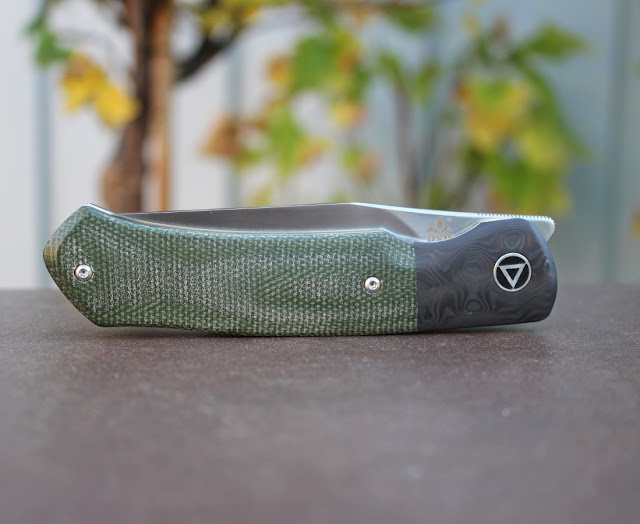
The gannet has been given a handle that can be varied a lot in appearance. This is because the knife has been fitted with bolsters. In this edition, the sides themselves are of green linen micarta and bolsters of carbon fiber. Both the quality of the materials and the workmanship are strikingly high.

The length of the handle is 11.5 cm and the height is measured at 24 mm. The thickness is 13.5 mm. It is slightly more than you might think due to the arched sides.

A very well-shaped handle in micarta and carbon fiber


This knife is a very sturdy construction based on a polished stainless steel frame. And speaking of polished, QSP has also remembered that it is important to round off the edges. Especially where the fingers and hand come in contact with them. That is the inside of the open back and the notch where the blade is housed. The frame is also a bit weight relieved with a couple of solid holes drilled in one side. But there I would have liked to have seen that they continued that good work and shaved a few more grams off the handle. As it is now, the knife is a bit too back-heavy. The balance is good but not perfect. I had wanted to bring it forward about an inch so it ends up in the middle of the finger groove. 

The handle itself consists of a bolster and a pair of micarta slabs. They have been screwed in place with really small T6 screws with rounded heads. In addition, there are a couple more screwed from the inside. It's a detail I do not fully appreciate. They do not pose a major problem for me personally as I very rarely disassemble my knives. But for those who do, it is not the most sustainable option. Flat heads and slightly deeper grooves give stronger screws. It's also nicer to look at. 

The sides themselves and the bolsters are of all the higher quality. The fit between the materials is excellent and they have been given an elegant roundness. What is sometimes referred to as 3D-milled. This makes the handle more comfortable in hand.

Otherwise, the handle is soft and not much to brag about for those looking for a "traction plan". The bolsters are smooth, almost polished and the micarta certainly gives some added traction, but as you wear it, it becomes less coarse. It can of course be roughened up with a little sandpaper if you think the grip is too slippery. But that's not something I'd considered. 

The sides are well rounded and in the back, a partial backspacer is found


The handle is semi-open in the back. A backspacer made of G10 runs along about half the length of the handle. It is a solution I have increasingly come to prefer. More contact surface against the hand provides a more comfortable handle. I often hear that completely open constructions are easier to clean. But that argument does not hold up on closer inspection. There are other, more important, factors that make folding knives difficult to keep free of dirt. Like how they look on the inside for example.

There is one thing you don't find in the backspacer and that is an attachment point for a lanyard. Not something I miss but somebody else might so it can be good to know. 

Balanspunkt och i hand
The gannet is a tad bit butt heavy but generally very good in the hand


In addition to the blade cutting damn well, Gannet is also comfortable to hold. This applies both when the knife is only tested briefly and when working with it, that is ergonomics. The shape is rather "nice" in that it does not boast extreme design. It is a fairly straight handle that is rounded and has a shallow depression for the index finger and a small shoulder at the back so you do not slip backward when cutting. In addition, Gannet's back arches a little. That shape goes a long way and enables all the grips you can possibly use. The handle would be very close to excellent if it were not, for one thing, the clip.

For me, it's actually annoying! It's not felt in hammer grip but all the more in saber grip with a thumb on the blade spine. The shape and placement of the clip far back on the handle make it want to attack my hand.

The only detail I do not appreciate with the handle


Otherwise, the length of the handle is very good, or rather the space is. Part of the explanation is found in the opening system. There is nothing here that steals room for the hand, but most of the handle can be used to grip. 


Opening and Lock


And now it's time to talk about what makes Gannet unique in QSP's catalog and that is the opening method. Incidentally, this blade can only be opened in one way. Otherwise, it is not entirely uncommon that when you, as here, have chosen to use a front flipper, you also add a thumb stud or the like.

Truth be told, there is another way of opening the knife. You can open the blade with two hands if you really want to. The detent is not so strong that the blade is "fixed" and it protrudes enough blade to grip around.

A front flipper is the opening method if you do not want to use two hands


However, you do not need backup methods when the flipper works as well as here. The "fin" itself is small and does not protrude more than 6 mm. Or rather, it does not really protrude beyond the outer line of the handle at all since the bolster is rounded at the front edge. However, the flipper tab is well placed and equipped with exemplary grooves for really good traction. They are not sharp at all but provide the friction needed.

The operation is therefore both simple and gives lightning-fast results. Behind that success are a well-tuned detent and fine ceramic ball bearings. A material that is also found in the detent ball. The blade runs very smoothly, even if the resistance from the lock itself means that it does not fall freely when the knife is to be closed. Something I appreciate as I like my fingertips and want to keep them.

A liner lock in steel that works just as it should


The lock bar is very easy to access. Here you can also see the exemplary lack of gaps between the handle materials


The Gannet comes with a simple, uncomplicated liner lock. In that case, the knife does not offer anything unusual, but it is not needed either. The function is very good. The lock bar tension is strong enough to engage the lock even if the knife opens slowly. An important detail as sometimes on quick-opening knives it is almost required that they be fast deployed for the lock to work. In addition to the lock, there is a solid stop pin that takes care of the forces from the blade. The blade stop is of integrated type, ie it is attached to the blade.

Once the lock bar is in place, I can not detect any play either sideways or vertically. Nor does the blade slip during lighter "spine whacking", meaning that I knock against a piece of wood with the blade turned upside down, or when I press the tip of the blade in the wrong direction. I checked it extra carefully because I once had a knife from QSP with a less-than-perfect lock. However, it has not happened before or after that, and definitely not on this knife. 


To Carry


Neutral. That's the word I would choose to describe how this knife feels to carry. The length is a bit in between, not extremely large or very small. As I said, it measures around 11.5 cm. The thickness means that Gannet does not belong to the really slim knives, but it is also not eutrophicated.

The weight, on the other hand, stands out positively as the knife, certainly with the smallest possible margin, weighs in under one hundred grams. Not bad for a knife that has a blade of over eight and a half centimeters. 

The deep carry type clip unfortunately protrudes a bit from the handle itself and the tip points in the wrong direction!


Other advantages are that everything on the knife is rounded. It goes for the frame, front and rear of the handle, and the sides themselves. It makes the knife comfortable in the pocket. Especially when combined with polished materials and an excellent flipper tab that is completely invisible in the pocket. A certain well-known Youtuber usually talks about "pocket peckers" but in this case, it's rather the opposite. The small beak is both rounded and points downwards while not extending beyond the outer line of the bolster. That's good!

The clip is recognizable from other QSP models and it renders both praise and critique on my part. If we start with the positive, it works. The knife is kept in place as it should and that requires good tension because the material underneath is so well polished. The ramp is large enough to pass most normal fabric edges and the same can be said about the space under the clip. However, it could have been even better if the screws had also been countersunk. As it is now, only the clip is. It provides better stability, especially when combined with screws placed in tandem.

But then it was the choice of screws again. It's good that there is consistency in that part but they are still small! Then I'm not a fan of the angle of the tip of the clip. It points outwards! It is not so bad as long as you look at the knife lying on a table. But if it is placed in a pair of trousers with thicker fabric, it points even more outwards, whereupon problems arise. It wants to hit my hand when I walk and it searches for sofas and car seats and other things to scratch. No, I do not like that.

However, my biggest objection is that it's a "deep ride clip" on this knife. Usually, I am a friend of that solution as very little of the knife is visible. This also applies here. However, I do not like how the placement of the clip together with the angled beveled rear end of the handle interacts. The edge of the clip simply feels too much against my hand.


To Conclude


Gannet is an example of a successful excursion in the exciting landscape of variety. It doesn't offer huge deviations from the standard template made by QSP. But they have combined a nice flat-ground blade, which is not their standard with a front flipper. That way of opening is certainly not what they are known for. In addition, the knife comes with bolsters. That solution offers a combination of materials which in turn gives variety. When talking about materials, the steel choice can also be mentioned as it is 154CM. It may not be top of the line anymore but it represents a willingness to try new things. Then it is not too bad when it comes to performance either. 

Gannet is an excellent EDC knife!


Overall, I am very fond of this knife, but there are a couple of things I would have changed if I was in charge. One is the type of screws used. The pivot screw is both well dimensioned and D-shaped so it does not spin, that's good. But the smaller ones, despite the affected appearance, could have been a size larger and in return got flat heads, which could have made them more discreet while being stronger.

It would also have given more space under the clip, which brings us to critique number two regarding this area. I would have liked to have seen another clip on this knife. With this rounded rear end on the handle, this shape does not work in all aspects. It creates a hotspot in certain grips. Of course, if you have very small hands, it is not a problem because it then ends up outside the hand. To some extent, the problem can be avoided if I grip the knife excessively far forward. But it does not become natural in relation to the groove that exists for the index finger.

A third detail is that this otherwise very fine blade deserves a slightly better edge. QSP has almost succeeded with the sharpening choil staying clear of the plunge line. But as it is now, a small "smile" can be seen towards the heel of the blade and it is likely to get worse over time with more sharpening.

But it should not be exaggerated and the blade is otherwise both nice and extremely effective. A real knife blade in the sense that it cuts well. The finish with a longitudinal satin polish feels extra luxurious.

QSP Gannet is definitely a knife that also works well in the great outdoors


Then the handle is generally damn good. The knife fits well in the hand and maybe even better in a slightly smaller hand than mine as the clip issue probably disappears completely. Something that contributes to the good ergonomics is how nicely arched the sides are. It also makes the knife a little thicker than the first impression tells you. It can also be stated that the materials are of very good quality. That also goes for the way in which they are put together. There are no gaps at all between bolsters and sides.

All in all, QSP Gannet is both a well-built and stylish knife that is also a good cutting tool. I can without hesitation recommend it both for everyday use and actually as an outdoor knife. The latter as long as you avoid stuffing it in mud and saltwater even though it is a gannet. After all, it contains ball bearings. But the blade is really good for all kinds of chores around a campfire.


Specification:


Length Overall: 200 mm
Length Folded: 114 mm
Weight: 99 g
Blade Length: 86 mm
Blade Thickness: 3 mm
Blade Steel: 154 CM
Handle Materials: Micarta with Carbon Fiber bolsters
Lock: Liner lock

Produced by: QSP, made in China


/ J - very happy

* It was rather developed for use in the aircraft industry in the early 1970s if I remember correctly. 

#knivesandbikes #aliaspostmortem #knivigtvarre  

tisdag 8 juni 2021

Ny kniv - QSP Gannet

Gannet heter den här kniven från QSP Knife. En intressant kniv såtillvida att den på ett flertal punkter avviker från vad som är brukligt från dem. Det gjorde mig intresserad. Fast mest intresserad blev jag faktiskt av bladet då jag är svag för en snygg clip point. Som jag brukar hävda är troligen en bra drop point mer praktisk men ibland får det stå tillbaks för det estetiska. Fast i det här fallet har man "fuskat" lite genom att först låta bladryggen resa sig något innan den dyker ned mot spetsen. Det ger en clip point som i praktiken är en drop point. Det bästa av båda världar måhända?

Ny kniv QSP Gannet
QSP QS137-C Gannet


Förutom ett attraktivt blad får man ett handtag som till största delen består av linnemicarta även om bolstren är gjorda av kolfiber. En förbaskat fin kolfiber kan tilläggas. Dessutom är skarvarna mellan materialen exceptionellt snyggt gjorda och omöjliga att känna. 

Bolstren är också en ovanlig detalj för QSP även om de inte är unika. De har gjort det en gång förut på modellen "Worker". Bladstålet är såvitt jag vet ett första försök för QSP. Det är 154CM som används till den här kniven. En annan nyhet för QSP är att det här är deras första front flipper. Ett lyckat första försök då den fungerar utmärkt. I övrigt är det ett sedvanligt kvalitetsbygge med en både polerad, rundat och lättad ram försedd med en back spacer i G10. Kniven har även fått keramiska kullager. 

Allt detta och lite till skall jag förstås beskriva i kommande recension av kniven!